Greek mythology · Mythical objects
The Golden Fleece: royal symbol and prize of the Argonauts' quest
The Golden Fleece in Greek mythology: the hide of the divine ram Chrysomallus, treasure of Colchis guarded by a dragon, and the legendary prize of Jason and the Argonauts.
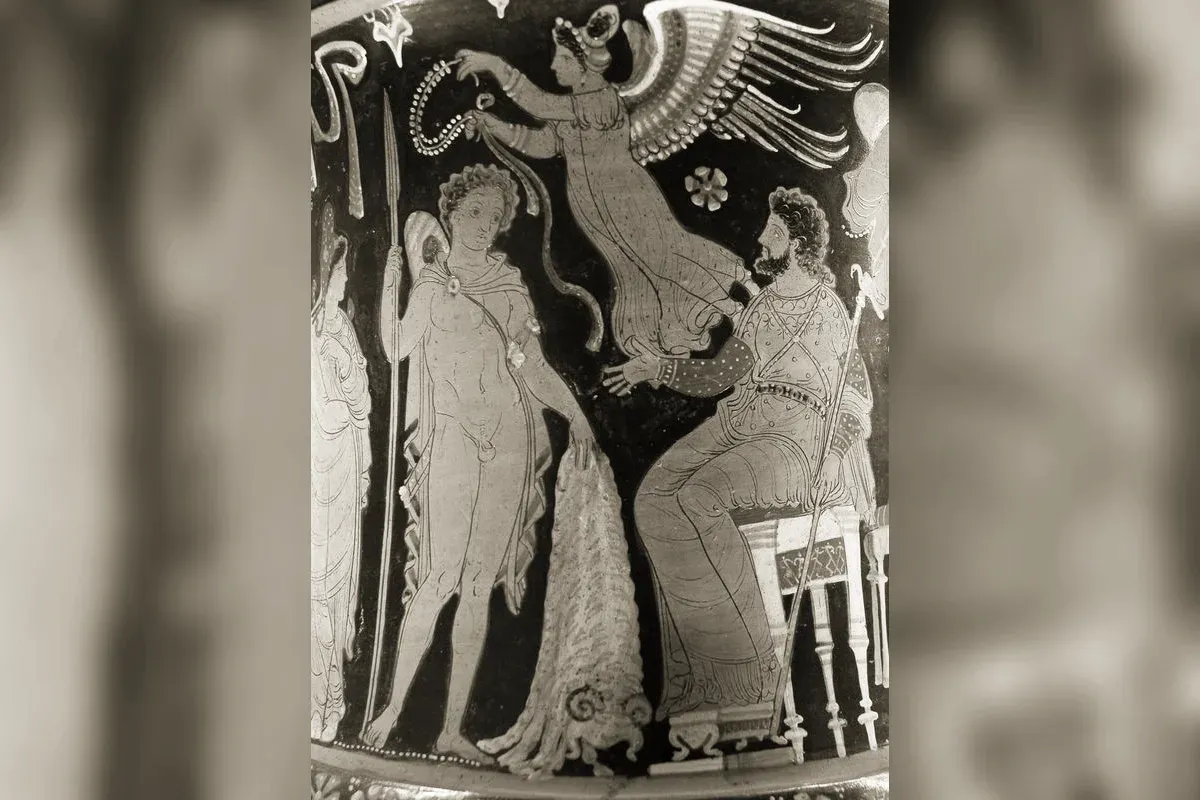
Among the objects most charged with meaning in Greek mythology, the Golden Fleece occupies a unique position. It is neither a weapon like the thunderbolt of Zeus nor a sacred place like Olympus: it is a treasure to be won, the goal of a journey that structures one of the oldest epics in the Greek tradition — the Argonauts’ quest led by Jason. To understand the Golden Fleece is to understand the logic of heroic quests: the hero does not obtain the fleece because he already deserves it, but proves he deserves it by going to get it.
The ram Chrysomallus: divine origins of the fleece
The Golden Fleece does not begin with Jason. Its story is rooted in an older myth — that of Phrixus and Helle, two children of King Athamas of Boeotia. Their stepmother Ino, jealous and malevolent, plotted to have them sacrificed. Faced with this mortal danger, the gods — Hermes or Zeus himself depending on the source — sent a marvellous ram with golden wool to save the children.
Chrysomallus — whose name means literally “golden-woolled” — was a divine animal, born of Poseidon and the nymph Theophane according to some versions. His wool shone like the sun, and in certain texts he was gifted with speech. Phrixus and Helle mounted his back. The ram took flight above the seas.
But the crossing turned to tragedy: above the strait separating Europe from Asia, Helle lost her grip and drowned. That stretch of water took her name: the Hellespont — the sea of Helle. Phrixus arrived safely in Colchis, a kingdom on the eastern shores of the Black Sea, at the farthest edge of the world the Greeks knew.
In gratitude, Phrixus sacrificed the divine ram to Zeus and gave its fleece to Aeëtes, king of Colchis and son of the Sun (Helios). Aeëtes hung the fleece in the sacred grove of Ares, guarded by an immortal dragon or serpent that never slept. The fleece was thus consecrated twice over: by its divine origin, and by its integration into the cult of Ares.
Kingship and the object: why the fleece symbolises power
In Greek mythic logic, the Golden Fleece is not merely a precious object — it is an emblem of royal legitimacy. Its golden radiance evokes solar divinity, its absolute rarity makes it a peerless treasure, and its placement in the grove of Ares puts it under the protection of the god of war.
When Jason receives from his uncle Pelias the mission to fetch the fleece from Colchis, the commission appears as a favour but is in reality a death trap: Pelias hopes that this impossible quest will permanently remove the nephew whose rightful claim to the throne of Iolcus he has usurped. In demanding the fleece, Pelias implicitly acknowledges that it is the mythic equivalent of the throne — whoever possesses it proves their worth and divine favour.
Jason, by accepting the challenge, transforms the quest for the fleece into an act of personal legitimation. To succeed where any ordinary man would fail is to assert that the gods support his cause. The fleece is therefore not merely an object: it is proof of deserved kingship.
The voyage of the Argonauts
To reach Colchis, Jason assembled an extraordinary crew: the Argonauts, named after their ship the Argo (built from the sacred wood of Dodona by Argus, under Athena’s guidance). This crew was a constellation of heroes: among them Heracles, Orpheus — whose music would enchant the Sirens and calm the waters — the Dioscuri Castor and Pollux, Theseus in some versions, and numerous other heroic figures.
The quest was beset with trials: the Harpies tormenting the blind seer Phineus, the Clashing Rocks (the Symplegades) at the entrance to the Black Sea that threatened to crush the ship, the Amazons to be avoided, and the island of Ares haunted by birds with bronze feathers.
The most complete account of this expedition is that of Apollonius of Rhodes in the Argonautica (3rd century BCE) — the definitive epic for understanding the fleece in its full narrative context, which is told in our article on Jason and the Golden Fleece.
Medea: the key to the conquest
Arriving in Colchis, Jason faced an apparently impossible ordeal. Aeëtes would surrender the fleece only to whoever accomplished three tasks: yoking two fire-breathing bronze-hoofed bulls, ploughing a field with them, sowing the field with dragon’s teeth, and then defeating the armed warriors who would spring from them — before finally confronting the sleepless dragon that guarded the fleece itself.
It was here that Medea intervened — daughter of Aeëtes, granddaughter of Helios, priestess of Hecate and formidable sorceress. Struck by overwhelming love for Jason (according to Apollonius, by an arrow from Eros loosed at the instigation of Hera and Aphrodite), she decided to help him by betraying her father.
Medea gave Jason a magical ointment that rendered him impervious to the bulls’ fire for one day, taught him the stratagem for defeating the Sparti (the warriors born from the dragon’s teeth), then accompanied him to the sacred grove where she put the guardian dragon to sleep with her herbs. Jason seized the fleece. Without Medea, the quest was impossible.
This point is essential to the myth’s symbolic architecture: the fleece is not won by heroic strength alone, but by a combination of courage, intelligence, and love. Jason is the hero of the quest; Medea is the condition of its success.
The fleece and cross-mythological comparisons
The Golden Fleece belongs to a long tradition of golden tokens of royal legitimacy across world mythologies: the Apples of the Hesperides (also in the Greek tradition), the Arthurian Grail that validates the worthiness of the King’s knights, the Caledonian Boar that only true heroes can hunt. In all these cases, the rare and sacred object matters less in itself than as a revealer of the hero’s worth.
The comparison between the Golden Fleece and the Holy Grail is particularly rich: in both cases, a dispossessed (or impeded) king sends a young hero toward an unreachable object; in both cases, the object is guarded by a magical guardian; in both cases, access requires a spiritual or moral qualification, not merely physical strength.
The legacy of the Golden Fleece
The Golden Fleece has passed from antiquity through the Middle Ages into modernity without losing its symbolic force. In the 15th century, the Duke of Burgundy Philip the Good founded the Order of the Golden Fleece (1430), one of the most prestigious chivalric orders in Europe, which still exists today. The choice of the fleece as emblem was deliberate: it symbolised the quest for glory, loyalty to the sovereign, and the legitimacy of nobility, exactly as Jason had proved his royal legitimacy by bringing back the impossible object.
In modern literature, the Golden Fleece inspires fantasy novels, operas (Cherubini composed Médée in 1797), and numerous artworks. The figure of Jason and his quest remain a universal metaphor for any voyage toward a difficult goal that transforms the one who pursues it.
Further reading
For the complete narrative of the quest, read the page on Jason and the Golden Fleece. For the hero who accomplished the quest, consult the page on Jason. For the other great divine object forged for a Greek ruler, read the page on the thunderbolt of Zeus. For the goddess whose support was decisive to Jason’s quest, see the page on Hera. For the divine messenger whose intervention at the start of the myth enabled Phrixus to escape sacrifice, see the page on Hermes.
See also
Stories featuring this entity
Frequently asked questions
Where does the Golden Fleece come from?
The Golden Fleece is the skin of the ram Chrysomallus, a divine animal with golden wool sent by Hermes (or Zeus in some versions) to save Phrixus and his sister Helle from being sacrificed. Arriving in Colchis, Phrixus sacrificed the ram to Zeus and gave its fleece to King Aeëtes, who hung it in the sacred grove of Ares.
Why did Jason want the Golden Fleece?
Jason wanted it to reclaim the throne of Iolcus of which his father had been dispossessed. His uncle Pelias, the usurper, had sent him on this quest believing he would never return. By succeeding at the impossible, Jason would assert his royal legitimacy through a demonstration of heroic worth and divine favour.
How did Jason obtain the Golden Fleece?
With the help of Medea, daughter of King Aeëtes and priestess of Hecate, skilled in magic. She helped him put the guardian dragon to sleep with her herbs, complete the impossible trials set by Aeëtes, and then flee with the fleece. Without Medea, Jason could never have succeeded.
What became of the Golden Fleece after Jason?
Ancient sources are vague about the fleece's final fate. Jason brought it back to Iolcus to hand over to Pelias, but Pelias was killed by his daughters (deceived by Medea). In some versions, the fleece was placed in a temple or kept at Corinth. Its ultimate fate disappears from the record once the quest is accomplished.