Greek mythology · Journeys & quests
Jason and the Golden Fleece: the quest of the Argonauts in Greek mythology
Jason assembles the Argonauts to seize the Golden Fleece from Colchis: the Clashing Rocks, Medea's magic, fire-breathing bulls, and the sleepless dragon.
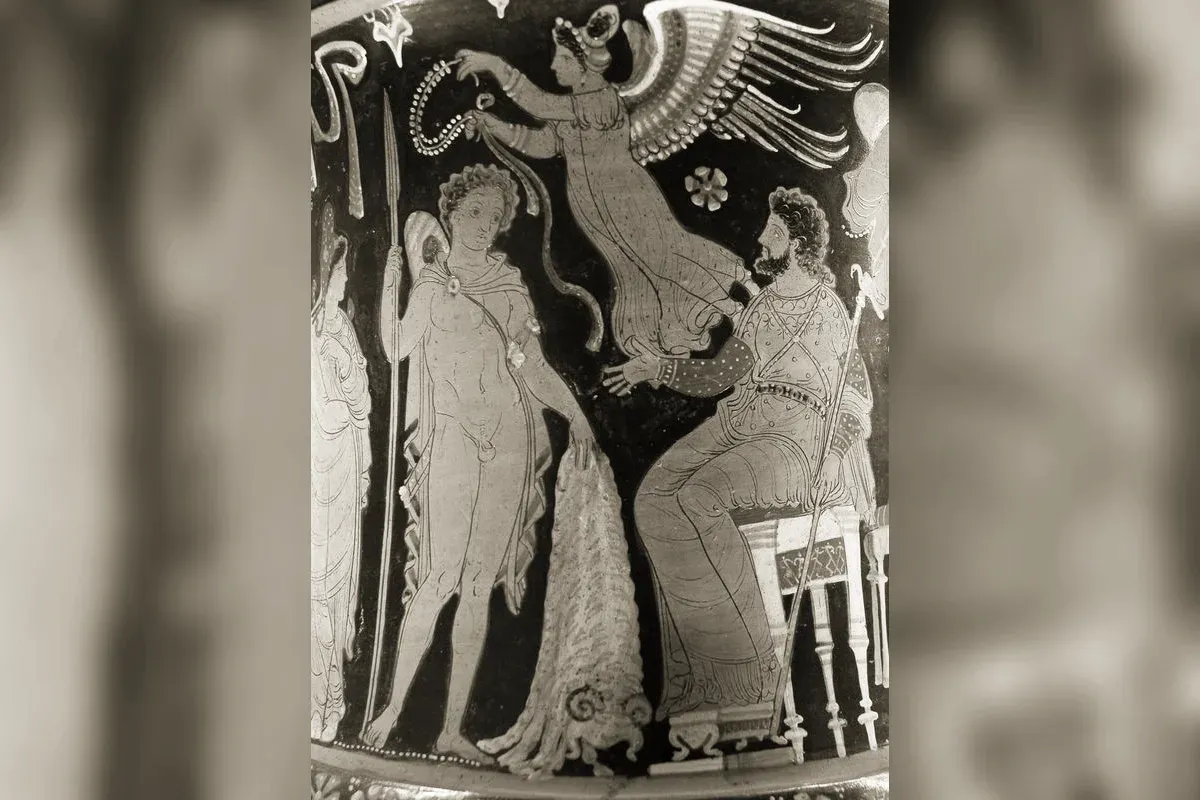
In Greek mythology, the myth of Jason and the Golden Fleece tells how the dispossessed heir of Iolcos sails to Colchis to win back a kingship that Pelias refuses to surrender. The quest for the Golden Fleece is simultaneously the defining voyage of the Argonauts, a test of divine favor and navigation at the edge of the known world, and the beginning of the catastrophe that will destroy Jason and Medea. It is one of the most revealing Greek myths about rightful rule, heroic fame, and the moral cost of ambition.
The stolen throne and an impossible condition
Jason is the rightful heir to the throne of Iolcos in Thessaly. His uncle Pelias overthrew his father Aeson and seized power. When Jason returns as a young man to claim what is his, Pelias makes him an offer he cannot refuse: bring back the Golden Fleece from Colchis, and the throne is his.
The Fleece hangs in the sacred grove of Ares at the far end of the world, at the eastern shore of the Black Sea. It belonged to the golden ram the gods had sent to save Phrixus from ritual sacrifice. The ram was sacrificed on arrival; its glittering fleece was nailed to an oak tree, watched over by a dragon whose eyes had never once closed in sleep.
Pelias is certain Jason will never return. Jason accepts.
Athena watches over the undertaking from the beginning. It is she who guides the shipwright Argus in building the Argo — a fifty-oared vessel of extraordinary speed, fitted with a plank of prophetic oak from the oracle grove of Dodona, which can speak when the gods require it.
The Argonauts: the heroes of a generation
The call goes out across Greece and the greatest heroes of the age respond. The crew of the Argo reads like a roster of legend:
- Heracles, strongest of all mortals, who takes his place at the forward oar alongside his companion Hylas
- Orpheus, whose lyre can calm storms, charm rocks, and outplay the Sirens
- Castor and Pollux, the Dioscuri, sons of Zeus, one mortal and one divine
- Peleus, who will later father Achilles
- Meleager, the great hunter of Calydon
- Atalanta, the swiftest mortal alive, in some traditions the sole woman among the crew
Together they are the Argonauts — sailors of the Argo — and their voyage will become the template for every collective heroic enterprise the ancient world imagined.
Early trials: Lemnos, Heracles lost, and the boxer-king
The voyage opens with a troubling pause. On Lemnos, the crew lingers among the island’s women — who had killed all their men — and Jason fathers children with the queen Hypsipyle. Only the insistence of Heracles drags them back to sea.
In Mysia, the story loses its greatest warrior. Heracles’s beloved companion Hylas goes ashore to fetch water and is dragged under a spring by enamoured nymphs. Heracles searches for him through the forest, roaring his name. The Argo sails on without him. The loss is never fully explained — some say Zeus himself arranged it, knowing Heracles’s destiny lay elsewhere.
In Bithynia, the crew meets King Amycus, who rules by challenging every visitor to a boxing match to the death. The Dioscuri’s Pollux — the finest boxer alive — accepts and kills him with a single precise blow to the temple.
Phineus, the Harpies, and the Clashing Rocks
The decisive threshold before Colchis waits at Salmydessus in Thrace. The blind prophet-king Phineus lives under divine punishment: every meal set before him is snatched or defiled by the Harpies, winged monsters sent by Zeus to torment a seer who revealed too much of the gods’ will.
Two Argonauts — Zetes and Calais, winged sons of the North Wind — pursue the Harpies to the ends of the earth and drive them away forever. In gratitude, Phineus maps out the remainder of the route.
But first: the Symplegades, the Clashing Rocks. Two enormous cliffs rise from the sea and crash together, pulverizing anything that passes between them. Phineus’s counsel is to send a dove ahead: if she makes it through, the Argo can follow. The dove passes, losing only her tail feathers. The crew rows with everything they have; the rocks slam shut, shearing the ornament from the stern. Having at last allowed a vessel to pass, the Symplegades freeze in place for all time.
Arrival in Colchis: an audience with the Sun’s son
Colchis is ruled by Aeëtes, son of the Sun, brother of the sorceress Circe. He is not welcoming. When Jason states his purpose, Aeëtes sets conditions he regards as a death sentence.
Jason must yoke a pair of fire-breathing bulls with hooves of bronze, plow a field with them, sow it with dragon’s teeth, and then single-handedly defeat the army of armed warriors — the Spartoi — that will spring from the soil. Complete this in a single day, and the Fleece is his.
It is the work of a man who cannot be killed by ordinary means.
Medea: the god-sent love that changes everything
Medea, Aeëtes’s daughter and priestess of Hecate, is a sorceress of extraordinary power. Aphrodite, enlisted by Athena and Hera, sends her son Eros to strike Medea with an overwhelming love for Jason. The moment she sees the stranger, her fate is sealed.
That night she meets Jason in secret. She gives him an ointment brewed from the ichor of Prometheus — an herb born from the blood of the Titan where it fell during his torment. Rubbed on his body and weapons, it makes him invulnerable to fire and iron for a full day. She also tells him the secret of the Spartoi: throw a heavy stone among them, and they will turn on each other in confusion.
At dawn Jason enters the field. He yokes the fire-snorting bulls without flinching, plows the furrows, sows the teeth. Fully armed warriors erupt from the earth. He hurls a boulder into the middle of them. Unable to identify their enemy, the Spartoi slaughter one another to the last man.
Aeëtes retires to plot. Medea knows her father intends to kill the Argonauts before dawn.
The sleeping dragon and the Fleece
In darkness, Medea leads Jason through the sacred grove. The dragon coiled around the oak never sleeps — ancient, enormous, its scales shimmering with the light of the stars. Medea sings a long incantation to Hecate and sprinkles the creature’s eyes with a distillation of sleep. Slowly, inexorably, the coils loosen. The great head drops.
Jason reaches up and takes the Golden Fleece. It is heavier than expected, radiant, draped over his shoulder like a cloud caught on fire.
They run back to the Argo before the dragon wakes.
Flight, betrayal of blood, and divine punishment
Medea takes her young brother Apsyrtus as she flees with Jason. The fleet of Aeëtes gains on the Argo. In the most harrowing moment of the voyage, Medea kills Apsyrtus and scatters pieces of his body across the sea — knowing that her father, a pious king, cannot leave his son unburied and will stop to gather the remains.
The stratagem works. But the murder of a kinsman by treachery is a grave pollution. Zeus, watching from Olympus, condemns the Argonauts to wander without direction until they have been purified. The speaking beam of the Argo tells them the way: they must seek out Circe — sorceress, aunt of Medea, resident of the island of Aeaea.
Circe purifies them of Apsyrtus’s blood, though she refuses to offer hospitality to those who have committed such an act against their own family.
Sirens, the Libyan desert, and the long way home
The return route through the western seas brings further trials. Before the Sirens, whose singing has wrecked more ships than any reef, Orpheus plays his lyre so loudly and so beautifully that the enchantment is drowned out. Only one Argonaut — Butes — leaps overboard toward the voices; Aphrodite saves him, carrying him to Sicily.
In Libya, a supernatural storm deposits the Argo in the desert. The crew carries the ship on their shoulders for twelve days across the sands to reach the sea again.
When they at last sight the coast of Greece, the voyage has taken longer and cost more than anyone who set out from Iolcos could have imagined.
Return to Iolcos: Pelias does not keep his word
Jason returns with the Fleece. Pelias refuses to yield the throne.
Medea acts. She approaches Pelias’s daughters with a demonstration: she cuts an old ram into pieces, boils the parts in a cauldron with enchanted herbs, and draws out a living lamb. The daughters, convinced she can do the same for their aging father, cut Pelias apart and throw him in the pot. He does not emerge.
The throne of Iolcos is freed — but the killing drives Jason and Medea out of Thessaly. They settle in Corinth, where they rule for years and raise two sons.
The betrayal in Corinth
Stability does not hold. Jason, calculating and ambitious, decides to marry Glauce, the daughter of King Creon of Corinth, for political advantage. He sets Medea aside, offering legal arguments to justify what is, in every moral sense, a total betrayal of the woman who had sacrificed her homeland, her father, her brother, and her honor to make his triumph possible.
Medea’s vengeance is total and cold. She sends Glauce a wedding gift: a beautiful robe and a golden diadem soaked in fire-poison. Glauce puts them on and cannot remove them; Creon, trying to tear the garment from his dying daughter, is consumed as well. Both die in agony.
Then Medea kills her own two sons — not in madness, but in full understanding. She takes from Jason the one thing that could have consoled him in old age: his children and his legacy.
She escapes in a dragon-drawn chariot sent by her grandfather the Sun.
Jason lives on, stripped of everything. Tradition finds him at the end wandering near the rotting hull of the Argo, beached and abandoned. He sits in its shadow. The decayed prow-beam falls and kills him.
What changes across the ancient sources
Jason’s story is not identical in every ancient retelling. In Pindar (Pythian IV), the expedition strongly emphasizes Jason’s royal legitimacy and the pan-Hellenic prestige of the voyage: recovering the Fleece is bound up with restoring a stolen kingship. In Apollonius of Rhodes (Argonautica), the narrative becomes broader, more maritime, and far more attentive to Medea — her divinely induced love, hesitation, intelligence, and magic give the myth its full tragic depth.
In Euripides’ Medea, by contrast, the conquest of the Fleece recedes into the background and Jason’s betrayal comes to the front. The myth is no longer just about a heroic quest, but about oath-breaking, exile, and the destruction unleashed when the man who wins through another’s sacrifice later denies the debt. That shift is exactly why the Argonaut story remains richer than a generic adventure tale: the ancient sources treat it as both expedition and moral disaster.
The legacy of the Argonauts
The voyage of the Argonauts held a unique place in Greek imagination: it was the definitive collective heroic enterprise, the template for every shared quest. It also offered the ancient world one of its most searching portraits of betrayal and consequence.
Achilles — the greatest hero of the next generation — was the son of Peleus, one of those who rowed the Argo. The world of the Trojan War grows directly from the world of the Argonauts.
The Titanomachy had established the order of the gods; the quest for the Golden Fleece established the heroic ideal of the mortal world — and then, through the figure of Medea, asked how far that ideal could be pushed before it destroyed everything it had touched.
For a parallel voyage into the same mythological landscape, read the story of the Odyssey, which also passes through Circe’s island, the Sirens, and the gates of the Underworld. For Heracles, the Argonaut whose strength defined one era of heroism, see his page. For Athena, who guided the building of the Argo and watched over the quest, read her page. For Hera, protector of Jason throughout the voyage, read her page. For Zeus, whose judgement shaped the voyage’s darkest turns, see his page.
Story beats
- 01Pelias usurps the throne of Iolcos; Jason is sent on an impossible quest
- 02The Argo is built; the Argonauts assemble from across Greece
- 03Lemnos, Samothrace, and the Propontis: early ports of call
- 04Phineus and the Harpies; passage of the Symplegades
- 05Arrival in Colchis; audience with King Aeëtes
- 06Medea falls in love; her magic shields Jason against the fire-breathing bulls and the Spartoi
- 07The Golden Fleece seized; the sleeping dragon
- 08Flight from Colchis; the murder of Apsyrtus
- 09Return through the western seas; purification by Circe
- 10Betrayal in Corinth and Medea's revenge
Ancient sources
- Apollonius of Rhodes, Argonautica
- Pindar, Pythian IV
- Euripides, Medea
- Apollodorus, Library I
See also
Frequently asked questions
What is the Golden Fleece and why did Jason have to find it?
The Golden Fleece was the fleece of a miraculous golden ram sent by the gods to save Phrixus from death. After the ram was sacrificed to Ares in Colchis, its fleece was hung in a sacred grove and guarded by a dragon that never slept. King Pelias, who had usurped the throne of Iolcos, sent Jason to retrieve it as a condition for returning power — a mission he believed would be fatal.
Who were the Argonauts?
The Argonauts were the crew of the Argo, a fifty-oared ship built by the craftsman Argus with Athena's guidance. Ancient sources list between forty-five and fifty members — among the greatest heroes of the generation before the Trojan War: Heracles, Orpheus, Castor and Pollux, Meleager, Peleus (father of Achilles), and others. Their collective adventure represents the last heroic age before the cataclysm of Troy.
How did Jason and Medea's story end?
After ruling in Corinth for several years, Jason abandoned Medea to marry Glauce, daughter of King Creon. Medea took revenge by sending Glauce a poisoned robe that killed her and Creon, then killed the two sons she had borne Jason. Jason died alone and broken — tradition says he was struck and killed by the rotting prow-beam of the abandoned Argo as he rested in its shadow.