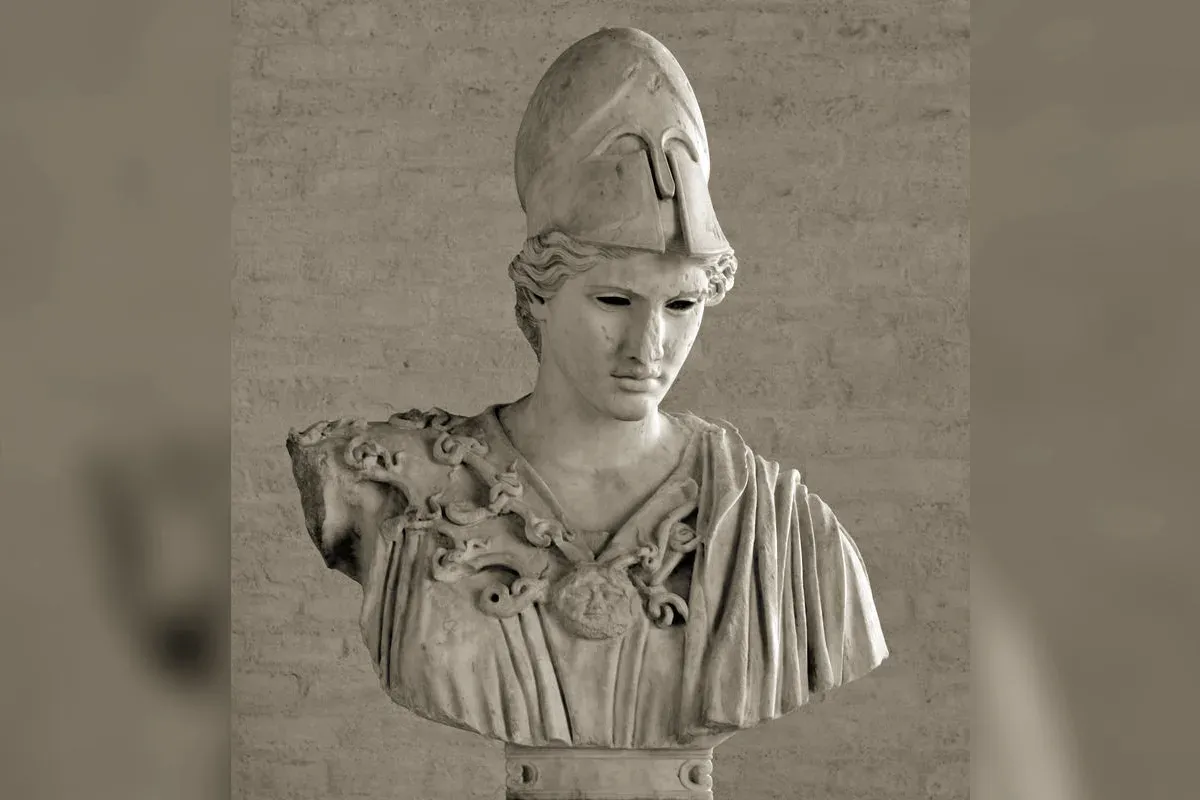
Athena, goddess of wisdom and strategic warfare
Athena is one of the most complex figures in the Greek pantheon: virgin goddess of wisdom, war waged with intelligence, craftsmanship, and civilization. She is inseparable from Athens, whose patron she is, and from the Parthenon dedicated to her on the Acropolis.
A birth without a mother
Her birth is unique in Olympian mythology. Zeus had received an oracle that the child of the Titaness Metis — embodiment of cunning wisdom — would overthrow him if male. He swallowed Metis while she was pregnant. Athena grew inside her father until the day Hephaestus (or Prometheus in some versions) split Zeus’s skull with an axe. Athena leaped out already adult, in full armor, with a war cry.
The strategic war goddess
Athena embodies war as intellectual discipline, planning, and justice — the direct opposite of Ares, who represents the raw fury of battle. Greek tradition constantly contrasts the two: where Ares is despised even by the Olympians, Athena is respected and celebrated.
She wields the aegis, the shield bearing the head of Medusa — a gift from Perseus — which petrifies enemies. Her owl symbolizes wisdom and nocturnal vigilance.
Protector of civilization
Athena governs the arts of craftsmanship: weaving, pottery, metalwork. She guides heroes: she directs Perseus toward Medusa, counsels Odysseus throughout the Odyssey, and supports the Greeks in the Trojan War.
The contest for Athens’s patronage sets Athena against Poseidon: she offers an olive tree, he a saltwater spring. The citizens choose the olive, symbol of peace and prosperity. The city takes her name.
Cult and the Parthenon
The Parthenon, built in the fifth century BCE on the Athenian Acropolis, housed the chryselephantine statue of Athena Parthenos, one of the supreme achievements of ancient art. The Panathenaic festival, the city’s main civic celebration, was entirely devoted to her.
Further reading
To place Athena in the Olympian genealogy, read the page on Zeus and that of Ares, her divine opposite. For the broader place of Greek warfare in comparative mythology, see war gods in 8 world mythologies. For her central role as a protagonist of the Trojan War, read the Trojan War narrative. For her civic and divine rivalry, continue with the page on Poseidon. For the heroes she arms and guides, read the pages on Perseus and Heracles. For the Gorgon whose head adorns her aegis, see Medusa.
See also
Related entries
Stories featuring this entity
Comparisons
Frequently asked questions
Who is Athena's Roman counterpart?
Minerva, Roman goddess of wisdom and the arts, who shares most of Athena's attributes and forms part of the Capitoline Triad with Jupiter and Juno.
How was Athena born?
According to Hesiod, Zeus swallowed the Titaness Metis while she was pregnant to prevent her child from overthrowing him. Athena then burst fully armed from Zeus's head after Hephaestus split it open with an axe.
Why is Athena a virgin goddess?
Athena's power is rooted in self-mastery and reason rather than procreation. Her virginity underlines her independence from the passions that drive other gods.