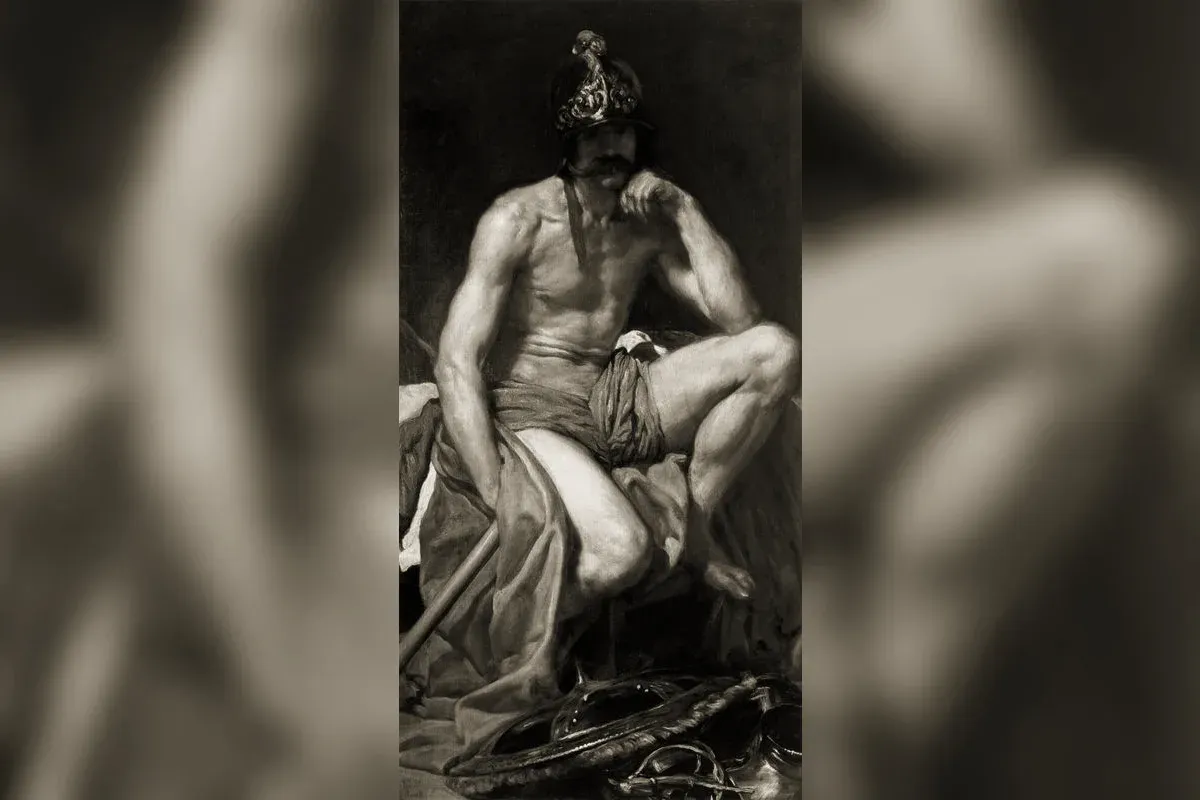
Ares, god of war in Greek mythology
Ares is the most ambivalent figure on Olympus: god of war, he embodies not strategy or military glory but the raw fury of combat — spilled blood, blind violence, the chaos of the melee. Son of Zeus and Hera, he is consistently presented as the least-loved of the Olympians, even by his own father.
An unloved son
In the Iliad, Zeus tells Ares: “You are the most hateful to me of all the gods.” This reputation for uncontrolled violence runs through the whole of Greek literary tradition. Where Athena presides over ordered, intelligent warfare, Ares is the agent of pure destruction. The two are regularly in conflict — and Athena almost always wins.
Ares is accompanied in battle by his sons Phobos (Fear) and Deimos (Terror), personifications of what war first inspires.
The lover of Aphrodite
Ares’s relationship with Aphrodite is one of the most celebrated stories in Greek mythology. Married to the smith Hephaestus, Aphrodite secretly unites with Ares. Hephaestus traps them beneath an invisible golden net and exposes them to the assembled gods’ laughter. The couple survives the scandal: their union produces Harmonia, Phobos, Deimos, and in some versions Eros.
Ares in the Trojan War
During the Trojan War, Ares sides with the Trojans, partly at Aphrodite’s request. In the Iliad he is wounded by the Greek hero Diomedes, aided by Athena — a symbolic moment showing the superiority of intelligent warfare over brute violence. Zeus, unmoved by his pain, simply tells him to go get healed.
Ares and Mars: two war gods
Ares’s Roman counterpart Mars is a radically different deity: father of Romulus, founder of Rome, an honored and central figure of Roman civic religion. Where Ares is despised, Mars is celebrated — a gap that reveals the contrasting Greek and Roman visions of war. For a broader cross-cultural view, see our comparison of war gods.
Cult and sanctuaries
In Greece, Ares had few temples relative to his theoretical importance. His worship was strongest in Thrace, a region associated with martial valor, and in Sparta, where war was a civic ideal. In Athens, the Areopagus (Hill of Ares) was associated with him, but served chiefly as a site of justice.
Further reading
To understand the complementarity and rivalry between Ares and Athena, read her page. For his lover, explore the page on Aphrodite. For a wider perspective beyond Greece, continue with war gods in 8 world mythologies.
See also
Frequently asked questions
Who is Ares's Roman counterpart?
Mars, whose personality differs sharply: where Ares is despised even by the Olympians, Mars is Rome's founding father and a central figure of Roman civic religion.
Why is Ares despised by the other gods?
Ares embodies war as pure violence: blood, fury, chaos. The Greeks preferred Athena, who represents strategic and reasoned warfare. Even Zeus confesses to hating him in the Iliad.
Who are Ares's children?
His most famous sons are Phobos (Fear) and Deimos (Terror), who accompany him into battle. With Aphrodite he fathers Harmonia, and according to some traditions, Eros.