Greek mythology · Heroes & mortals
Orpheus, the divine poet of the Underworld in Greek mythology
Orpheus, son of Apollo: the lyre that moved all nature, descent into the Underworld for Eurydice, the fatal glance, and the founding of the Orphic mysteries.
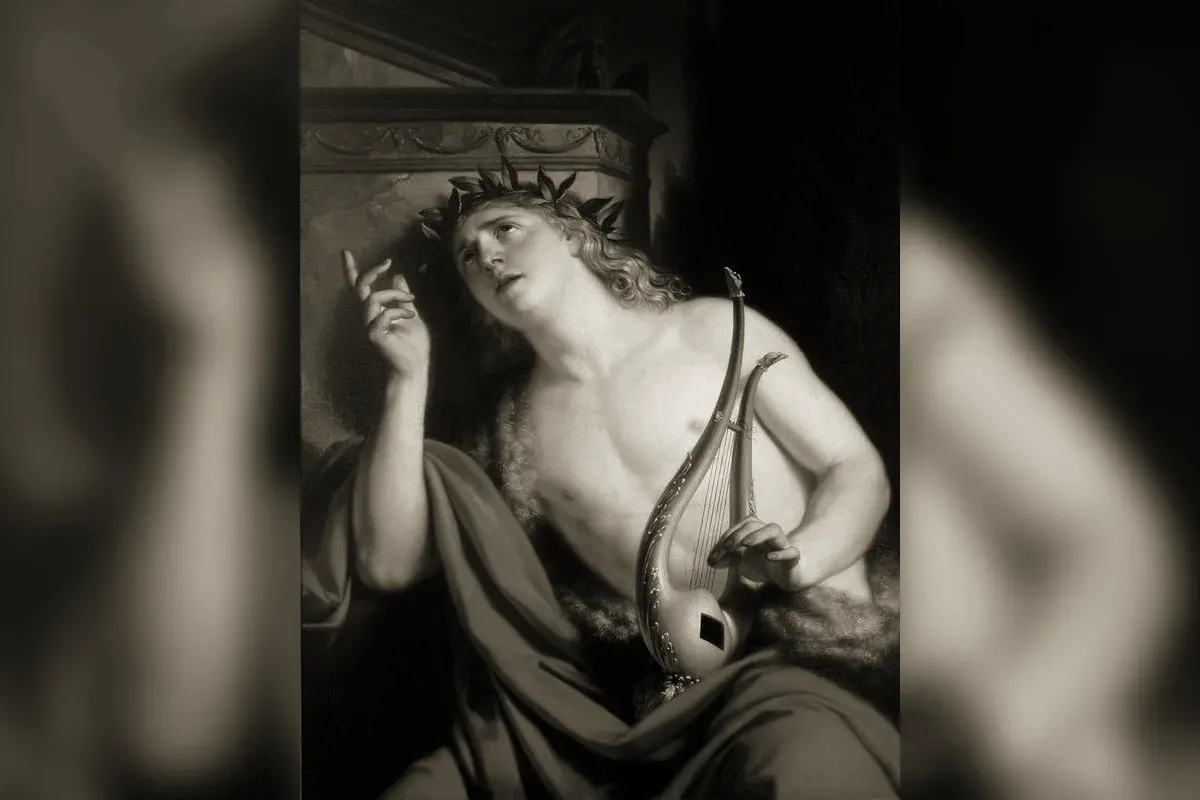
Orpheus is the greatest musician in the Greek mythological tradition — a figure so extraordinary that his art stands apart from heroic strength, divine power, and mortal endurance alike. His lyre does not merely entertain: it commands. Rivers stop flowing to listen. Trees uproot themselves and lean toward him. Wild animals sit tame at his feet. When he descends into the Underworld for his dead wife Eurydice, he does what no living being was supposed to do: he moves the gods of death to compassion. And then, in a moment of human weakness, he loses everything.
Divine birth and the gift of music
The genealogy that has become standard in antiquity gives Orpheus two parents who between them define his nature completely. His father is Apollo, god of music, poetry, prophecy, and the sun. His mother is Calliope, the Muse of epic poetry — the divine inspiration behind Homer and Hesiod. Orpheus is therefore the child of both the divine source of music and the divine source of the poetic word. His gift is not a talent: it is an inheritance from the two most powerful creative forces in the Greek cosmos.
Apollo gives him a lyre — or, in some versions, teaches him to play one he already possesses — and the young Orpheus’s mastery quickly exceeds everything in the mortal world. He is born in Thrace, the wild northern region that the Greeks associated with music, ecstatic religion, and the margins of civilisation: a fitting birthplace for a figure who will always live at the threshold between the human and the divine.
The accounts of his power are consistent across sources: when Orpheus plays and sings, not only humans but every element of the natural world responds. Stones gather around him. Rivers reverse their courses. The wind stills. Birds perch on his shoulders. Beasts of every kind — wolves lying beside deer, lions beside lambs — come and sit in a trance of listening. This is not poetic exaggeration in the sources; it is treated as literal. Orpheus’s music reaches something in the world that ordinary human art does not touch.
Orpheus among the Argonauts
Before the loss of Eurydice, before the descent, Orpheus sails with Jason as a member of the Argonauts on the voyage for the Golden Fleece. His role on the expedition is explicit in Apollonius of Rhodes’s Argonautica: he is brought not as a fighter but as a musical counterforce. When the crew’s rowing falls out of rhythm, his lyre sets it right. When disputes threaten the expedition’s cohesion, his music calms the mood.
His most critical contribution comes when the Argo approaches the island of the Sirens — the creatures whose singing lures sailors to wreck themselves on the rocks. Against the Sirens’ enchanted voices, Orpheus simply plays louder and more beautifully: his music drowns theirs, and the Argo passes safely. The one crewman who still jumps toward the Sirens — Butes — is rescued by Aphrodite.
This episode establishes a crucial dimension of Orpheus’s power: his music is not merely more beautiful than other music; it is capable of outcompeting supernatural enchantment. He does not resist the Sirens; he replaces them.
Eurydice and the loss
After the return of the Argonauts, Orpheus marries Eurydice, a young woman — a nymph or mortal, depending on the source — who becomes the centre of his existence. The marriage is brief. Eurydice, fleeing the unwanted advances of Aristaeus (a minor deity of beekeeping and rural crafts), steps on a serpent hidden in the grass and dies from the bite.
Orpheus’s grief is unlike any described elsewhere in Greek literature. He does not accept the loss. He does not perform the standard rituals of mourning and then return to life. He grieves with a completeness that stops him living entirely — his music, which had once charmed the world, now only pours out lament. The sources emphasise that this grief is not just sorrow: it is a kind of refusal of the natural order. And it is this refusal that leads him to the most extraordinary decision in his story.
The descent into the Underworld
Orpheus descends alive into the world of the dead. This is the katabasis — the descent that marks the most extreme boundary a mortal can cross. He takes no weapons, no divine armour, no allies. He takes his lyre.
He passes the entrance to the Underworld, crosses the river Styx — either charming Charon into taking him, or simply crossing on foot — and enters the realm of Hades. Cerberus, the three-headed dog who guards the boundary of the dead, falls still and lets him through. This alone is without precedent: Cerberus exists to prevent exactly this kind of passage.
In Tartarus and the deeper halls of the Underworld, the eternal punishments pause. Tantalus stops reaching for the fruit that always recedes. Sisyphus sits down on his stone. Ixion’s wheel stops turning. For the first and only time in the history of the Underworld, the suffering of the condemned is interrupted by beauty.
Orpheus reaches the throne of Persephone and Hades himself and plays his appeal. He does not threaten, beg, or bargain: he plays and sings the story of his love and his loss. Even the Furies — the embodiment of divine vengeance — weep. Persephone herself is moved. Hades, who has never once relented in the entire history of myth, agrees to release Eurydice on a single condition: she will follow Orpheus back to the surface, but he must not look back at her until they have both fully crossed into the light of the living world.
The fatal backward glance
They climb. The path is long, the light distant, the silence between them absolute. Orpheus cannot hear Eurydice’s footsteps — either because she is a shade with no weight, or because the silence is simply unbearable. He does not know, with every step, whether she is truly there.
The moment arrives at which human certainty fails against divine faith. At the threshold, in the very last section of the path before the light, Orpheus turns. He sees her. For a single suspended instant, she is there — her face, her eyes — before she recedes. The word she speaks, in Virgil’s version, is his name. Then she is gone, taken back to death by the force of the condition he has broken.
The full story is told in the narrative of Orpheus and Eurydice. What the moment means has been debated for two thousand years: was it doubt? Was it love that could not wait? Was it the inevitability that any mortal would fail this test? The myth offers no single answer, and its power lies precisely in that silence.
Orpheus returns to the living world alone. He attempts to descend a second time, but Charon will not take him.
Death at the hands of the Maenads
Back in Thrace, Orpheus is inconsolable. He withdraws from human society, particularly from the company of women, either from grief or — in some versions — because his experiences in the Underworld have led him to favour the love of young men. This rejection of women eventually provokes the fury of the Maenads, the female devotees of Dionysus.
The exact circumstances of his death vary: some sources say Dionysus himself sends the Maenads against him, angered by Orpheus’s devotion to Apollo and his conversion of the Thracian men to that cult; others say the women simply resent his rejection of their sex. Either way, the Maenads tear Orpheus apart in a Bacchic frenzy — a sparagmos, the ritual dismemberment associated with Dionysiac rites — and scatter his limbs.
His lyre and severed head are thrown into the river Hebrus. And here the myth performs its most haunting final gesture: the head continues singing. It floats down the river and across the sea to the island of Lesbos, still playing, still singing, until the Muses collect the remains and give them burial. The lyre is placed among the stars as a constellation. The head, on Lesbos, becomes an oracle, until Apollo silences it.
Orphism and the legacy
Orpheus’s descent to the Underworld and return gave him an authority about the afterlife that no living person could claim. The Orphic mysteries — a set of religious beliefs attributed to him — drew on this authority. Orphic gold tablets buried with the dead across the Greek world from the 5th century BCE onward provide the dead with passwords and instructions for navigating the afterlife: what to say at the gates, which spring to drink from, how to address Persephone. They describe a soul capable of escaping the wheel of rebirth through purity and initiation.
These ideas fed directly into Pythagoras, who shared with Orphism the belief in metempsychosis (the transmigration of souls), and into Plato, whose dialogues — especially the Phaedo, the Republic, and the Symposium — owe profound debts to Orphic theology. The Neo-Platonic tradition of late Antiquity built an elaborate philosophical framework on Orphic foundations.
In literature, Orpheus passes through Virgil’s Georgics, Ovid’s Metamorphoses, Boethius’s Consolation of Philosophy, Monteverdi’s opera L’Orfeo (1607, one of the first operas), Rilke’s Sonnets to Orpheus, Cocteau’s film, and Margaret Atwood’s poetry. He is the emblem of the artist confronting death, of love that refuses the world’s laws, of the moment when human certainty fails divine command.
No other figure in Greek mythology spans so completely the register from celestial gift to mortal loss. He is the child of Apollo and the Muse, and he dies torn apart by the servants of Dionysus — the god who represents ecstasy, chaos, and the dissolution of self. His life and death are the myth of art itself: the reaching toward perfect expression, and the violence of the world that answers.
Further reading
For the full account of Orpheus’s descent and the backward glance, read the narrative of Orpheus and Eurydice. For Apollo, Orpheus’s divine father and the source of his musical gift, see the dedicated page. For Hades, whose heart Orpheus moves to relent, see the page on the god of the dead. For Cerberus, the guardian Orpheus’s music subdues, see his page. For the voyage Orpheus shared with Jason and the Argonauts, read the account of the quest for the Golden Fleece. For Dionysus, whose Maenads kill Orpheus, see his page.
See also
Stories featuring this entity
Frequently asked questions
Why does Orpheus look back at Eurydice?
Ancient sources are not entirely uniform on this. The most emotionally resonant explanation — implicit in Virgil's Georgics and Ovid's Metamorphoses — is that Orpheus cannot suppress his fear that Eurydice is not truly following, his overwhelming love becoming doubt, doubt becoming the fateful glance. Some later interpretations read the backward look as inevitable: a mortal cannot, in the end, resist the pull of certainty over trust. The condition given by Hades — walk and do not look back — functions as a test of faith that the god perhaps already knows will be failed.
Was Orpheus really the son of Apollo?
The most widely accepted genealogy makes Orpheus the son of Apollo and Calliope, Muse of epic poetry, making him heir to both divine music and poetic tradition. Some versions name his father as the Thracian king Oeagrus, demoting him from divine son to royal one. But the identification of Apollo as his father explains the almost supernatural quality of Orpheus's gift: his lyre is literally the instrument of the god of music, and his voice carries an authority that belongs to no merely mortal lineage.
What is Orphism?
Orphism is a set of mystery beliefs attributed to Orpheus that flourished across the Greek world from at least the 6th century BCE. Orphic texts — written on gold leaves placed in tombs — describe the soul's journey through the afterlife, the importance of ritual purity, and the possibility of escaping the cycle of reincarnation. These beliefs influenced Pythagoras, Plato, and later Neo-Platonism, and contain striking parallels with other ancient mystery traditions. Orpheus is credited as their founder: the man who descended to the Underworld and returned gave uniquely authoritative testimony about what lay beyond death.