Greek mythology · Loves
Orpheus and Eurydice: descent into the Underworld and impossible love
Orpheus and Eurydice in Greek mythology: the descent into the Underworld to reclaim the beloved, the power of the lyre, Hades' impossible condition, and the fatal backward glance.
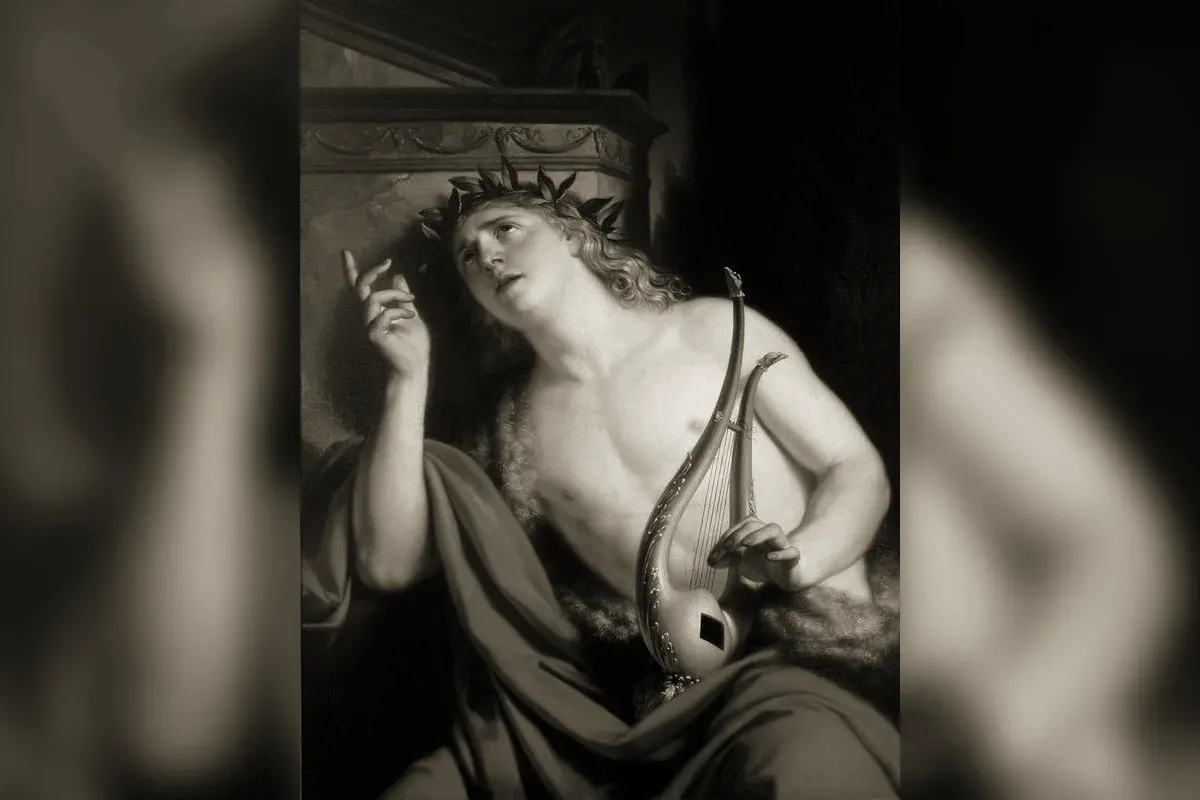
The myth of Orpheus and Eurydice is one of the most heartbreaking love stories in all of Greek mythology. It is not a story of triumph. It is the story of a man who possesses the most extraordinary gift in the world — a music capable of moving gods themselves — and who, at the decisive moment, cannot help being human. The beauty of this myth lies precisely in that fragility: Orpheus does not fail for want of love, but because love alone is not enough against death.
Orpheus, child of music and the divine
Orpheus was born in Thrace, a region associated in the Greek imagination with a particular musical wildness — both primitive and ecstatic. His genealogy varies by source, but the most widely received version makes him the son of Apollo, god of music and light, and of Calliope, the Muse of epic poetry. From his divine father he inherits the gift of the lyre; from his mother, mastery of the word and the hexameter.
Very early, Orpheus surpasses that inheritance. His lyre does not merely accompany banquets or processions: it orders the natural world. Rocks begin to move to hear him better. Rivers pause in their beds. Trees tear their roots from the earth to draw closer. Wild beasts — wolves, lions, bears — sit at his feet like domestic animals. Orpheus is living proof that art can be more powerful than force.
He sails with the Argonauts alongside Jason, and it is he who, during the passage of the Sirens, saves the ship by playing louder and more beautifully than they do — while Odysseus, in the Odyssey, must have himself tied to the mast, Orpheus answers dangerous beauty with a greater beauty still.
The marriage and the death of Eurydice
Orpheus meets and marries Eurydice, a nymph of extraordinary beauty. The union is perfect, luminous — and brief. On the very day of their wedding, or shortly after depending on the version, Eurydice is bitten by a serpent while walking through the meadows with her companions. The bite is fatal. She descends immediately into the kingdom of the dead.
Virgil, in the fourth book of the Georgics, gives a version in which Eurydice was fleeing the advances of Aristaeus (a pastoral deity) when she stepped on the snake. Ovid, in the Metamorphoses, is more spare: the nymph walks, and fate strikes. In both cases, the death is absurd, sudden, unjust — which is precisely what makes Orpheus’s grief so immediate and so recognizable.
Orpheus is inconsolable. He refuses mourning, refuses forgetting. And he makes the only decision his gift allows him to conceive: to descend alive into the Underworld and bring Eurydice back.
The descent into the Underworld
No mortal descends to the Underworld and returns. Heracles went there to capture Cerberus, but he was the son of Zeus and had the explicit protection of Athena and Hermes. Odysseus consults the shades from the threshold in the Nekyia, without ever truly crossing the boundary. Orpheus is only a musician.
He descends through an underground entrance — sources mention Cape Taenarum at the southern tip of the Peloponnese — and advances into Tartarus, the world of the depths that the gods themselves do not inhabit willingly. What he has with him is his lyre.
The crossing is a succession of musical miracles. Cerberus, the three-headed dog guarding the entrance to the Underworld, falls asleep or is won over by the sound of the strings. The Furies, goddesses of vengeance with serpents for hair, who know no tears, weep. Sisyphus, condemned to roll his boulder for eternity, sits on the rock and listens. Tantalus forgets for a moment his hunger and thirst. The Danaids set down their endless perforated jars. All the world of the dead comes to a standstill in listening.
Orpheus reaches the throne of Hades and Persephone, sovereigns of the Underworld. He plays and sings before them. He tells them he has come not as an enemy, not to steal anything — only to reclaim what death has taken too soon. His music is so perfect, his pain so authentic, that Persephone weeps. Hades himself — who had received the realm of the dead by lot after the Titanomachy and had never once relented — is moved.
They grant Orpheus’s request. Eurydice may ascend with him toward the world of the living. One condition only: throughout the climb, Orpheus must walk ahead of her and never turn to look at her. If he turns before crossing the threshold of the living world, Eurydice will return immediately to the dead — forever.
The ascent and the fatal glance
Orpheus accepts and begins the climb. Behind him, Hermes — psychopomp, guide of souls — accompanies Eurydice. Orpheus walks in total darkness, hearing or believing he hears footsteps behind him. The closer he comes to the threshold, the more doubt rises.
And there, a few steps from the light, he looks back.
Why? The ancient sources diverge, and that divergence is itself revealing. Ovid reads it as an ontological doubt: Orpheus fears it is only a shade, an illusion — that the gods have played him false and he is climbing alone. Virgil reads it as a madness of love: iamque pedem referens casus evaserat omnis, / reddita Eurydice superas veniebat ad auras — he had nearly escaped every danger, he was nearly free, and amor destroys him. In both readings there is neither cowardice nor betrayal: only the fundamental human inability to trust without seeing, to love without seeking proof.
His gaze lands on Eurydice. And immediately, without a cry, without a word of reproach, she falls back. She is drawn into the depths. Her arms reach out toward him, but she already belongs no longer to the world of the living. Orpheus tries to follow her, to cross the threshold again, but the ferryman Charon refuses: one crosses twice only by dying.
The wandering and the death of Orpheus
Orpheus returns to the world of the living, broken. For months or years — sources vary — he wanders through Thrace, still playing, mourning Eurydice, refusing all human love. He turns away the women offered to him, perhaps out of faithfulness to her, perhaps because he has discovered, in some later versions, love for young men.
It is this rejection that brings about his end. The Maenads — the Bacchante women, priestesses of Dionysus — feel insulted or consumed by jealousy. During an orgiastic festival in honor of the god, they fall upon Orpheus, tear him limb from limb, and throw his head and lyre into the river Hebrus.
Yet Orpheus’s severed head does not stop singing. It drifts on the water, crossing the Aegean Sea, and washes up at last on the island of Lesbos — an island that would later become the homeland of the poet Sappho, and which the Ancients associated with a particular musical and lyrical sensibility. The Muses gather Orpheus’s scattered limbs and bury them with dignity. His lyre is transformed into a constellation.
Orpheus’s soul at last rejoins Eurydice in the Underworld, and this time, according to the more consoling versions of the myth, nothing separates them again.
Orphism: a movement born from the myth
The myth of Orpheus does not remain confined to literature. It generates a religious movement: Orphism, a Greek mystical current claiming the revelations attributed to the Thracian bard. Orphism proposes a cosmogony alternative to Hesiod’s, centered on Dionysus Zagreus and the original sin of the Titans who devoured him. From that cosmic transgression humanity is born — a mixture of Dionysiac element (the soul) and Titanic element (the body).
Orphism teaches that the soul is immortal and condemned to reincarnate until it is sufficiently purified to join the blessed. Gold tablets found in tombs across Magna Graecia and Thrace (4th–2nd centuries BCE) contain practical instructions for the soul in the afterlife: which spring to drink from, what formulas to recite, which guardians to avoid. These are direct echoes of Orpheus’s descent.
Plato knows Orphism and alludes to it in several dialogues — notably in the Symposium and the Phaedrus — even if he sometimes judges harshly the itinerant practitioners who sell their purification rites. Orphism also influences Pythagoreanism and, much later, Neoplatonism.
Interpretations and legacy
The myth of Orpheus and Eurydice is among the most re-read, reinterpreted, and reappropriated in all of Antiquity down to the present day.
The oldest allegorical reading sees in it a lesson about art and its limits: music can soften everything, but it cannot reverse death; art illuminates life without indefinitely prolonging it. A philosophical reading sees in Orpheus’s glance the illustration of the human desire for certainty — the inability to act in the dark, the need for immediate proof that destroys the very thing it protects. A modern psychoanalytic reading perceives the death drive at work within desire itself: Orpheus, unconsciously, wanted to lose Eurydice, not knowing what to do with a life returned to normal.
Poets, composers, and filmmakers have never stopped returning to this myth. Monteverdi makes it the first great opera in history (L’Orfeo, 1607). Gluck transforms it (Orfeo ed Euridice, 1762). Rilke dedicates the Sonnets to Orpheus to it. Marcel Camus transposes it to carnival-era Brazil (Black Orpheus, 1959). Sarah Ruhl makes it a contemporary stage play told from Eurydice’s point of view.
The reason for this longevity is simple: Orpheus touches the universality of grief, the impossibility of accepting loss, and the mistake we would all make — looking back to make sure what we love is still there.
Ancient sources
The most developed account comes from Virgil (Georgics, Book IV, lines 453–527), who inserts the myth into a poem about beekeeping — Aristaeus, whose fault caused Eurydice’s death, loses his bees as divine punishment. Ovid takes up the myth in the Metamorphoses (Books X and XI) with a fuller style and particular attention to Orpheus’s psychology after the second loss. Apollodorus mentions it briefly in the Library. Older fragments evoke Orpheus in Ibycus (6th c. BCE) and in the Orphic tablets, but the complete narrative of the descent into the Underworld belongs to the Hellenistic and Latin periods.
Story beats
- 01Orpheus, son of Apollo and Calliope, becomes the greatest musician in the world
- 02Marriage with Eurydice; her death by snakebite on their wedding day
- 03Orpheus descends to the Underworld armed only with his lyre
- 04He charms Cerberus, the Furies, Sisyphus, and every soul in the realm
- 05Hades and Persephone grant Eurydice's return on one condition: never look back
- 06The ascent toward the world of the living
- 07The fatal backward glance a few steps from the threshold
- 08Orpheus's wandering and death, torn apart by the Bacchantes
- 09Orpheus's severed head drifts singing to the island of Lesbos
Ancient sources
- Virgil, Georgics (Book IV)
- Ovid, Metamorphoses (Books X–XI)
- Apollodorus, Library
- Plato, Symposium (allusion)
See also
Frequently asked questions
Why does Orpheus look back?
Ancient sources do not all agree on the reason. Ovid stresses doubt: Orpheus fears Eurydice is no longer following, that she no longer truly exists behind him. It is the human inability to trust without seeing. Virgil reads it as a madness of love — amor — that breaks reason. In both cases, it is the fragility of the human condition before the invisible that brings about the fall.
Who is Orpheus in Greek mythology?
Orpheus is a mortal of Thracian origin, son of Apollo (in some versions) or of the Thracian king Oeagrus and the Muse Calliope. He is the musician and poet par excellence: his lyre stops rivers, makes rocks dance, charms wild animals, and even the deities of the Underworld. He is also the mythic founder of the mystical movement known as Orphism.
What is Orphism?
Orphism is a Greek religious and philosophical movement that claims the revelations attributed to Orpheus. It teaches an alternative cosmogony, the immortality of the soul, transmigration (metempsychosis), and purification rites allowing escape from the cycle of rebirths. Gold tablets found in Greek and Italian tombs (4th–2nd centuries BCE) contain instructions for the soul's journey in the afterlife — a direct legacy of the myth of Orpheus in the Underworld.