Greek mythology · Mythical places
Tartarus: the primordial abyss and Titan prison in Greek mythology
Tartarus in Greek mythology: the primordial void born before the gods, prison of the Titans after the Titanomachy, and place of eternal punishment distinct from Hades' kingdom.
At the very bottom of Greek cosmology, before the gods of Olympus ever reigned over the world, there existed a bottomless void that the ancients called Tartarus. It is not merely a prison or an underworld dungeon: it is a primordial entity, a cosmic force born at the very beginning of all things, as ancient as Chaos itself. To understand Tartarus is to grasp the vertical architecture of the Greek universe — from the brilliant summit of Olympus down to unfathomable depths where light has never penetrated.
Tartarus as a primordial entity: born before the gods
In Hesiod’s Theogony, the foundational text of Greek cosmogony, Tartarus is among the first existences to emerge from the primordial void. Hesiod writes that in the beginning there was Chaos, then broad-breasted Earth (Gaia), then Erebus and dark Night — and among the first forces, Tartarus in the recesses of the wide-pathed Earth.
This birth alongside Gaia places Tartarus in a category apart: it is not a creation of the Olympian gods, nor a place they fashioned. It predates the reign of Zeus, it predates the Titans themselves. It is the absolute bottom of existence, the lower limit of everything that can be.
Hesiod also attributes a personified divine nature to Tartarus. The abyss unites with Gaia to produce Typhon, the most terrifying of all monsters — the creature who nearly overthrew Zeus himself after the Titanomachy. This genealogy underscores the fundamental ambivalence of Tartarus: simultaneously a place, a cosmic force, and the ancestor of horror.
The geography of Tartarus: an abyss within the abyss
Greek mythology describes the universe as a series of superimposed layers. At the top, the bright aether and Olympus, home of the gods. Below that, the surface of the Earth, the domain of mortals. Lower still, the Underworld, the subterranean kingdom ruled by Hades and his wife Persephone, to which the souls of the dead flow.
And below all of that — further still beneath the earth than the sky is high above it, in Hesiod’s own formulation — lies Tartarus. A bronze anvil dropped from the surface would fall for nine days and nine nights before striking bottom.
This vertiginous distance is not mere poetic flourish: it encodes a moral and cosmological hierarchy. Tartarus is accessible only to entities and criminals who have shattered the fundamental order of the world. The gods themselves do not visit it by choice; heroes who venture near its confines do so at enormous personal risk.
The boundary between Hades’ kingdom and Tartarus proper blurs somewhat in later sources — notably in Virgil, who merges the two spaces in his Aeneid while reserving Tartarus for the gravest sinners. But in the Hesiodic and Homeric tradition, the distinction is clear: ordinary dead souls go to Hades; chained Titans and the mythically damned go to Tartarus.
The Titanomachy and the birth of the cosmic prison
Tartarus acquires its carceral function at the close of the Titanomachy, the ten-year war pitting the Olympian gods, led by Zeus, against the Titans under Cronus. This titanic conflict shook the very foundations of the cosmos: the clashes of battle made the Earth tremble and the seas boil, while the fires of Zeus’s thunderbolt lit up the abyss itself.
Zeus’s victory was decisive. The defeated Titans were hurled down into Tartarus, chained in its depths at a distance equal from the earth’s surface to the highest point of the heavens. To guard them, Zeus entrusted the watch to the Hecatoncheires — the three hundred-armed, fifty-headed monsters, Cottus, Briareus, and Gyges — whom the Titans had once imprisoned and whom Zeus had freed to make allies during the war.
This decision is foundational. Zeus does not destroy his enemies: he imprisons them. Tartarus becomes the cosmic lock that guarantees the Olympian order. As long as the Titans are held there, the stability of the world is assured. The depth of Tartarus measures the power of Zeus’s reign.
Famous prisoners: eternal punishments
While the Titans make up the bulk of Tartarus’s population, certain condemned figures serve individual sentences of memorably symbolic cruelty. These torments are not arbitrary: each reflects the precise nature of the transgression committed.
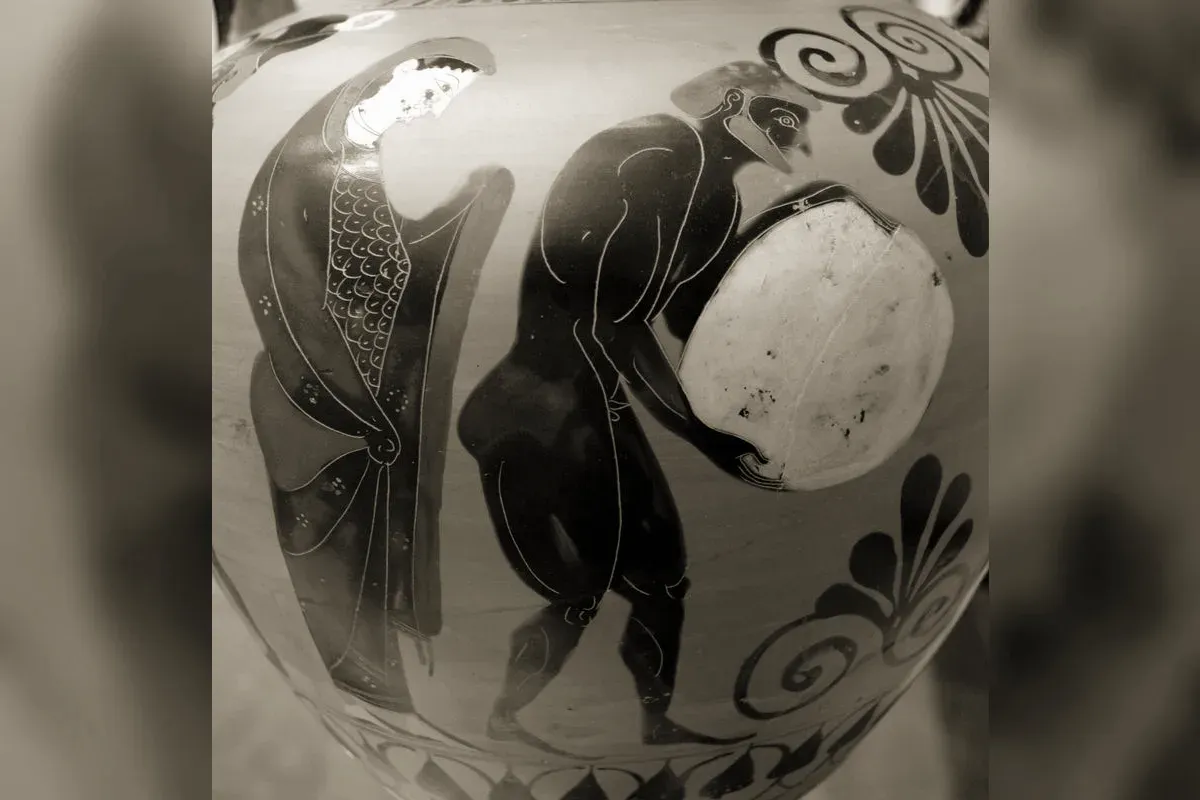
Sisyphus, king of Corinth, was condemned to roll a boulder eternally up a hillside, only to watch it tumble back down each time. His crime? Having cheated death on multiple occasions, shackling Hades himself during a visit, and using his cunning to return temporarily among the living. His punishment is the perfect emblem of futile obstinacy against the natural order.
Tantalus, king of Lydia and once a favorite of the gods, stands in water that recedes whenever he tries to drink, beneath fruit trees whose branches rise just out of reach whenever he stretches his hand. He had dared to serve the gods the flesh of his own son Pelops at a banquet — an incomparable desecration of divine hospitality.
Ixion, king of the Lapiths, was chained for eternity to a wheel of fire spinning endlessly. He had attempted to seduce Hera, Zeus’s wife, and boasted of the affront. Zeus, to punish him, had substituted a cloud-double (Nephele) for Hera, from which the Centaurs would be born — a vivid illustration of what the union of hubris and illusion produces.
The Danaids, the fifty daughters of Danaus who murdered their husbands on their wedding night, are condemned to fill a leaking barrel — or in some versions, a vessel with no bottom — for eternity. Their punishment articulates the impossibility of completing an act utterly devoid of moral foundation.
These figures are inseparable from Tartarus in the Greek imagination: they give the abyss a face and a drama. They transform an abstract cosmic void into a theater of divine justice.
Tartarus in the great epics: Heracles, Perseus, Orpheus
A small number of heroes approached Tartarus or its borderlands, most often during a descent into the Underworld — the katabasis — which constitutes one of the supreme trials of Greek mythology.
Heracles accomplished the most famous of these descents during his twelfth and final Labor: capturing Cerberus, the three-headed dog that guards the gates of the Underworld. Initially guided by Hermes, psychopomp and escort between worlds, he crossed the realm of Hades. Ancient sources do not place him inside Tartarus itself, but he came close to its frontier, confronting total darkness and the shadows of the dead. The success of this Labor testifies to his semi-divine nature: no ordinary mortal could pass through such depths and return.
Perseus, during his expedition against Medusa, does not perform a true katabasis, but he receives the assistance of Hermes and Athena to venture through liminal spaces at the edges of the known world. The winged sandals lent to him by Hermes — or, in some versions, granted by the Nymphs — specifically evoke the capacity to cross boundaries between worlds.
Prometheus, although chained on the Caucasus rather than in Tartarus, exemplifies another form of the cosmic punishment ordered by Zeus. His torment — having his liver devoured by an eagle each day, the liver regrowing each night — matches the suffering of Tartarus’s inmates in cruelty. Hesiod mentions in certain passages that precipitation into Tartarus represents one of the ultimate sanctions available to Zeus against those who rebel against the divine order.
The literary tradition: from Hesiod to Virgil
The most systematic description of Tartarus as a cosmic location appears in Hesiod’s Theogony (around lines 720–745), where the poet devotes an extended ekphrasis to its dimensions, its materials — bronze doors, bronze walls, a triple layer of night surrounding the chasm — and its guardians.
Homer alludes to it in the Iliad (VIII, 13–16): Zeus threatens to hurl any opposing god into Tartarus, describing it as “as far below Hades as the sky is above the earth.” This Homeric formula becomes canonical.
Virgil, in the Aeneid (Book VI), revisits and amplifies the tradition in the framework of Aeneas’s descent into the Underworld. His Tartarus is encircled by a triple wall and by the river Phlegethon, ringed with flames; Rhadamanthus presides over the judgment of the great guilty. This Virgilian version, more architecturally structured and morally explicit, would durably shape Western representations of hell.
Plato, in the Phaedo and the Gorgias, takes up Tartarus within a philosophical framework: it becomes the fate reserved for incurable souls, those whose offenses are so grave that no purification is possible. This philosophical shift bears witness to the capacity of Greek myth to serve as a vehicle for ethical reflection.
The cosmological dimension: Tartarus as a principle of order
What sets Tartarus apart from simple sites of punishment is its structural role in Greek cosmology. It is not a moral invention added after the fact: it is an original given. Its presence guarantees that the universe possesses a lower limit, an absolute floor beyond which nothing can sink further.
The thunderbolt of Zeus, symbol of Olympus’s supreme power, draws part of its meaning from this vertical geography. To strike with the thunderbolt is potentially to hurl into Tartarus — in other words, to permanently exclude from the cosmic order. It is the ultimate sanction, one that admits no return.
In this sense, Tartarus is not the opposite of Olympus: it is its necessary complement. One is the luminous summit where divine order reigns; the other is the dark foundation that makes that order possible by containing what would threaten it if left free.
Further reading
For the luminous opposing pole of the Greek cosmos, consult the page on Elysium, the paradise of deserving souls. For the master of the underworld kingdom of which Tartarus forms the lowest extreme, read the page on Hades. For the war that sent the Titans to Tartarus, read the narrative of the Titanomachy. For the luminous summit that forms the opposite pole to Tartarus, consult the page on Mount Olympus. For the divine weapon whose threat embodies the possibility of being hurled into Tartarus, see the page on the thunderbolt of Zeus.
Primary sources: Hesiod, Theogony (8th–7th c. BCE); Homer, Iliad (Book VIII); Virgil, Aeneid (Book VI, 1st c. BCE); Plato, Phaedo and Gorgias (4th c. BCE).
See also
Stories featuring this entity
Frequently asked questions
What is the difference between Tartarus and the kingdom of Hades?
In Greek cosmology, Tartarus and Hades' realm are distinct: Hades is the domain of ordinary dead souls, with its various regions (Elysian Fields, Asphodel Meadows, Erebus). Tartarus lies even deeper, reserved for the imprisoned Titans and great criminals sentenced to eternal torment. Hesiod specifies that Tartarus is as far below the earth as the sky is above it.
Who is imprisoned in Tartarus?
After the Titanomachy, Zeus imprisons the defeated Titans there, guarded by the Hundred-Handers. Among the famous mythic prisoners condemned to eternal suffering: Sisyphus (rolling his boulder), Tantalus (starving surrounded by food just out of reach), Ixion (chained to a wheel of fire), and the Danaids (condemned to fill a bottomless barrel).
Is Tartarus also a deity?
Yes. In Hesiod's Theogony, Tartarus is one of the primordial entities born at the dawn of time, alongside Chaos and Earth (Gaia). It is therefore both a cosmic place and a personified deity. His union with Gaia produces Typhon, the monster of all monsters who will challenge Zeus after the Titanomachy.