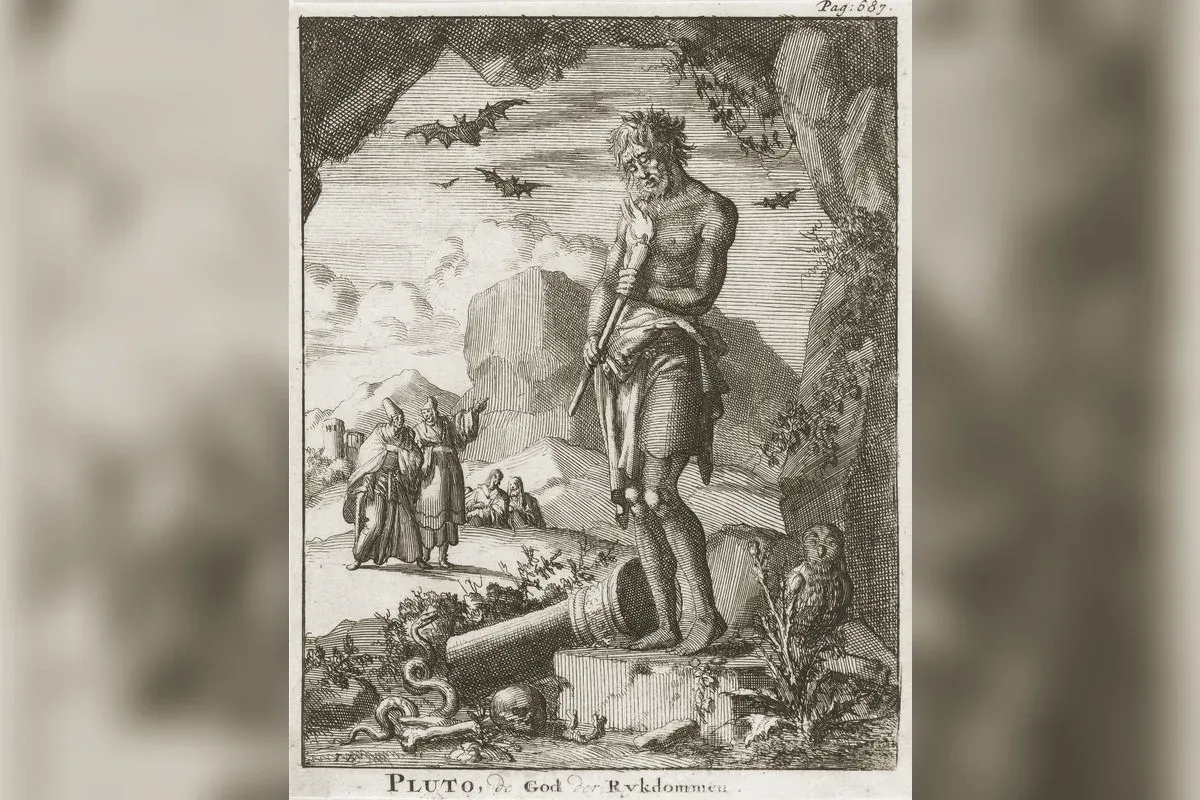
Hades, god of the Underworld in Greek mythology
Hades is the third of the great Olympian powers: brother of Zeus and Poseidon, he receives the realm of the dead as his share after the victory over the Titans. An unyielding sovereign of a domain the living dread, he is neither devil nor evil god — simply the impartial guardian of the inevitable.
The drawing of lots
After the Titanomachy, the three brothers draw lots for the domains of the world. Zeus draws the sky, Poseidon the seas, Hades the underworld. The Earth remains common ground. Hades accepts his lot without revolt and has ruled the realm of shadows ever since.
The Cyclopes forge him the cap of invisibility, which allows him to move unseen — a weapon lent to Perseus during his quest against Medusa.
The realm underground
The Greek underworld is not hell in the Christian sense: it is a structured world governed by rules. One enters across the Styx, the river on which Charon ferries shades in exchange for an obol. Cerberus, the three-headed dog, guards the gate so that no dead can return.
Souls are judged by Minos, Aeacus, and Rhadamanthus. Virtuous heroes reach the Elysian Fields, criminals are hurled into Tartarus, and the rest wander the Asphodel Meadows.
The abduction of Persephone
The great myth surrounding Hades is his love for Persephone, daughter of Demeter. He abducts her while she gathers flowers, carries her to the underworld, and makes her his queen. Demeter, devastated, lets the earth become barren. Zeus negotiates a compromise: Persephone will spend part of the year below and part with her mother. This myth explains the seasons.
Hades the Rich
His epithet Pluto — the Rich — signals that precious metals and gems originate in the depths he governs. This beneficial aspect stands in contrast to his image as the ruler of death.
Few heroes cross his realm alive: Orpheus descends for Eurydice, Heracles to capture Cerberus, Odysseus to consult the shades.
Cult and representations
Unlike Zeus or Apollo, Hades had almost no open temples. Black animals were sacrificed to him, turned face-down toward the earth. His name was avoided as an ill omen — Pluto was preferred to keep his name unspoken.
Further reading
To understand Hades’s place among the Olympians, start with the pages on Zeus and Poseidon, then read the full story of the Titanomachy. For the myth of the seasons, read the pages on Persephone and Demeter. For the journey of a mortal through the underworld, read the story of Orpheus and Eurydice. For the abyss where the Titans are imprisoned, see the page on Tartarus. For the paradise where heroes are rewarded, consult the page on Elysium. For the heroes who cross his realm alive, see the pages on Heracles and Perseus. To compare Hades with death gods from other world mythologies, read the gods of death comparison.
See also
Frequently asked questions
Is Hades the god of death?
Hades is the king of the dead, but death itself is personified by Thanatos. Hades rules over the realm of the departed without being the agent of death.
Why is Hades called Pluto?
Pluto comes from Greek ploutos (wealth): precious metals and stones rise from the depths he governs. This euphemistic name avoided uttering Hades's name, considered a bad omen.
Is Hades evil?
No: Hades is just and implacable, not cruel. He receives all the dead without discrimination and maintains the order of the underworld. His grim image reflects the nature of his domain, not personal malice.