Greek mythology · Gods & goddesses
Prometheus, the Titan who gave fire to humanity
Prometheus in Greek mythology: the theft of fire, Zeus's punishment, the creation of humanity, Pandora's jar, and his liberation by Heracles.
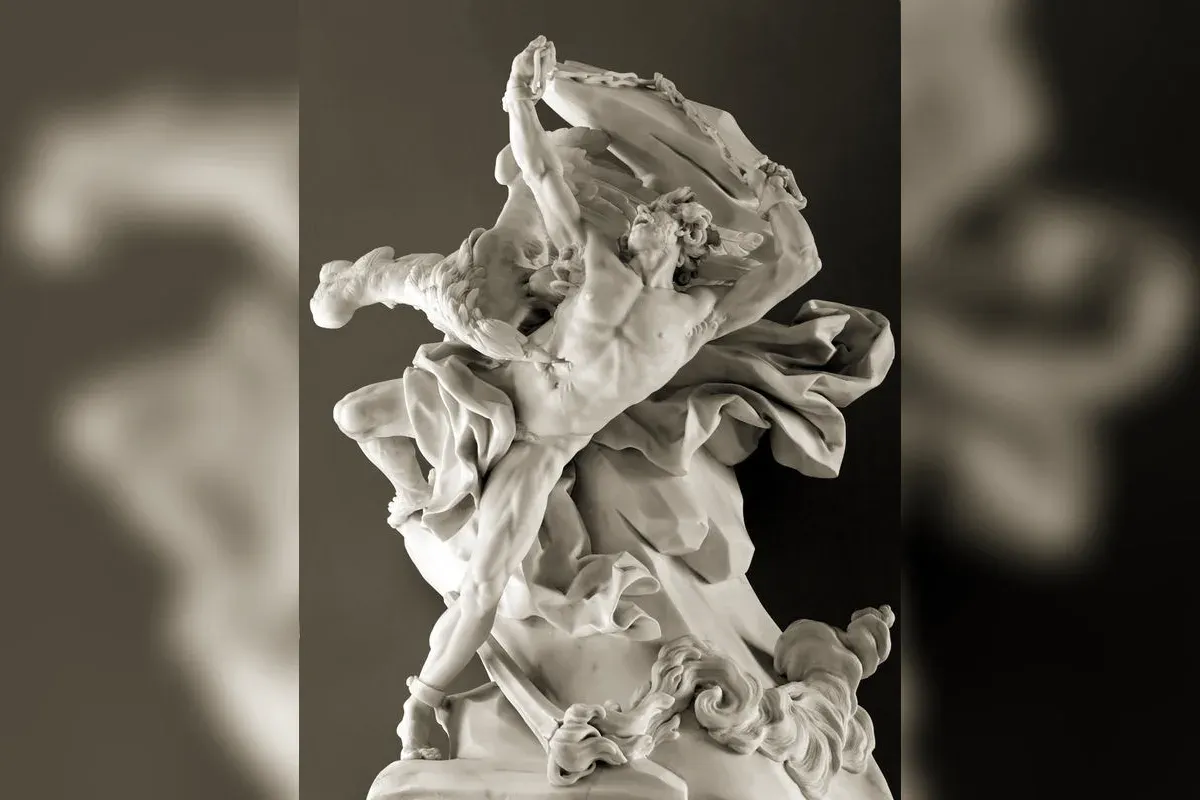
In Greek mythology, Prometheus is the Titan of stolen fire, foresight, and resistance to the will of Zeus. Neither an Olympian god nor a simple mortal, he stands between two worlds: the divine powers of Olympus and a still-fragile humanity below. His defining act — stealing fire and giving it to humankind — earns him eternal punishment, but it also makes him central to any reading of Greek myth about civilization, Pandora, and the dangerous price of knowledge.
A Titan on the side of the Olympians
Prometheus is the son of the Titan Iapetus and the Oceanid Clymene. Brother of Epimetheus (the Afterthought), Atlas, and Menoetius, he belongs to the generation of Titans that preceded the Olympian gods. Yet unlike most of his kin, he does not fight alongside the Titans during the great Titanomachy: his legendary foresight reveals that the Olympians will win, and he sides with Zeus.
This decision places him in a unique position — a Titan admitted into the new order, a bridge between the old divine generation and the new. But his loyalty has its limits, and it is precisely there that his story truly begins.
The sacrifice trick and the withholding of fire
The first rupture between Prometheus and Zeus grows from a dispute over sacrificial offerings. At Mecone, during a banquet meant to settle relations between gods and mortals, Prometheus slaughters a great ox and divides it into two portions. On one side, the best cuts of meat hidden beneath the unappetizing hide; on the other, the bones wrapped in gleaming fat. He invites Zeus to choose. Zeus, sensing the trick but unwilling to be openly outwitted, selects the fat — and finds himself holding bones. Angered, he retaliates by withholding fire from the human race.
This is the moment Prometheus makes his most audacious move. He climbs to Olympus — or, in some versions, approaches the chariot of the Sun — and hides a live coal in a hollow fennel stalk (narthex). He descends to humanity and delivers this decisive gift. For the first time, mortals can warm themselves, cook their food, forge weapons, work metal, and defend against wild beasts. Fire is far more than a flame: it is the founding act of human civilization.
The punishment on the Caucasus
Zeus’s revenge matches the scale of the Titan’s insolence. He orders Hephaestus, god of fire and the forge, to chain Prometheus to a rocky peak in the Caucasus Mountains at the edge of the known world. The bonds are unbreakable; the Titan can neither lie down nor stand freely.
Every dawn, an enormous eagle — sent by Zeus, or created by him in some accounts — descends upon Prometheus and tears out his liver. Each night, the organ regenerates completely. The torment resumes at first light. This perpetual regeneration — in ancient Greek physiology, the liver was the seat of life and vitality — transforms the punishment into endless agony: Prometheus is condemned to die each day without ever truly dying.
In the tragedy Prometheus Bound, attributed to Aeschylus, the Titan endures his sentence with stoic dignity, certain that Zeus’s order will eventually crumble too. He holds a secret — the prophecy that Zeus’s union with the Nereid Thetis would produce a son more powerful than his father — and refuses to reveal it under any threat. This silence, maintained against all coercion, is Prometheus’s final act of defiance.
Prometheus and the creation of humanity
A major strand of Greek tradition credits Prometheus not only with the gift of fire but with the fashioning of humanity itself. According to these versions, the gods charged the two brothers Prometheus and Epimetheus with equipping all living creatures with their faculties. Epimetheus distributed the available gifts generously — speed to some, strength to others, fur, claws, wings — until he had exhausted every resource. When it came time to provide for the human race, he had nothing left.
Prometheus intervened. He modeled men from clay, in the image of the gods, and went to steal not only fire but also technical wisdom — technê — from the workshop of Hephaestus and Athena. Thus humanity received what it lacked: creative intelligence and mastery of the flame. This version positions Prometheus as the spiritual father of the human race — the figure who substitutes cunning for brute force, and mind for claw.
Pandora: punishment delegated to mortals
Zeus does not punish Prometheus alone. He punishes humanity as well, for having received the forbidden gift. At his command, Hephaestus fashions Pandora, the first woman, molded from clay and adorned with gifts from every god: Athena teaches her the arts, Hermes gives her speech and guile, Aphrodite bestows irresistible charm. Pandora is literally “she who possesses all gifts” — but the gift is a trap.
She is sent to Epimetheus, Prometheus’s brother, and welcomed despite his brother’s repeated warning: “Never accept gifts from Zeus.” Epimetheus yields. Pandora opens her jar (commonly but inaccurately called a box), and from it pour all the evils of the world: disease, grief, war, jealousy, old age. Only Hope remains trapped inside when the lid is slammed shut in time. This foundational myth — through which Hesiod explains the human condition — is inseparable from the figure of Prometheus.
Liberation by Heracles
The punishment of Prometheus was, in theory, meant to last forever. That was Zeus’s decree. Yet the cycle breaks thanks to the greatest of mortal heroes.
During his wanderings across the world, Heracles passes through the Caucasus. Seeing the chained Titan and the eagle descending upon him, he raises his bow — the bow whose arrows are dipped in the venom of the Lernaean Hydra — and kills the bird with a single shot. Then he breaks or has the chains broken. Prometheus is free.
Some versions note that Zeus permitted this liberation: his son gave him the opportunity to show clemency without losing face. Others stress that Prometheus had finally revealed the secret of Thetis to Zeus — sparing him from the catastrophic union that prophecy had warned against — and that this disclosure ultimately convinced the lord of Olympus to accept the Titan’s release.
What the ancient sources actually emphasize
Prometheus does not mean exactly the same thing in every ancient author. In Hesiod (Theogony, Works and Days), he is above all the architect of the sacrificial trick at Mecone and the indirect cause of humanity’s suffering through the episode of Pandora. The emphasis falls on Zeus’s cosmic order: the theft of fire breaks the proper boundary between gods and mortals, and punishment restores that hierarchy.
In Aeschylus, by contrast, Prometheus Bound turns the Titan into far more than a punished trickster. He becomes the lucid benefactor of humankind — the one who gives not only fire, but also arts, calculation, medicine, shipbuilding, and technical intelligence. This tragic reading explains why later centuries transformed Prometheus into a symbol of intellectual revolt. To reduce him to “the Titan who stole fire” is therefore too narrow: ancient sources also present him as a thinker of power, justice, and human progress.
A universal symbol
Prometheus travels through the centuries with a vitality unmatched by almost any other figure in Greek mythology. His story concentrates several fundamental questions: the price of knowledge, the legitimacy of defying established power, and solidarity with the weakest. In the modern philosophical and literary tradition, he has become the metaphor for the human being who defies the limits imposed by divine or natural order.
Zeus represents in this myth the authority that jealously guards its prerogatives. Hera is almost absent — the conflict here is between the principle of divine power and humanity’s aspiration to rise above its condition. Athena, goddess of wisdom and craft, is simultaneously the unwitting victim of Prometheus’s theft and the tutelary figure of the very arts that theft made possible. Hermes acts as the instrument of Zeus’s reprisal, tasked with carrying the divine will to Epimetheus and endowing Pandora with language — the last, most subtle weapon in the punishment.
Further reading
To understand Prometheus’s place in the cosmic order, read the story of the Titanomachy that precedes his own. For the full narrative of Pandora’s jar and the origin of human suffering, read the Myth of Pandora. For the hero who liberates him, see the page on Heracles. For the gods directly involved in his punishment and in the creation of Pandora, explore the pages on Zeus, Hephaestus, and Athena. For the god who gave Pandora the gift of speech — the last instrument in the divine scheme — see the page on Hermes.
See also
Frequently asked questions
Why did Prometheus steal fire from the gods?
Prometheus, gifted with foresight and deeply attached to humanity, saw that mortals were naked, defenseless, and outmatched by animals. He stole fire from Olympus — hidden in a hollow fennel stalk according to Hesiod — to give humans a tool for warmth, cooking, metalwork, and survival that Zeus had deliberately withheld after the dispute at Mecone.
What was Prometheus's punishment?
Zeus ordered Hephaestus to chain Prometheus to a peak in the Caucasus Mountains with unbreakable bonds. Every dawn, an enormous eagle descended and devoured his liver. Every night, the liver grew back entirely. The torment began again at first light. This eternal cycle ended only when Heracles shot the eagle and broke the Titan's chains.
What is the connection between Prometheus and Pandora?
To punish humanity for receiving the stolen fire, Zeus commissioned Hephaestus to fashion Pandora, the first woman, adorned with gifts from every god. She was sent to Epimetheus, Prometheus's brother, who accepted her despite his brother's repeated warnings never to take gifts from Zeus. Pandora opened her jar and released all evils into the world; only Hope remained trapped inside.