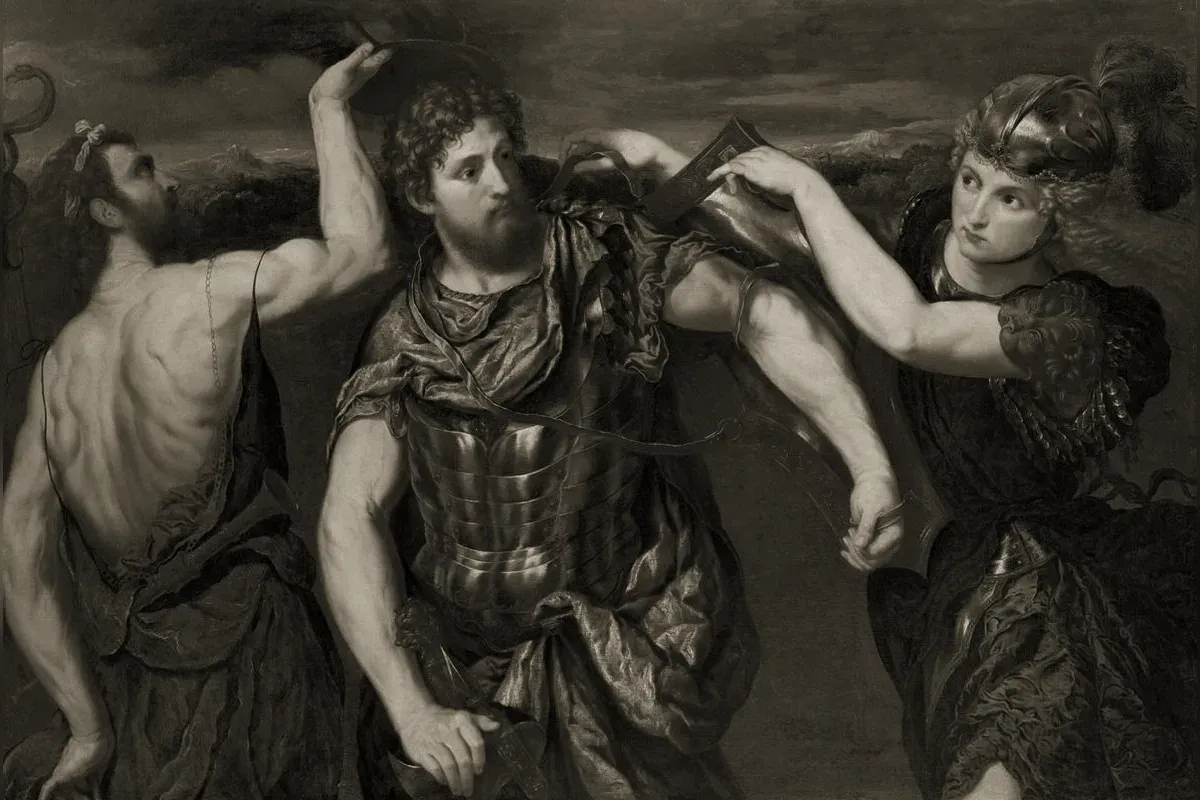
Hermes, messenger of the gods and guide of souls
Hermes is one of the most active and mobile deities in the Greek pantheon: messenger of Olympus, protector of travelers and merchants, guide of souls to the land of the dead, inventor of the lyre and of language. His domain covers everything that moves — words, goods, souls, secrets.
A precociously cunning birth
Son of Zeus and the Pleiad Maia, Hermes is born in a cave on Mount Cyllene in Arcadia. On the very day of his birth, he slips out, finds a tortoise, and crafts the first lyre from its shell. He then steals the sacred cattle of Apollo and hides them, covering his tracks by various tricks. Apollo, furious, drags him before Zeus. Hermes plays his lyre and dazzles Apollo, who accepts it in exchange. They are reconciled: Apollo receives the lyre, Hermes the caduceus and the guardianship of herds.
Messenger between worlds
Hermes is the angel of the Greek pantheon — the only god who moves freely between Olympus, the Earth, and the realm of the dead. He is entrusted with the most delicate missions: carrying Zeus’s decrees, escorting the souls of the dead to the underworld of Hades (his role as psychopomp), outwitting monsters and guardians.
He is the one who lulls Argus, the hundred-eyed giant set to watch Io, and cuts off his head — earning the epithet Argeiphontes. He guides Perseus to the Nymphs, leads Odysseus to Circe, and shields heroes on dangerous missions.
Guardian of boundaries
Herms — stone pillars topped with a bust and a phallus — marked crossroads and boundaries throughout the Greek world. They protected travelers and delimited spaces. Hermes thus presides over all thresholds: between life and death, inside and outside, speech and silence.
Inventor of language and cunning
Hermes is also the patron of language (Logos), eloquence, and rhetoric. He governs mediation, negotiation, and all exchange. His quickness of mind and stratagems make him an admired figure — where Ares is brutal and Athena severe, Hermes is mischievous and light.
Cult and hermetic tradition
His cult expressed itself at crossroads and in sacrifices before journeys. His intellectual tradition — Hermeticism — developed in the Hellenistic period under the syncretic figure of Hermes Trismegistus, a fusion of the Greek god and the Egyptian Thoth.
Further reading
To place Hermes in the Olympian genealogy, read the page on Zeus. For his role as guide to the underworld, see the page on Hades and the story of Orpheus and Eurydice. For the lyre he invented, explore the page on Apollo. For the hero to whom he lends his winged sandals, read the page on Perseus.
See also
Related entries
Frequently asked questions
Who is Hermes's Roman counterpart?
Mercury, Roman god of commerce and messengers, whose cult is heavily shaped by Greek Hermes but with a stronger emphasis on trade and financial transactions.
What is Hermes's caduceus?
The caduceus is a staff topped with two wings and entwined by two serpents. It is the symbol of the divine messenger and of mediation. Not to be confused with the Rod of Asclepius (a single serpent), the medical symbol.
Why is Hermes the god of thieves?
On the very day of his birth, Hermes steals Apollo's cattle and crafts the lyre from a tortoise shell. This early cunning makes him patron of all who live by ingenuity, speed, and resourcefulness — including thieves.