Greek mythology · Mythical places
Mount Olympus: home of the gods in Greek mythology
Mount Olympus in Greek mythology: the sacred mountain of the twelve Olympian gods, its cosmic role in Homer and Hesiod, and its place at the heart of the Greek universe.
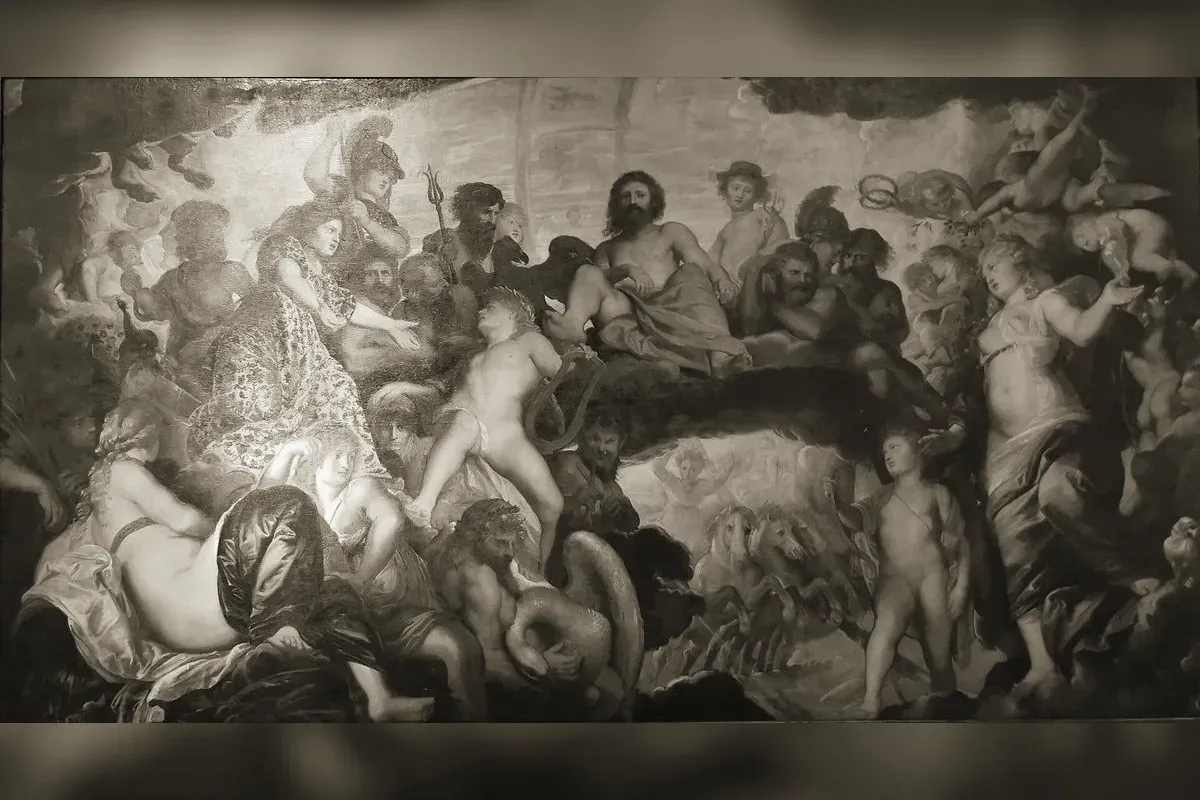
No place in ancient Greek religion carries the weight of Mount Olympus. At once a real peak visible from the plains of Thessaly and an eternal dwelling beyond mortal reach, Olympus is the fixed point around which the entire Greek divine order revolves. It is where cosmic authority is exercised, where wars among gods are debated, and where the boundary between immortal and human is most sharply drawn.
Etymology and geography: a name older than Greek
The name Olympos belongs to the oldest layer of Greek vocabulary — one that predates the arrival of Greek-speaking Indo-European peoples in the Aegean. Linguists classify it as pre-Greek, meaning it was already attached to the mountain before the language we call Ancient Greek took shape. Two competing interpretations have been proposed: a root meaning luminous, evoking the divine radiance associated with the peak, and a root simply meaning high place or elevated ground.
Geographically, the mountain straddles the border between Thessaly and Macedonia in northern Greece, reaching 2,917 metres at its highest point, the Mytikas. What made it mythically potent was its weather: the summit is almost perpetually hidden behind heavy cloud cover, a natural phenomenon the ancient Greeks read as the divine veil separating mortal sight from the gods’ eternal residence.
The name’s power is confirmed by its spread: several other mountains across the ancient Greek world — in the Troad, Lydia, Cyprus, and Arcadia — were also called Olympus. This multiplication suggests that Olympos described a concept as much as a location: the archetype of the sacred height where heaven and earth meet.
After the Titanomachy: Olympus as the prize of cosmic war
Olympus did not always belong to the gods we know. Before the Titanomachy, the cosmos was governed by the Titans, the older divine generation born from Ouranos (Sky) and Gaia (Earth). It was only after a ten-year war of extraordinary violence that Zeus and his siblings — the future Olympians — overthrew their predecessors and established a new divine order.
Victory came with a division of realms: Zeus claimed the sky and Olympus, Poseidon took the seas, and Hades received the underworld. The earth itself remained common ground, subject to the influence of all three brothers. The defeated Titans were not merely exiled — they were hurled into Tartarus, the bottomless pit beneath even the underworld, as far below the earth as Olympus rises above it.
This founding act of the Olympian era explains why Mount Olympus is inseparable from the idea of divine legitimacy. It is not simply where the gods happen to live; it is the trophy of a war that determined the shape of the universe.
The twelve Olympians: who dwells on the sacred mountain?
Ancient Greek tradition grouped the principal gods into a council of twelve — the Dodekatheon — though the exact roster shifted across centuries and city-states. The most widely accepted canon assembles:
Zeus, king of Olympus and master of the sky, whose absolute authority is embodied in the thunderbolt of Zeus, forged for him by the Cyclopes. Hera, queen of the gods and guardian of marriage, Zeus’s wife and frequent rival. Athena, goddess of wisdom, crafts, and strategic warfare, born fully armed from the head of Zeus — a birth that took place on Olympus itself in many versions. Apollo, god of light, music, prophecy, and poetry, twin of Artemis and one of the most widely worshipped of the Olympians. Artemis, goddess of the hunt, wilderness, and the moon, whose domain lay largely outside the mountain but whose seat on the divine council was secure. Aphrodite, goddess of love and beauty, born from the sea-foam according to Hesiod, an outsider to the Olympian bloodline who nonetheless holds one of its central thrones. Ares, god of war and martial violence, feared rather than beloved even among the Olympians. Hephaestus, the divine smith, builder of the gods’ palaces and forge of their weapons and wonders. Hermes, messenger of the gods, guide of souls, and patron of travellers, whose journeys constantly carry him between Olympus, earth, and the underworld. Demeter, goddess of grain and agriculture, whose connection to the earth and its seasons kept her closely tied to mortal life. Dionysus, god of wine, ecstasy, and theatre — the last deity to be admitted to the Olympian circle, a latecomer who displaced Hestia in some traditions. And Poseidon, who, though he presides over the seas from his own underwater palace, belongs fully to the divine council.
The variation in lists reflects genuine theological debate in antiquity. Some traditions placed Hestia, goddess of the hearth, among the twelve rather than Dionysus. Others occasionally included Persephone, Eos, or Heracles — the mortal-born hero who earned a place among the gods after his death — as a thirteenth figure elevated to divine status.
Homer’s Olympus: the bronze and golden court
Homer gives Olympus its most vivid literary form. In both the Iliad and the Odyssey, the mountain appears not as a vague celestial space but as a richly detailed divine court, with architecture, politics, and social hierarchies that mirror — and satirize — the aristocratic world of Archaic Greece.
In Homer’s telling, Olympus lies above all weather: no wind blows there, no rain falls, no snow accumulates. It is bathed in permanent radiance, a cloudless space that paradoxically remains hidden from mortals by the clouds that cling to the mountain below. The Hours (Horai), goddesses of the seasons, guard its gate, opening and closing a curtain of cloud to let the gods pass.
The palaces of Olympus were built by Hephaestus, crafted in bronze and gold, with floors of gleaming metal and great halls suited to divine assembly. Zeus’s palace is the largest and most imposing, the venue for the councils of the gods that drive much of the Iliad’s action — particularly the ongoing debate over the Trojan War, where the gods divide into opposing factions, some supporting Troy, others the Greeks.
The Homeric Olympus is a place of constant tension. Hera schemes against Zeus’s decisions; Hermes receives his commissions as divine messenger; Ares and Athena clash, literally, on the battlefield below. Far from being a serene paradise, Homer’s Olympus is a court defined by power struggles, patronage, and divine ego — familiar human dynamics elevated to cosmic scale.
Hesiod’s Olympus: fixed point of a structured cosmos
Where Homer makes Olympus a stage for divine drama, Hesiod’s Theogony treats it as a cosmological necessity. In Hesiod’s systematic account of how the world came to be, Olympus is not described so much as explained: it is the inevitable result of the ordering of the cosmos after the Olympians’ victory over the Titans.
Hesiod’s most striking contribution to the geography of Olympus is his measurement of cosmic distance. An anvil of bronze dropped from the sky, he says, would fall for nine days before reaching the earth; another nine days of falling would be needed to reach the floor of Tartarus. Olympus stands the same distance above the earth as Tartarus lies below it — a perfectly symmetrical cosmic architecture in which the mountain of the gods and the prison of the Titans balance each other exactly.
This symmetry is not decorative. It encodes the fundamental structure of Greek theology: the universe is ordered, bounded, and ruled by a principle of cosmic justice in which the exaltation of the victors is inseparable from the abasement of the defeated.
The seat of divine government
Beyond being a residence, Olympus functions as the seat of divine government in Greek religion. Zeus convokes the assembly of the gods — theoi agoreuontai — on its heights to deliberate over the fates of mortals and heroes. These councils are described in precise procedural terms in Homer: the gods take their seats according to rank, speak in turn, and defer — however reluctantly — to Zeus’s final authority.
From Olympus, Zeus exercises his three great moral functions: overseeing oaths, protecting strangers and suppliants, and maintaining the law of hospitality (xenia). The punishment of Prometheus — who stole fire from the gods to give to humanity — is conceived explicitly as a violation of an Olympian decree. Prometheus is punished not merely for theft but for breaking the divine order that Olympus represents. His punishment, chained to a distant rock far from the mountain, is also a form of exile: removal from the divine community whose seat is Olympus.
Olympus and Tartarus: the vertical axis of Greek cosmology
The most revealing way to understand Olympus is through its opposition to Tartarus. The two form the absolute poles of the Greek universe: Olympus at the pinnacle of light, permanence, and sovereign power; Tartarus at the nadir of darkness, formlessness, and punishment. Everything else — the earth of mortals, the realm of Hades, the intermediate spaces — exists between these extremes.
The world of mortals occupies the middle ground, subject to time, decay, and divine intervention from above and below. Hades, the underworld kingdom of the dead, lies beneath the earth but is distinct from Tartarus, which is reserved for cosmic criminals: the Titans, Sisyphus, Tantalus, and others whose offences violated the divine order itself.
This vertical structure explains the logic of heroic apotheosis. Heracles, the most celebrated of Greek heroes, earns a place on Olympus after his death precisely because his labours demonstrated the kind of superhuman excellence (arete) that the divine order rewards with elevation. Conversely, hybris — the Greek term for the arrogance of those who challenge the gods — is punished with a downward trajectory, toward Tartarus.
The axis is not merely cosmological but moral. Where you end up on it depends on how you lived.
From ancient mountain to global symbol
The afterlife of Olympus in world culture is vast and largely unambiguous. The word “Olympian” in modern European languages retains its ancient connotation of serene, superhuman majesty. The modern Olympic Games — launched in 1896, drawing on the ancient Panhellenic Games held at Olympia in the Peloponnese — carry the mountain’s name into every corner of the globe, fusing the sacred peak of Thessaly with the sanctuary of Zeus at Elis into a single enduring symbol of physical and competitive excellence.
In literature, art, and popular culture, Olympus has served as the template for any divine or exalted realm: from the ceiling frescoes of Baroque palaces to the world-building of contemporary fantasy fiction. The real Mount Olympus, protected as a national park since 1938, receives tens of thousands of hikers each year — evidence that the geography and the myth have never been fully disentangled, and that the impulse to climb toward the summit retains something of its ancient charge.
Further reading
For the war that made Olympus the home of the gods, read the account of the Titanomachy. For the king of Olympus himself, explore the page on Zeus and the article on his defining weapon, the thunderbolt of Zeus. For the cosmic counterweight to Olympus, see Tartarus. Among the Olympians, the pages on Hera, Athena, Apollo, Artemis, Hephaestus, and Hermes each illuminate a different facet of what it meant to dwell on the sacred mountain. For the gods whose domains extend beyond Olympus, read the pages on Poseidon, Hades, and Demeter. For the Titan punished for defying the Olympian order, see Prometheus. For the mortal hero whose excellence won him a place on Olympus, read the page on Heracles.
See also
Stories featuring this entity
Frequently asked questions
Is Mount Olympus a real place?
Yes, Mount Olympus is a real mountain in northern Greece (Thessaly), the highest peak in the country at 2,917 metres. The ancient Greeks identified its perpetually cloud-covered summit as the actual home of their immortal gods, never fully separating geography from myth.
Who are the twelve gods of Olympus?
The most common canon includes Zeus, Hera, Athena, Apollo, Artemis, Aphrodite, Ares, Hephaestus, Hermes, Demeter, Dionysus, and Poseidon — though Poseidon chiefly dwells in the seas. The precise list of the twelve Olympians varies slightly across ancient sources and city-states.
What is the difference between Olympus and Tartarus?
Olympus and Tartarus form the two extreme poles of Greek cosmology: Olympus is the luminous summit, home of the victorious gods; Tartarus is the deepest abyss, prison of the defeated Titans. Together they frame the vertical axis of the Greek mythic universe.