Greek mythology · Heroes & mortals
Jason and the Golden Fleece: leader of the Argonauts in Greek mythology
Jason, leader of the Argonauts, the quest for the Golden Fleece in Colchis, Medea's magic, and the tragic fall of a hero who betrayed his saviour.
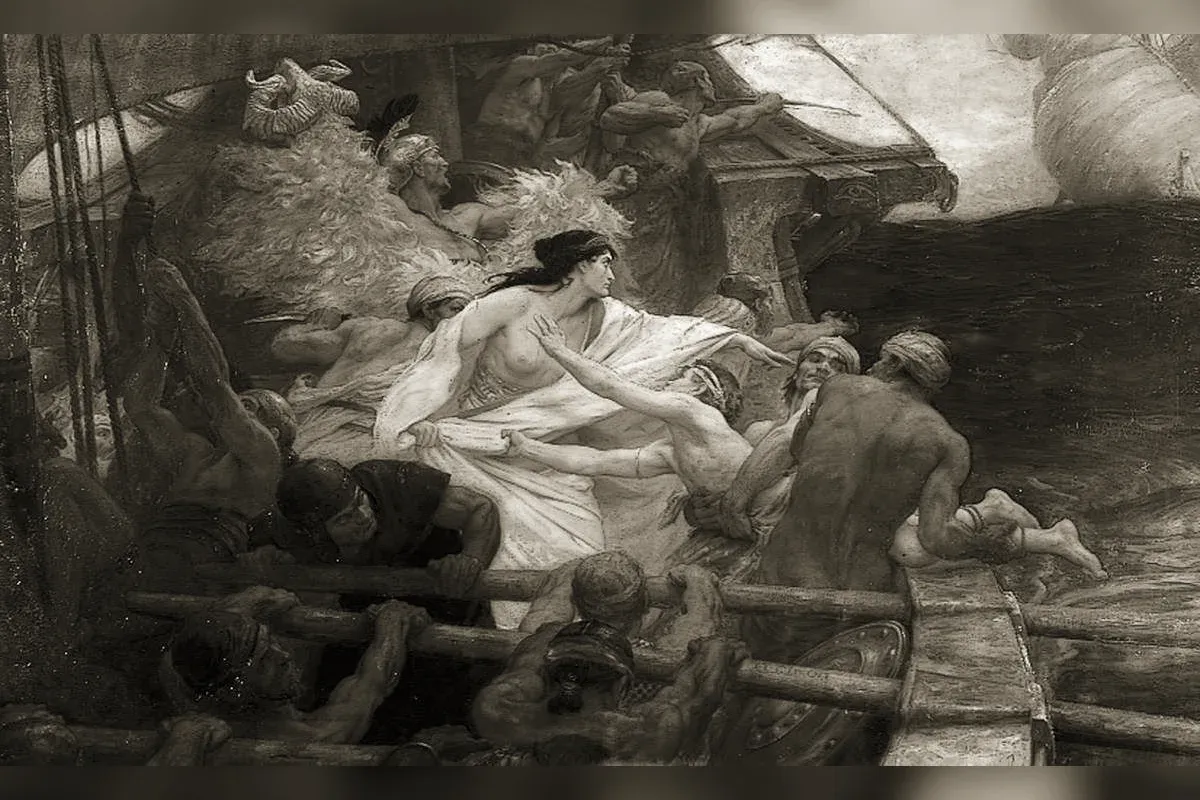
Jason is the leader of the Argonauts, the great assembly of Greek heroes who sailed to the ends of the known world to retrieve the Golden Fleece from Colchis. His story, told in greatest detail by Apollonius of Rhodes in the Argonautica and revisited by Pindar, Euripides, and Ovid, is an extraordinary arc: from a young man cheated of his birthright, to the captain of the most celebrated crew in myth, to a hero destroyed by his own abandonment of the woman who made his triumph possible.
Birth and betrayal
Jason is the son of Aeson, rightful king of Iolcos in Thessaly. Before Jason is born, Aeson’s half-brother Pelias seizes the throne and confines Aeson. To protect the infant, his mother sends him away to be raised on Mount Pelion by the centaur Chiron — the same divine teacher who raises Achilles and several other Greek heroes. Chiron educates Jason in medicine, music, and the arts of war, giving him a name that means “the healer.”
An oracle warns Pelias to beware of a man wearing one sandal. When Jason arrives in Iolcos as a young man — having lost one sandal crossing a river — Pelias recognises the danger. He cannot simply kill the young man without provoking divine wrath, so he devises a more elegant solution: he sends Jason on a quest from which no man returns. He promises the kingdom in exchange for the Golden Fleece, the sacred skin of the golden ram that had once carried the children of Athamas to Colchis and now hangs in the sacred grove of Ares, guarded by a dragon that never sleeps.
The assembly of the Argonauts
Jason does not go alone. He commissions the master shipwright Argus to build a ship — the Argo, the “swift one” — guided by a plank of prophetic wood from the oracle at Dodona cut from Zeus’s sacred oak. Then he calls across Greece for companions, and the heroes answer.
The crew of the Argo is the most celebrated ensemble in Greek mythology: Heracles, the strongest man alive; Orpheus (link: see the dedicated page on Orpheus), whose lyre calms seas and men; Castor and Pollux, the divine twin horsemen; Peleus, father of Achilles; Meleager, slayer of the Calydonian Boar; Atalanta, the swift huntress; Zetes and Calais, winged sons of Boreas. The Argonauts represent a full cross-section of the Greek heroic world, and the voyage is as much a catalogue of that world as it is a narrative of adventure.
The Argo itself is blessed: a speaking plank in her hull can prophesy, and Athena herself oversaw her construction, ensuring she is the swiftest ship ever built.
The quest for the Golden Fleece
The voyage to Colchis takes the Argonauts through dangers that test every member of the crew. At Lemnos they spend time with the island’s women, who have killed all their men. At Cyzicus they accidentally kill their own hosts in a night battle. Heracles is left behind after he goes ashore to search for his companion Hylas, seized by water-nymphs — the greatest individual hero of the tradition exits the most celebrated collective voyage before its climax, a detail that underscores how the Argonautica deliberately sidelines individual heroism in favour of collective enterprise.
The Symplegades — the Clashing Rocks that crush any ship attempting to pass — are defeated by a stratagem: a dove is released to fly between them and trigger their clash before the Argo rushes through in the gap before they reset. This is the threshold of the known world. Beyond lies Colchis.
At Colchis, King Aeetes has no intention of surrendering the Fleece. He sets Jason three impossible tasks: to yoke a pair of fire-breathing bronze bulls, to plough a field with them, to sow the field with dragon’s teeth that will spring up as armed warriors, and to defeat the warriors. Jason would fail and die on the spot — except that a god has intervened.
Medea, the sorceress-ally
Aphrodite, at the request of Athena and the other gods who favour the quest, sends her son Eros to strike Medea with his arrow. Medea is the daughter of Aeetes and the granddaughter of the Sun; she is a priestess of Hecate and one of the most powerful sorceresses in the ancient world. When Eros’s arrow finds her, she falls into a violent and consuming love for Jason.
Medea provides Jason with an ointment that renders him invulnerable to fire and iron for a single day. With it, he yokes the bulls, ploughs the field, sows the teeth — and when the warriors spring from the earth, he hurls a rock among them as Medea has instructed: they turn on one another and destroy themselves. The final obstacle is the sleepless dragon coiled around the Fleece. Medea sings it to sleep with enchanted herbs, and Jason seizes the Fleece.
She has betrayed her father, her country, and her divine obligations for him. In the flight from Colchis, she commits an act of terrible desperation: she kills her own brother Absyrtus and scatters his limbs into the sea, knowing that Aeetes will have to stop to collect them for proper burial, buying the Argo time to escape. The crime marks Medea permanently. It also binds her to Jason in a shared guilt that cannot be undone.
The betrayal and its price
The Argonauts return to Greece, where Medea uses her magic to rejuvenate Jason’s aged father Aeson, and later engineers the death of Pelias by tricking his daughters into a botched rejuvenation. But Pelias’s son Acastus drives Jason and Medea from Iolcos. They settle in Corinth, where Jason is offered the hand of Glauce, daughter of King Creon — a politically advantageous match that would install him as heir to the Corinthian throne.
Jason accepts. He sets aside Medea — his wife, the mother of his children, the woman without whose magic he would have died in Colchis — for political ambition. In the Greek heroic world, this is not merely a personal betrayal: it is the violation of xenia, guest-friendship and mutual obligation, and an affront to the gods who had sanctioned Medea’s help.
Medea’s revenge is total. She sends Glauce a gift: a beautiful robe and crown that burst into supernatural fire when worn, killing Glauce and her father Creon when he tries to save her. Then — in the version that Euripides makes definitive, though it may be his invention — she kills her own children by Jason, not from madness but from a calculated decision to deny him his legacy. She escapes on a chariot drawn by winged dragons, a final demonstration of power that underscores how entirely Jason depended on her.
A solitary end
Jason is left without kingdom, without wife, without children, without divine favour. The gods who had helped him — Hera in some versions, Athena in others — withdraw their protection when he breaks faith. He spends his remaining years at Corinth, a solitary figure beside the beached hull of the Argo, now rotting.
The tradition records his death as the least heroic in Greek mythology: he is killed by a falling timber from the Argo as he sits in its shadow. No battle, no glory, no sacrifice. The ship that was his instrument of triumph becomes his coffin — a death with the brutal symmetry of myth.
Jason in the Greek heroic tradition
Jason occupies a peculiar position in the Greek heroic canon. He is given all the ingredients of the supreme hero — noble birth, divine guidance, an impossible quest, divine allies — but he does not become great through personal virtue or strength. The Golden Fleece is won by Medea’s magic, not by Jason’s arms. His achievement is the leadership that assembles the Argonauts and holds them together long enough to complete the voyage; his failure is a moral one, a betrayal of the human bond that made the quest possible.
This distinguishes him sharply from Heracles, who earns his redemption through the brute labour of twelve impossible trials, or from Odysseus, whose cunning is consistently employed in the service of homecoming and loyalty. Jason’s cunning serves his ambition, and when ambition replaces loyalty, the myth punishes him absolutely. He stands close in the tradition to Perseus and Theseus — heroes of quest, heroes whose success relies heavily on supernatural aid — but neither Perseus nor Theseus abandons a saviour to die in their wake.
The story of the Argonauts endures because it contains everything: adventure at the world’s edge, the full assembly of Greek heroism, a love story of extraordinary violence, and a moral reckoning that the tradition refuses to soften.
Further reading
For the full narrative of the Argonauts’ voyage, read Jason and the Golden Fleece. For the legendary object at the heart of the quest, consult the page on the Golden Fleece. For Aphrodite, the goddess whose intervention causes Medea to fall in love with Jason, see her dedicated page. For the hero Orpheus who sailed with the Argonauts and whose lyre was the crew’s secret weapon against the Sirens, see the page on Orpheus. For the hero whose Twelve Labors stand in implicit contrast with Jason’s quest, read about Heracles. For the hero whose cunning intelligence Jason’s story most closely echoes but ultimately cannot match, see the page on Odysseus.
See also
Stories featuring this entity
Frequently asked questions
Who is Medea in Jason's story?
Medea is the daughter of King Aeetes of Colchis and a priestess of the goddess Hecate, gifted in sorcery. She falls in love with Jason — in some accounts through the intervention of Aphrodite and Eros — and uses her magic to help him complete the impossible tasks set by her father. She betrays her family and flees Colchis with Jason, becoming his wife. When Jason later abandons her for the Corinthian princess Glauce, her vengeance is devastating: she kills their children and escapes on a chariot drawn by dragons.
Why does Jason seek the Golden Fleece?
Jason's uncle Pelias has usurped the throne of Iolcos. When Jason appears to claim his birthright, Pelias sends him on what he intends as a death mission: to retrieve the Golden Fleece of the divine ram from Colchis, at the far end of the world. The Fleece is guarded by a sleepless dragon and represents sovereignty and divine favour. Jason accepts the quest in order to legitimise his claim to the throne.
What is Jason's tragic end?
Jason ends his life in bitter solitude. Abandoned by Medea, rejected by the princess he had chosen over her, stripped of divine favour, he is said to have died at Corinth beneath the decaying hull of the Argo — either crushed by a falling beam from his old ship or simply sitting in its shadow, consumed by grief and regret. It is the most unheroic death in the Greek tradition: no battle, no sacrifice, no glory.