Greek mythology · Heroes & mortals
Odysseus, the hero of the Odyssey in Greek mythology
Odysseus, king of Ithaca: cunning, endurance, and the ten-year journey home from Troy — Polyphemus, Circe, the Underworld, the Sirens, and the return.
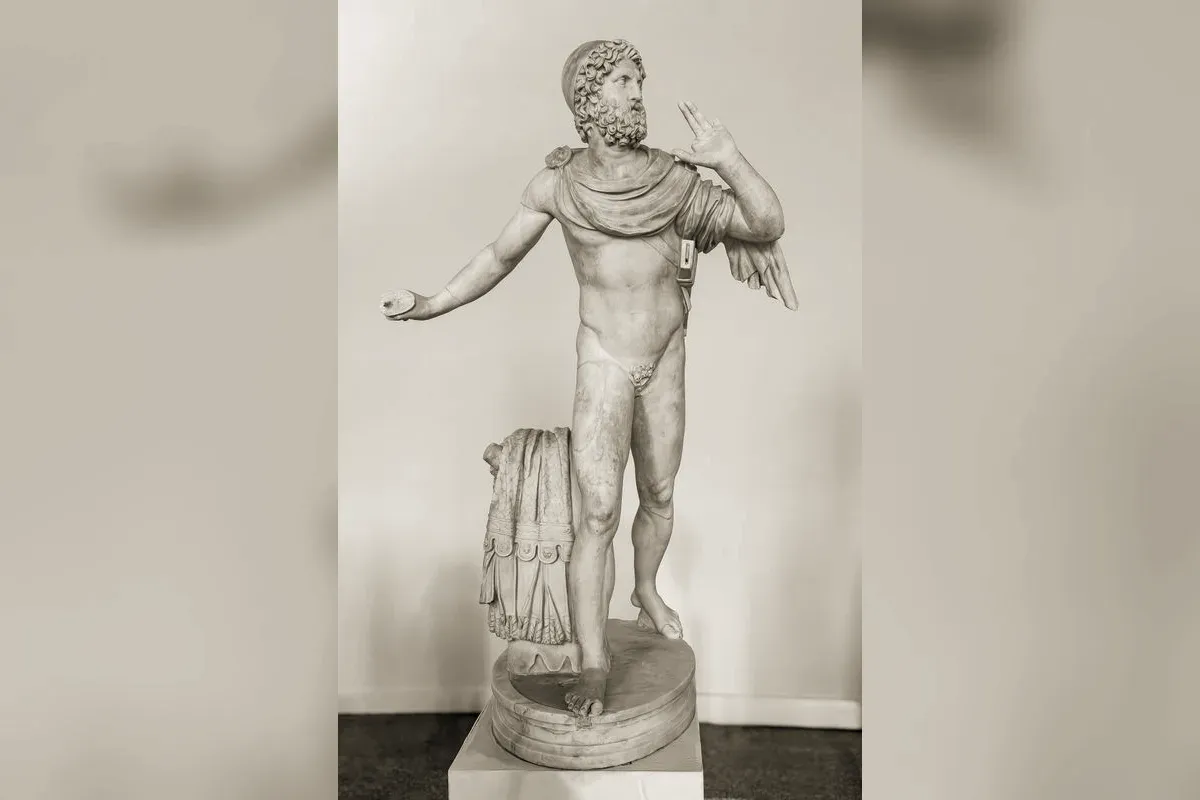
Odysseus is the great antithesis of the Greek hero as pure force. Where Achilles is defined by his wrath and his body, Odysseus is defined by his mind. His name — polytropos, the man of many turns — announces from the first line of Homer’s Odyssey that what we are about to follow is not a tale of combat but a tale of survival through intelligence. He is king of the small island of Ithaca, husband of Penelope, father of Telemachus, and the last of the Greek heroes to come home from the Trojan War — ten years after the fall of Troy, ten years of wandering across a world that refused him passage.
Portrait: the man of many turns
Odysseus belongs to a different category of hero from any before him in the Greek tradition. He is not the strongest, the fastest, or the most beautiful. He is the most cunning. His key epithet, polytropos, captures a quality that has no single English equivalent: it means simultaneously “of many twists,” “of many resources,” and “who has visited many places.” He turns situations to his advantage with a speed and fluency that other heroes cannot match.
His eloquence is another defining characteristic. In the Iliad, where he appears as a secondary figure, the other Greeks already acknowledge that no speaker alive rivals him. When he addresses the assembly, men fall silent. He can lie convincingly, construct a plausible false identity in minutes, and tell a story so complete in its fictional detail that even seasoned kings believe him.
What separates him morally from figures like Achilles is his willingness to subordinate heroic pride to the demands of survival and homecoming. Achilles refuses humiliation from Agamemnon and accepts death as the price of his dignity. Odysseus disguises himself as a beggar in his own palace and tolerates years of insult because the goal — his home, his wife, his son, his kingdom — matters more than immediate honour. This is not cowardice: it is a different and perhaps more difficult form of heroism.
Odysseus at Troy: architect of victory
The Trojan War lasts ten years partly because of Odysseus’s late involvement in its outbreak: the hero had feigned madness to avoid serving, ploughing salt into his fields. When Palamedes placed his infant son Telemachus before the plough, Odysseus swerved, revealing his sanity. He went to war.
At Troy, Odysseus serves as the Greek army’s chief strategist and diplomat. He leads the embassy to Achilles when that hero withdraws from battle. He participates in night raids and spy missions, including the famous expedition with Diomedes to capture the Trojan prophet Helenus and steal the Palladium — the sacred statue of Athena whose presence guaranteed Troy’s safety. But his supreme contribution to the Greek victory is the device that ends the war: the Wooden Horse. After ten years of siege, Odysseus conceives the stratagem that no direct assault had achieved. A giant wooden horse, hollow and packed with Greek soldiers, is left outside the gates as an apparent votive offering while the Greek fleet pretends to depart. The Trojans, persuaded by the double agent Sinon and against the warnings of Cassandra, drag the horse inside their walls. That night the soldiers emerge, open the gates, and Troy burns.
Ten years of wandering
The voyage home — the nostos — is the subject of the Odyssey and takes as long as the war itself. It is not simply a journey: it is a sustained encounter with every form of danger that the Mediterranean world — real and mythological — could produce.
The first major catastrophe comes from Odysseus’s own pride. After blinding Polyphemus, the Cyclops, Odysseus cannot resist shouting his real name as his ship pulls away. Polyphemus is the son of Poseidon, and the sea god’s curse — that Odysseus reach home late, alone, on a foreign ship, to find only suffering — shapes the entire rest of the voyage. Every storm, every delay, every loss of crew can ultimately be traced to that one act of boastful revelation.
The episodes that follow chart a world at the edges of human possibility. Circe, the enchantress who turns men to animals, is countered with the herb moly that Hermes provides — a meeting that illustrates perfectly how Odysseus survives: not by force but by the timely intervention of the right divine helper and the quick use of information. He stays with Circe for a year before she agrees to send him on his way, first requiring him to descend to the Underworld.
The descent into the Underworld — the katabasis — brings Odysseus to the edge of Tartarus to consult the shade of the blind prophet Tiresias. There he encounters the dead: the shade of Elpenor, who fell from Circe’s roof; his own mother Anticleia, whose death he learns of only now; and the shade of Achilles himself, who tells Odysseus, bitterly, that he would rather be the living slave of the poorest man than king of all the dead. It is one of the most devastating reversals in Greek literature: the hero who chose glory over life admitting, in the afterlife, that life was the better choice.
The Sirens — creatures whose singing draws sailors to wreck themselves on their island — are passed by the simplest stratagem: Odysseus orders his men to plug their ears with beeswax. He alone hears the singing, lashed to the mast, because he insists on the experience while preventing the self-destruction it would otherwise cause. This capacity for controlled exposure to danger — wanting the full experience without being consumed by it — is quintessentially Odyssean.
Charybdis (the whirlpool) and Scylla (the six-headed sea monster) must be navigated without a safe course: Odysseus steers close to Scylla and loses six men rather than risk the entire ship to Charybdis. The decision is ruthless and arithmetically rational. After losing his remaining crew when they slaughter the forbidden cattle of the sun god Helios, Odysseus washes up alone on the island of Calypso, who keeps him for seven years, offering immortality — the one thing he will not trade for his mortal home.
The return to Ithaca
Odysseus arrives in Ithaca in disguise, as an old beggar, guided ashore by Athena. In his absence, over a hundred suitors have installed themselves in his palace, consuming his wealth and pressing Penelope to choose a new husband. Penelope has delayed them with the famous ruse of Laertes’s shroud — weaving by day and unraveling by night — but the situation has become critical.
The recognition is staged in careful degrees. Odysseus reveals himself to his son Telemachus, to the swineherd Eumaeus, to his old nurse Eurycleia (who recognises him by a scar on his thigh). He endures the suitors’ insults, awaiting the moment of his choosing.
That moment arrives when Penelope announces the contest of the bow: whoever strings Odysseus’s great bow and shoots an arrow through twelve axes in a line shall have her hand. Not one suitor can bend the bow. When the beggar asks to try, the suitors laugh — and then fall silent as he strings it with one smooth motion and drives the arrow clean through all twelve axes. The slaughter of the suitors follows: Odysseus, Telemachus, Eumaeus, and the loyal cowherd Philoetius against more than a hundred men, the doors sealed, Athena watching invisibly from above.
The reunion with Penelope is the emotional heart of the return. She tests him — asking Eurycleia to move their marital bed, knowing it cannot be moved because Odysseus himself built it around a living olive tree — and he passes the test in the only way possible: by knowing the secret of the bed. It is a recognition scene built entirely on private knowledge rather than physical appearance, fitting for a hero whose chief attribute was always the mind.
Divine protections and divine wrath
The divine framework of the Odyssey rests on two opposed deities. Athena, goddess of wisdom and craft, is Odysseus’s constant protectress. The affinity between them is explicit: she tells him plainly that she loves him because he is, of all mortals, the most like her — cunning, adaptable, resourceful. She intervenes at nearly every critical juncture: disguising him, coaching Telemachus in his absence, facilitating the recognition, and personally restraining the vengeance of the suitors’ families at the poem’s close.
Against him stands Poseidon, whose son Polyphemus he blinded and whose curse pursues him across every sea. The tension between these two divine forces — one on land, one over water — structures the entire voyage and explains why a journey of weeks turns into ten years.
Hermes appears as a more neutral enabler: it is he who carries Zeus’s order to Calypso to release Odysseus, and he who provides the moly herb that neutralises Circe’s magic. He is the facilitator of movement, the god of transitions, fitting for a hero perpetually in motion between worlds.
Odysseus’s legacy
The word “odyssey” has entered every major European language as the common noun for any long and eventful journey — testimony to the depth with which the poem lodged itself in Western consciousness. Homer’s Odysseus, however, had a complicated legacy. The Greeks admired him; the Romans, perhaps influenced by the perspective of Troy’s survivors, were less sure. Virgil’s Aeneid makes Odysseus — as Ulysses — a treacherous figure, the deceiver whose stratagems brought down a city that the Romans claimed as their own founding myth.
In the Middle Ages and Renaissance, Odysseus split into two figures: the dangerous intellectual who pursues knowledge past all permitted limits (the Ulysses of Dante’s Inferno, who sails beyond the pillars of Hercules to his death) and the faithful wanderer longing for home. Joyce’s Ulysses and Kazantzakis’s Odyssey rewrote him entirely for the modern world.
What endures is the model he represents: that intelligence, adaptability, and endurance can be heroic virtues as surely as strength. Against Achilles — who chooses a glorious, short life — Odysseus chooses every available means to return to an ordinary life, because that ordinary life is his, and its recovery demands everything he has.
Further reading
For the complete narrative of Odysseus’s voyage home, read the Odyssey. For the war that sets everything in motion, read the Trojan War. For Athena, his divine protectress, see her dedicated page. For Poseidon, his divine enemy, see the page on the sea god. For Hermes, the divine helper who enables his escape from Circe and Calypso, see his page. For the hero Odysseus contrasts most sharply with, read the page on Achilles. For the enchanting creatures he was the only mortal to hear without dying, see the page on the Sirens.
See also
Stories featuring this entity
Frequently asked questions
Why does it take Odysseus ten years to return to Ithaca?
The delay is the result of accumulated divine wrath and mortal error. After blinding Polyphemus — who is the son of Poseidon — Odysseus draws the sea god's relentless anger. He also loses time through the enchantments of Circe and Calypso, survives storms sent by Zeus, and descends into the Underworld before he can finally reckon with the course home.
What is Odysseus's most famous trick?
The Wooden Horse. During the Trojan War, Odysseus devises the stratagem of building a giant hollow horse filled with Greek soldiers and presenting it as a sacred offering. The Trojans wheel it inside their walls. That night the Greeks emerge and sack Troy, ending a decade of siege.
Who helps Odysseus throughout the Odyssey?
Athena is his constant divine protectress — she appears in disguise, pleads his case before the gods, and guides him through the dangers of Ithaca on his return. Hermes helps at key moments, such as delivering to him the herb moly that counteracts Circe's magic. His own crew, his son Telemachus, and the loyal swineherd Eumaeus also play vital supporting roles.