Greek mythology · Creatures
The Sirens, deadly enchanters of Greek mythology
The Sirens of Greek mythology: half-woman half-bird, their deadly song, Odysseus's ordeal, the Argonauts' escape, and the symbol of fatal seduction in antiquity.
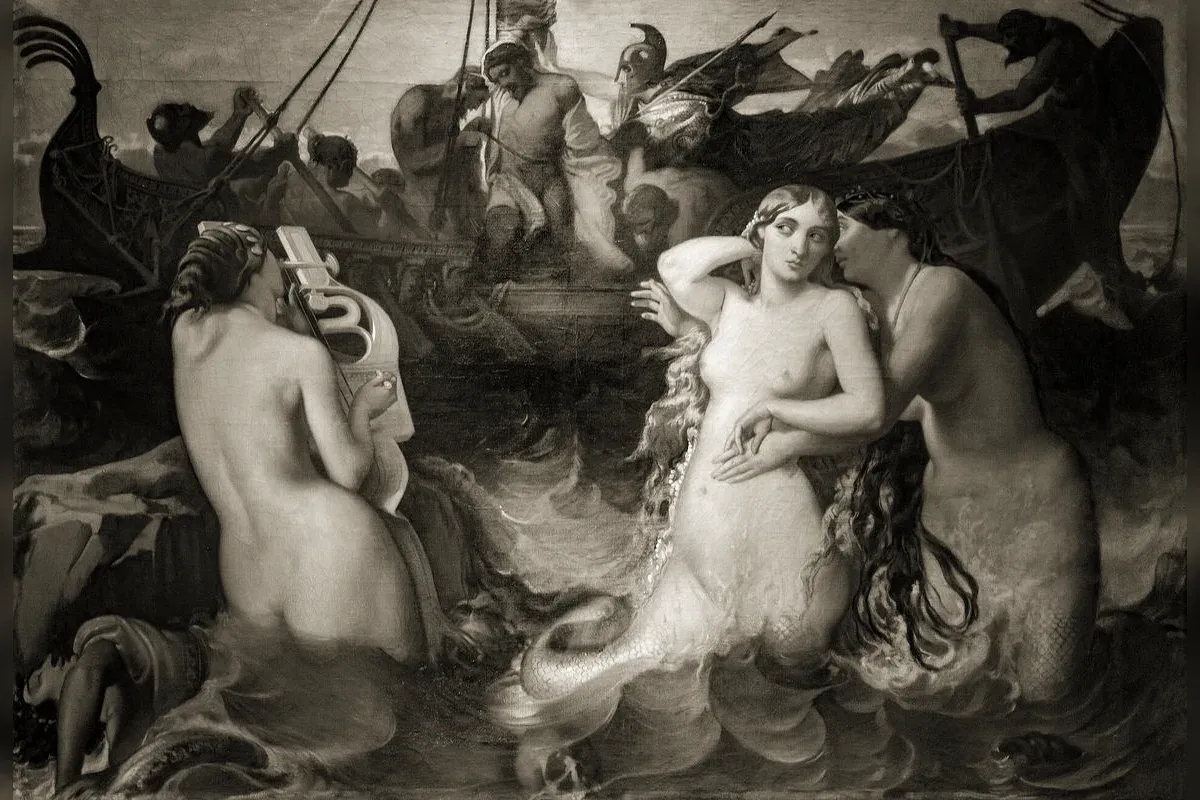
The Sirens are hybrid creatures of Greek mythology — half-woman, half-bird — whose song is so irresistible that it lures sailors to the reefs where they perish. Their most celebrated appearance is the episode in the Odyssey where Odysseus withstands their call, lashed to his ship’s mast. They embody the temptation of absolute knowledge and the fatal boundary between desire and death.
Appearance and nature
In ancient sources and Greek vase-painting, the Sirens have a bird’s body — talons, feathers, wings — and a woman’s face and voice. They perch on rocks above the sea. The half-woman half-fish image only became dominant in the Latin Middle Ages, through syncretism with other water-spirit traditions.
Their central power is song: a melody that paralyzes the will, not through magic but through the promise it carries. They tell each sailor what he most desires to hear, know, or feel. Homer presents them as omniscient: they know everything that passes on earth and the events of the Trojan War.
Genealogy and number
Ancient texts disagree on their origin. In most authors they are daughters of Phorcys or the river-god Achelous, and a Muse (often Terpsichore or Melpomene). Their number varies: two in Homer (Odyssey XII), three in other authors — the names Parthenope, Ligeia, and Leucosia appear in Hellenistic sources. Which parent an author picks changes what the Sirens are for: the Phorcys line — followed by the genealogy on this site — groups them with Echidna and Scylla as sea-born monsters, while the Achelous line makes them half-sisters to song itself and explains the voice rather than the danger.
The ordeal of Odysseus
The most celebrated episode appears in the Odyssey (Book XII). Circe had warned Odysseus of the Sirens’ danger:
- He plugged his crew’s ears with beeswax
- He had himself bound to the mast, hands tied, with orders to his men not to release him no matter what he said or did
- As they sailed past the island, he heard the song and begged to be freed — his deaf crew tightened the ropes
- Once out of range, his reason returned
This episode is unique in Homeric epic: it is the only time a hero chooses to listen to a dangerous voice while deliberately depriving himself of the ability to respond. Odysseus’s trick is not to flee but to hear without dying.
The Argonauts and Orpheus
During the quest for the Golden Fleece, the Argonauts also sailed past the Sirens’ rock. Orpheus, the divine musician, played his lyre with such power and beauty that his music drowned out the Sirens’ song. The Argonauts heard nothing. Orpheus’s response is the antithesis of Odysseus’s: no restraints, no forced resistance, but superior beauty set against mortal seduction.
According to a tradition in Apollonius of Rhodes (Argonautica IV), the Sirens threw themselves into the sea after this failure and turned to rocks — for their fate was tied to their musical invincibility.
Symbolic significance
The Sirens illustrate the Greek tension between knowledge and danger. Their promise is not merely sensual: they offer total truth, an omniscience that fascinates and destroys. Plato (Phaedrus) associates them with the Muses and with philosophical inspiration. The allegory of the Sirens passed through all of ancient and medieval culture to denote anything that seduces by turning one away from the right path.
Further reading
For the main Siren episode in Greek tradition, read the Odyssey narrative and the page on Odysseus. For the quest in which Orpheus neutralized them through music, read the Jason and the Golden Fleece narrative. For the musician who resisted the Sirens in a way opposite to Odysseus, see the page on Orpheus.
Ancient sources
- Homer, Odyssey, 12.39-54 and 165-200
- Apollonius of Rhodes, Argonautica, 4.891-919
- Apollodorus, Epitome, 7.18-19
- Ovid, Metamorphoses, 5.552-563
See also
Related entries
Frequently asked questions
Were the Sirens part woman, part bird or part fish?
In original Greek mythology, the Sirens are depicted as half-woman half-bird: a bird's body (talons, wings, feathers) with a woman's face and voice. The half-woman half-fish image is a medieval Western invention, influenced by Nordic traditions and depictions of Melusine.
Who resisted the Sirens' song?
Two Greek heroes resisted. Odysseus, warned by Circe, had himself tied to the mast and stuffed his crew's ears with beeswax: he heard the song without being able to act on it. Orpheus, during the quest for the Golden Fleece, drowned out the Sirens' song by playing his lyre even more beautifully, saving the Argonauts without needing any restraints.
What did the Sirens sing?
Homer does not reproduce the exact words in the Iliad, but in the Odyssey the Sirens promise Odysseus that they know everything that happened at Troy and across the earth. Their song is a promise of total knowledge as much as an irresistible pleasure — an intellectual seduction as much as a sensory one.