Greek mythology · Creatures
Echidna, mother of monsters in Greek mythology
Echidna, mother of monsters: half nymph and half serpent, mate of Typhon, parent of Cerberus, the Hydra, the Chimera and the Sphinx.
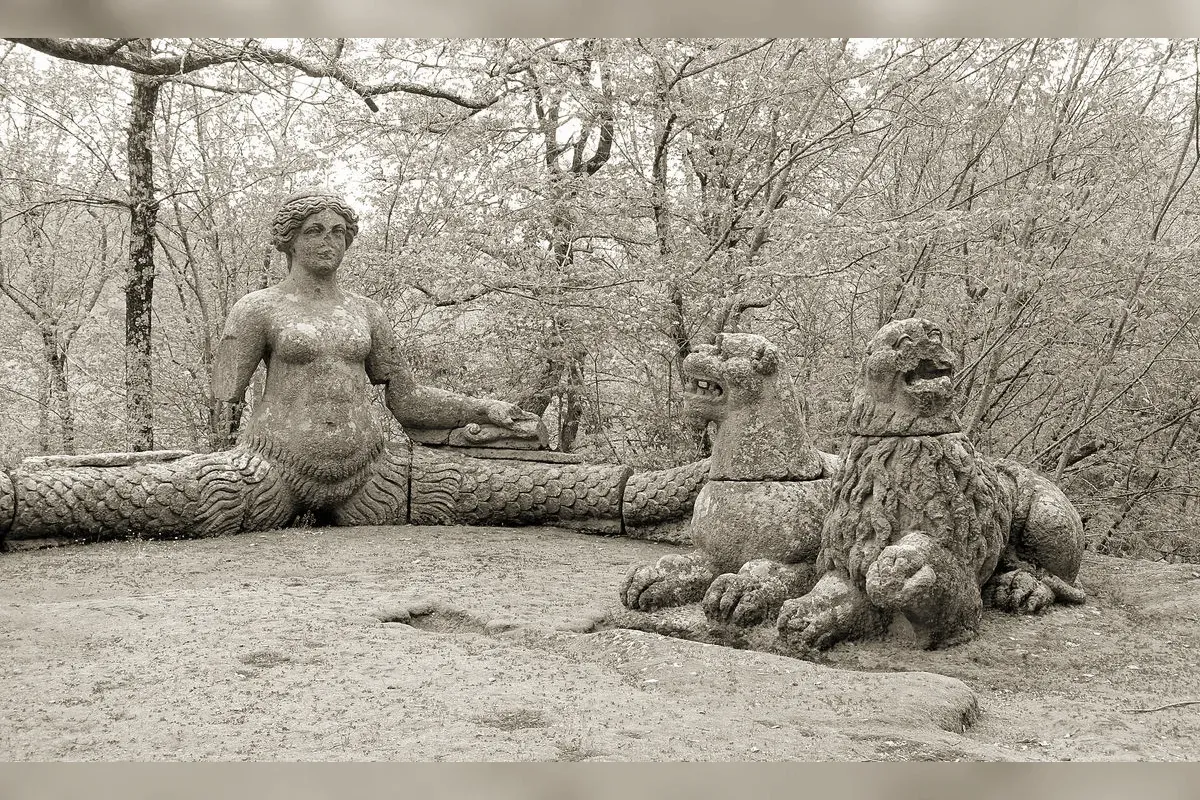
Echidna is a creature half beautiful woman and half enormous serpent, daughter of Phorcys and Ceto, mate of Typhon, and the mother of most of the monsters Greek heroes are famous for killing. Hesiod calls her a plague to men and gives her one of the strangest descriptions in the Theogony.
Half and half
Hesiod’s account is precise about the join. Above, she is a nymph with flashing eyes and fair cheeks; below, a monstrous serpent, huge and terrible, feeding on raw flesh. She is neither a woman who becomes a snake nor a snake that looks like a woman: the two halves are simultaneous and permanent.
She lives underground in a hollow cave among the Arimi, a location Homer also mentions for Typhon and which ancient geographers variously placed in Cilicia, Lydia, Syria or the volcanic fields of Campania. Nobody knew where it was, which is the point — she is filed at the edge of the map.
Hesiod also states that she is immortal and ageless, which sits awkwardly with the tradition that she was killed, and is a good example of the Theogony’s catalogue logic overriding narrative consistency.
The brood
With Typhon — the last and worst opponent Zeus faced — she produces the definitive list:
Cerberus, the fifty-headed hound of Hades. The Hydra of Lerna, reared by Hera specifically as a trial for Heracles. The Chimera, lion in front, goat in the middle, serpent behind, breathing fire. And the Sphinx, which will destroy Thebes with a riddle.
Later sources extend the list considerably — the Nemean lion, Ladon, the Colchian dragon, the Caucasian eagle, Scylla, the Crommyonian sow — until Echidna is effectively the mother of everything that has to be killed.
That expansion is worth noting as a process. Once a genealogy exists, unattached monsters get attached to it, and Echidna’s brood grows over centuries not because new stories were invented but because old ones were tidied into a family.
What her family is for
Set out the labours of Heracles, the exploits of Bellerophon, and the crisis at Thebes side by side, and the same household keeps appearing. Heroism in Greek myth is very largely a matter of working through one bloodline.
This is structurally deliberate. Typhon is the final challenge to Zeus’s order, defeated but not eliminated — buried under Etna, still producing storms. His children are the residue of that defeat, distributed across the world for a subsequent generation of mortals to finish. The gods secured the cosmos; heroes clean up what the gods left behind.
Her death
Apollodorus reports the end that Hesiod’s “immortal” would seem to forbid: Argus Panoptes, the herdsman with eyes all over his body who never slept with all of them at once, caught her sleeping and killed her.
The detail is exact and rather satisfying. The only way to kill something that never sleeps is to send something that also never sleeps — and then wait for the one time it does.
Ancient sources
- Hesiod, Theogony, 295-332
- Apollodorus, Library, 2.1.2
- Homer, Iliad (2.783) for the Arimi
- Hyginus, Fabulae, preface and 151
See also
Related entries
- Phorcys, god of sea dangers in Greek mythology
- Ceto, sea goddess and mother of the Gorgons in Greek mythology
- Cerberus, guardian of the Underworld in Greek mythology
- The Lernaean Hydra, the many-headed serpent of Greek mythology
- The Chimera, fire-breathing hybrid monster of Greek mythology
- The Sphinx of Greek Mythology: the creature with the fatal riddle
- Typhon, the monster who challenged Zeus in Greek mythology
Stories featuring this entity
Frequently asked questions
Where does Echidna live?
Underground, in a hollow cave among the Arimi — a location Homer also mentions for Typhon and that nobody in antiquity could place. Strabo runs through the candidates and rejects them one by one: Cilicia, Lydia, Mysia, Syria, or the volcanic fields of Campania. The indeterminacy is the point: she is filed at the edge of the map, in the part colonisation had not domesticated.
Is Echidna immortal?
Hesiod says she is immortal and ageless, which sits badly with the tradition that she was killed. Apollodorus reports the end: Argus Panoptes, the herdsman with eyes all over his body who never closed them all at once, caught her sleeping and killed her. The contradiction is a good illustration of the Theogony's priorities — catalogue consistency outranks narrative consistency.