Greek mythology · Creatures
The Chimera, fire-breathing hybrid monster of Greek mythology
The Chimera, Greek hybrid monster with a lion's head, goat's body, and serpent's tail: divine origin, devastation of Lycia, and death at the hands of Bellerophon riding Pegasus.
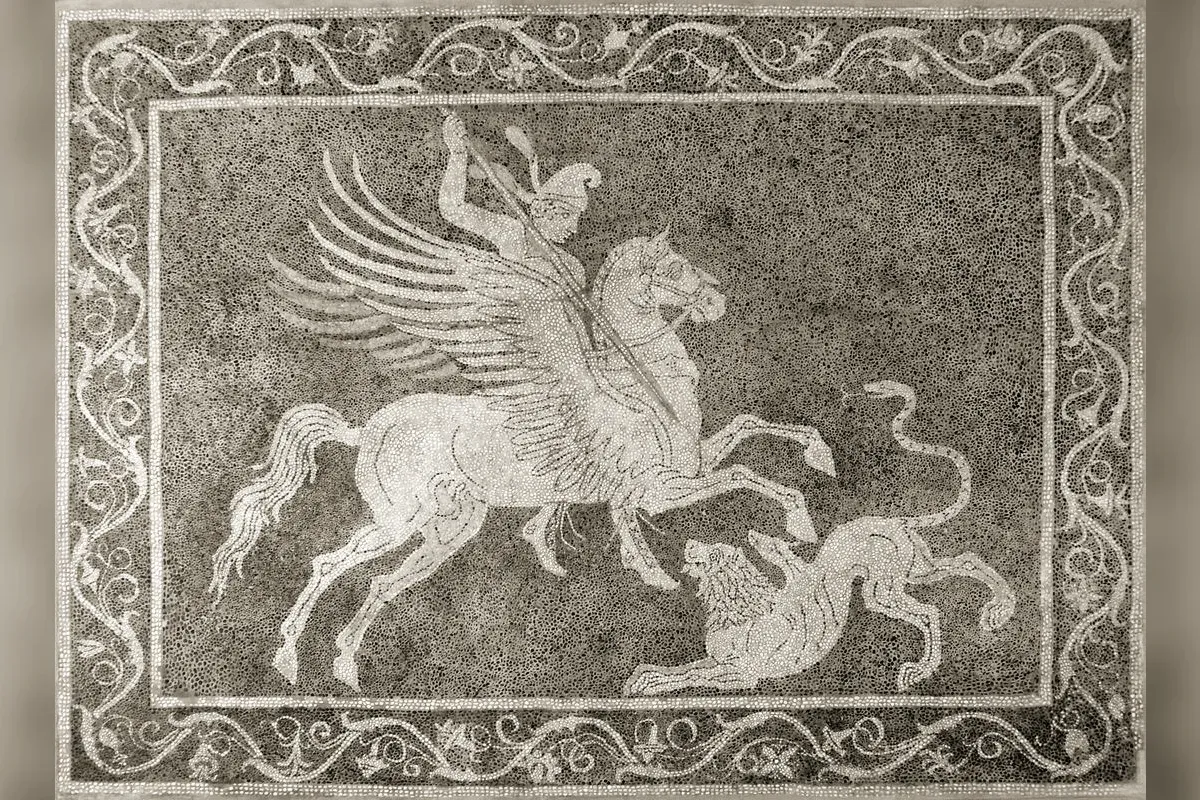
The Chimera is one of the most famous and most symbolic monsters of Greek mythology. A creature with a lion’s head, goat’s body, and serpent’s tail, capable of breathing devastating fire, she embodies monstrosity as a principle of incompatibility: she is made of parts that should not coexist within a single being. Her death at the hands of Bellerophon riding Pegasus is one of the clearest heroic narratives in Greek mythology: the victory of intelligence and elevation over brute, earthbound force.
Birth and lineage
The Chimera is born of the archetypal monstrous couple: Typhon and Echidna. Typhon is the last and most fearsome adversary of Zeus — a titanic creature with a hundred serpent heads whose voice imitates every animal. Echidna is a woman to the waist, a giant serpent below — immortal, and mother of many monsters.
From their union springs a brood of creatures that concentrates the gravest threats to divine and human order:
- Cerberus, the three-headed dog guarding the underworld
- The Lernaean Hydra, the multi-headed serpent with regenerating heads (one of the Labours of Heracles)
- The Sphinx, the winged riddler who devoured travellers outside Thebes
- The Nemean Lion, the monster with an invulnerable hide (first of Heracles’s Labours)
- The Chimera
Hesiod, in the Theogony (lines 319–325), gives the canonical description: she breathes fire, has a lion’s head, a goat’s body, and the tail of a powerful serpent. Some ancient depictions show not a serpent’s tail but a second head — a goat’s or dragon’s — rising from the middle of her back, multiplying the anatomical strangeness further.
The Chimera in Lycia: devastation and terror
The Chimera ravages Lycia, the region in south-western Anatolia (present-day Turkey). She lays waste to farmland, burns crops, destroys herds, and kills warriors who attempt to confront her. Homer’s Iliad (VI, 179–182) contains the oldest and most concise description: she is “of divine stock, not of men, lion in front, serpent behind, goat in the middle.”
Several traditions locate her habitat in areas of natural flame — in Lycia, the site of Yanartaş (“burning stone” in Turkish), above the ancient city of Olympos, has burned continuously for millennia from natural gas seeps. The ancients very likely connected these inexplicable fires to the mythical presence of the Chimera.
Death at the hands of Bellerophon
It is King Iobates of Lycia who assigns Bellerophon the task of killing the Chimera — a mission he expects to be fatal. Bellerophon, the hero of Corinth, could never accomplish it without his divine mount: Pegasus, the winged horse born from the blood of Medusa, captured with the golden bridle given by Athena.
The key to the battle is altitude. From the air, Bellerophon is out of reach of the Chimera’s flames and jaws. He attacks from the sky, raining arrows on her.
The final method varies between sources:
- In the most frequently cited version — Pindar (Olympian Odes, XIII) and later Hellenistic authors — Bellerophon fixes a lump of lead to his spear-tip and drives it into the Chimera’s flaming throat. The heat melts the metal within seconds. The molten lead pours down the Chimera’s gullet and kills her from within.
- In other versions, the shower of arrows alone suffices, Pegasus maintaining an absolute safe distance.
Whatever the exact method, Bellerophon’s victory illustrates a core idea in Greek heroic thought: a monster’s brute force can be overcome through ingenuity and elevation — both physical (flight) and intellectual (tactics).
The Chimera in art and culture
The Chimera is one of the most widely depicted mythological creatures in ancient Greek art. The Chimaera of Arezzo — an Etruscan bronze of the 5th century BCE, now in Florence’s National Archaeological Museum — is one of the most remarkable sculptures to survive antiquity. It clearly shows a lion’s head with a full mane, a goat rising from the back, and a serpent tail. This image fixed the creature’s iconography for the entire Western tradition.
The Palmyra Chimera mosaic (2nd century CE) depicts the battle between Bellerophon and the Chimera in a dynamic composition that illustrates the myth’s enduring popularity across the Roman Empire.
In heraldry, the Chimera appears as a symbol of power and danger on numerous medieval coats of arms.
The creature’s most durable legacy may be lexical: the word chimera, in English and most European languages, denotes an illusion, an unrealisable idea, an impossible project. The hybrid and contradictory creature became a metaphor for what cannot exist coherently — a dream or hope that defies reason.
In biology, the term chimera designates an organism containing cells with different genetic make-up within a single individual — a scientific usage that directly perpetuates the original mythological meaning.
Ancient sources
Homer (Iliad, VI, 179–182): first literary description. Hesiod (Theogony, 319–325): genealogy and description. Pindar (Olympian Odes, XIII, 90): Bellerophon and Pegasus’s victory. Apollodorus (Library, II, 3, 1): full account of the combat. Ovid (Metamorphoses, IX, 647): Latin evocation.
Further reading
For the hero who slays the Chimera by mastering the sky, read the page on Bellerophon. For the winged horse that makes his victory possible, see the page on Pegasus. For the goddess who provides the bridle needed to tame Pegasus, see the page on Athena. For the monstrous hound born of the same parents, discover the page on Cerberus.
See also
Related entries
Frequently asked questions
How did Bellerophon kill the Chimera?
Riding Pegasus, Bellerophon fought from the air, well out of reach of the Chimera's flames. According to the most frequently cited version, he attached a lump of lead to the tip of his spear and plunged it into the Chimera's flaming throat. The creature's own fire melted the metal, which poured down its gullet and killed it from within.
What other monsters are siblings of the Chimera?
The Chimera is the offspring of Typhon and Echidna, the archetypal monstrous couple of Greek mythology. Her siblings include Cerberus (the hound of the underworld), the Lernaean Hydra, the Nemean Lion, the Eagle of Prometheus, and the Sphinx. Together this brood concentrates the most dangerous threats in all of Greek mythology.
Why does the word 'chimera' mean an illusion?
The metaphorical use of 'chimera' — an illusion, an impossible idea, an unrealisable project — dates to antiquity itself. The Chimera is made of incompatible parts, a creature of logically contradictory nature: she represents the impossible, what cannot exist coherently. Hence the word's adoption to describe a vain hope or an imagined construction with no basis in reality.