Greek mythology · Heroes & mortals
Bellerophon, tamer of Pegasus and slayer of the Chimera
Bellerophon, Greek hero of Corinth: false accusation, capture of Pegasus, victory over the Chimera, exploits in Lycia, and the fall that punishes his hubris against the gods.
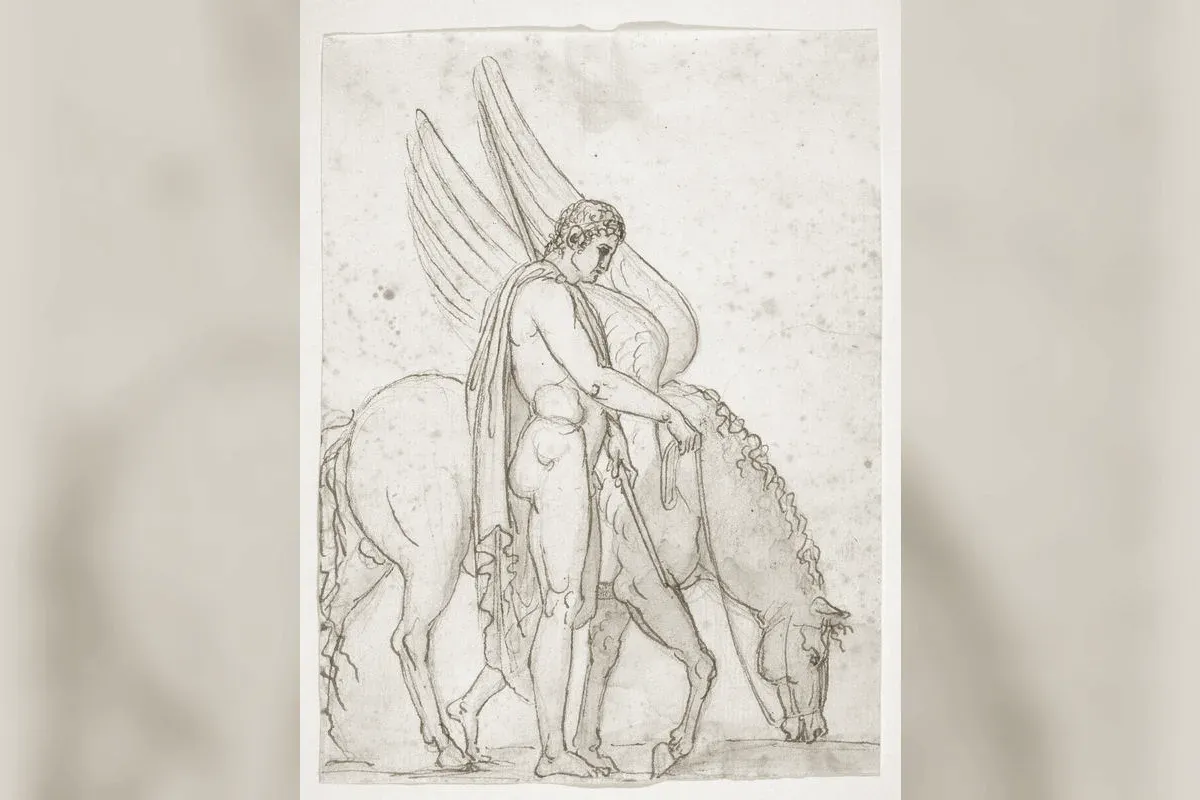
Bellerophon is one of the great heroes of Greek mythology — and one of its most tragic. His destiny illustrates with almost geometric precision the principle that governs Greek heroic ethics: the gods grant extraordinary gifts to certain mortals, and those gifts enable equally extraordinary feats. But the mortal who believes that his exploits entitle him to equal the gods triggers an irreversible fall. Bellerophon is that lesson in its purest form.
Origins and youth
Bellerophon is a prince of Corinth. His genealogy varies across sources: son of Glaucus, king of Corinth and grandson of Sisyphus, in the main tradition; son of Poseidon directly in other versions — which would explain the divine favour that allows him to tame Pegasus, born of the same god.
His birth name is said to have been Hipponous (“he who thinks of horses”). He takes the name Bellerophon after accidentally killing a man named Belleros — some authors see this as an accidental fratricide. The new name, “slayer of Belleros,” marks a break: he must go into exile to be purified of the blood he has shed.
The false accusation and the letter of death
Bellerophon travels to Tiryns, to the court of King Proetus, to be purified of his involuntary crime. Queen Anteia (sometimes called Stheneboea) falls in love with him. Bellerophon refuses her advances.
Humiliated, she accuses Bellerophon before her husband of having tried to seduce her. Proetus is in a difficult position: he cannot shed the blood of a guest he has welcomed (that would violate the sacred laws of hospitality, xenia). He devises a solution: he gives Bellerophon a sealed tablet — a message to be delivered in person to King Iobates of Lycia, his father-in-law. The message contains a secret instruction: kill the bearer.
This episode, told by Homer in the Iliad (VI, 155–195), contains one of the earliest mentions of a written document in Greek literature. The expression “Bellerophon letter” has entered several European languages to denote a missive that condemns its own carrier.
Bellerophon delivers the letter without knowing its contents. Iobates reads it, hesitates — he too is reluctant to kill a guest directly — and decides to send the hero on impossible missions, hoping he will not return.
The capture of Pegasus
Before facing his trials, Bellerophon needs a mount equal to his quest. The night before his departure, Athena appears to him in a dream (or Poseidon in other traditions) and presents him with a golden bridle — the only object capable of taming Pegasus, the winged horse born from the blood of Medusa.
Bellerophon goes to the Peirene spring in Corinth, where Pegasus comes regularly to drink. He waits, bridle in hand. When the winged horse descends, Bellerophon acts with precision and calm. Pegasus accepts the golden bridle — as if the gods themselves had willed this partnership.
Victory over the Chimera
The first trial set by Iobates is the most formidable: killing the Chimera, the hybrid monster with a lion’s head, goat’s body, and serpent’s tail, breathing fire, which has ravaged Lycia for years. No ground-based warrior has survived approaching her.
This is where Pegasus changes everything. From the air, Bellerophon is beyond the reach of the Chimera’s flames and jaws. He peppers her with arrows. According to the most widely cited version, he fixes a lump of lead to his spear-tip and drives it into the Chimera’s flaming throat: the heat melts the metal, which pours down the Chimera’s gullet and kills her from within.
The victory is total — and astonishing to Iobates.
Further exploits in Lycia
Iobates does not relent. He sends Bellerophon to face two more formidable enemies:
- The Amazons, the legendary warrior women of the Black Sea, reputed to be invincible in battle.
- The Solymi, a bellicose mountain people living in Lycia’s interior.
Bellerophon overcomes both, always from the air, exploiting the absolute advantage Pegasus gives him. Iobates, recognising that this man is clearly under divine protection, makes one last attempt to eliminate him by sending his best Lycian warriors to ambush him. Bellerophon kills them all.
Faced with such overwhelming evidence of divine favour, Iobates yields. He reveals to Bellerophon the content of the original letter, offers him the hand of his daughter Philonoe (or Cassandra in some traditions), grants him half his kingdom, and acknowledges him as an extraordinary hero.
Hubris and the fall
It is at the peak of his glory that Bellerophon tips into ruin. Covered in victories, surrounded by wealth and honour, he commits the fault the Greeks call hubris: the pride that drives a mortal to seek equality with the gods.
Bellerophon mounts Pegasus and steers toward the summit of Olympus. He wants to join the gods, to sit among them.
Zeus watches from on high. He sends a gadfly — a tiny insect, the derisory instrument of divine justice — that stings Pegasus. The horse rears violently. Bellerophon loses his grip and falls.
The fall does not kill him — perhaps because the gods judge that a quick death would be too kind. According to various sources, he then wanders alone in the plains of Aleion (“the plain of wandering”), blind or lame, shunning all human contact, “consuming his own soul” as Homer says, until an obscure and solitary death.
Pegasus, for his part, continues upward to Olympus — where Zeus welcomes him and entrusts him with carrying the thunderbolt.
Reading the myth
The myth of Bellerophon is a parable of hubris in its purest form. Its structure is rigorous:
- Initial injustice suffered → hero’s moral legitimacy established
- Divine gift → exploit legitimised by divine favour
- Repeated success → pride that forgets the divine source of the gift
- Transgression → immediate and irrevocable punishment
This pattern recurs in many Greek myths — Icarus with his wax wings, Phaethon with the sun’s chariot — but Bellerophon embodies it with particular clarity because his transgression is explicitly voluntary and conscious: he knows what he is doing, and does it anyway.
Pindar (Isthmian Odes, VII) sees in Bellerophon’s fall not a condemnation but a warning: even the greatest of heroes cannot cross the boundary between the human and the divine. Recognising that boundary is the supreme virtue.
Ancient sources
Homer (Iliad, VI, 155–211): the oldest account, placed in the mouth of Bellerophon’s descendant Glaucus during an encounter with Diomedes. Hesiod (Theogony): genealogy. Pindar (Olympian Odes, XIII; Isthmian Odes, VII): celebration of the exploits and meditation on the fall. Apollodorus (Library, II, 3): complete narrative. Horace (Odes, IV, 11): evocation of the fall.
Further reading
For the winged horse that makes his victories possible, read the page on Pegasus. For the hybrid monster he crushes from the air, see the page on the Chimera. For the goddess who provides the golden bridle and guides his mission, consult the page on Athena. For the master of Olympus who punishes him with a gadfly, read the page on Zeus.
See also
Related entries
Frequently asked questions
Why is Bellerophon sent to Lycia?
Queen Anteia (or Stheneboea in other sources), wife of King Proetus at Tiryns, falls in love with Bellerophon. He refuses her advances. She then accuses him before her husband of having tried to seduce her. Proetus, unwilling to shed a guest's blood himself, sends Bellerophon to Lycia with a sealed letter to King Iobates — secretly requesting that the bearer be killed. This is the first known example of a 'Bellerophon letter', a phrase still used to mean a message that condemns its own carrier.
How does Bellerophon capture Pegasus?
According to the main version, Bellerophon receives in a dream a visit from Athena (or Poseidon in some traditions), who offers him a golden bridle — the only object capable of taming Pegasus. He goes to the Peirene spring in Corinth and waits for the winged horse to come and drink. With patience and divine favour, he slips the bridle over Pegasus's muzzle, and the horse consents.
How does Bellerophon end his life?
After his exploits, Bellerophon commits the supreme act of hubris: he mounts Pegasus and attempts to reach Olympus to join the gods. Zeus sends a gadfly that stings Pegasus. The horse rears, Bellerophon falls. He survives but wanders blind (in some versions) or lame, alone, cursed by gods and men, until his miserable and obscure death — an exemplary punishment for overweening pride.