Egyptian mythology · Gods & goddesses
Nut, sky goddess who gives birth to the sun in Egyptian myth
Nut, Egyptian goddess of the sky: sister and wife of Geb, mother of Osiris, Isis, Seth and Nephthys. She swallows the sun each evening and gives it back to the world at dawn.
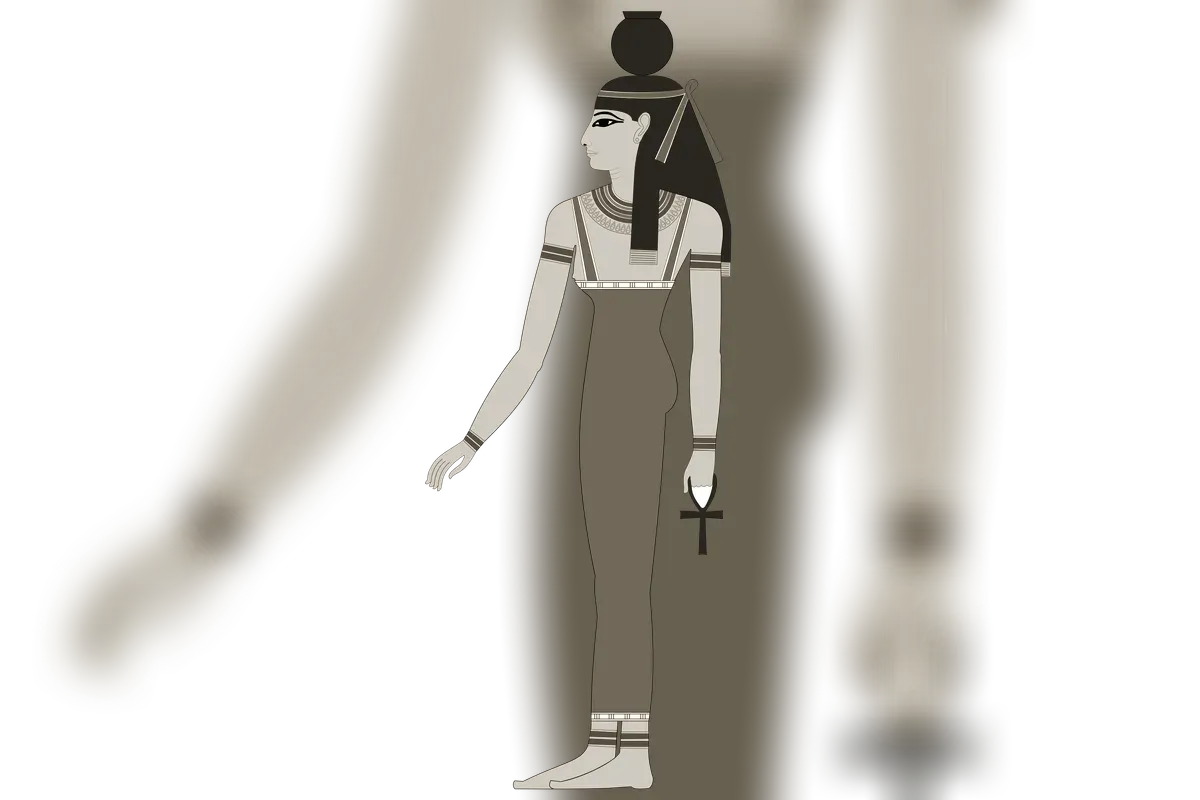
Who is Nut?
Nut is the Egyptian goddess of the sky. Daughter of Shu, the air, and Tefnut, the moisture, she forms with her brother Geb, the earth, the great cosmic couple of the Great Ennead of Heliopolis. Egypt imagines the sky not as an inert ceiling but as the body of an immense woman, arched above the world, her hands and feet touching the horizon, her skin covered with stars. Nut is this living vault: she covers the earth, separates the ordered cosmos from the waters of chaos, and governs the great cycle of day and night. Goddess of the birth of the stars, she is also, by extension, the goddess of the rebirth of the dead.
Role, nature and domains
Nut’s domain is the firmament in all its depth: the blue daytime vault, the starry night sky, and the path followed by the sun, the moon and the planets. Her most characteristic image shows her arched above Geb, held aloft by Shu: the earth below, the sky in an arc, the air between. This cosmological scene, everywhere on tomb ceilings and the interiors of coffins, expresses the very order of the world.
Nut has a double nature, maternal and devouring. She is called ‘the Great One who bears the gods’, but also ‘the Sow that eats her piglets’: for each evening she swallows the stars she brought forth in the morning. This ambivalence is not a contradiction — it expresses the cyclical rhythm of the sky, where all that is born is taken back to be reborn.
Genealogy and place in the Ennead
Nut is born, with Geb, of the union of Shu and Tefnut, themselves issued from the creator Atum. Wife of her brother Geb, she brings forth the four — sometimes five — deities who carry the great Egyptian drama: Osiris, Isis, Seth and Nephthys. Nut is thus the mother of the divine generation that, with Osiris and Horus, will found the kingship and the funerary theology of Egypt.
The myth of the five days won from the moon
One of the most ingenious tales in Egyptian mythology explains how Nut was able to give birth. In the Greek account preserved by Plutarch, Ra forbids Nut to give birth during a month or year. Thoth then plays a game with the Moon and wins part of its light, from which he forms five new days outside the twelve thirty-day months. This late version thereby explains the change from 360 to 365 days.
During these five epagomenal days, Nut bears her children, one per day: Osiris, Horus the Elder, Seth, Isis and Nephthys. This myth, reported by Plutarch, has a very real bearing: it explains the origin of the five days added to the Egyptian calendar of twelve months of thirty days to complete the solar year of 365 days. The mythological trick thus grounds an astronomical and administrative reality.
Nut, the sun and the rebirth of the dead
The daily cycle of the sun is played out in the body of Nut. Each evening the goddess swallows Ra in the west; the sun travels through her body during the twelve hours of the night — an underground journey that overlaps the crossing of the Duat — and then is reborn from between her thighs at dawn, in the east. This course makes Nut the matrix of solar rebirth, and by analogy that of every deceased.
Hence her major funerary role. Painted on the inside of coffin lids, Nut envelops the dead in her starry body as she envelops the sun: the deceased, lying in the coffin, is promised the same rebirth as Ra. The texts invoke her as a protective mother: ‘O my mother Nut, spread yourself over me, place me among the imperishable stars, that I may not die.’ Nut is thus the celestial guarantee of life after death.
What the ancient sources say
Nut is one of the most constantly attested deities, from the Pyramid Texts — where she receives the dead king among the stars — to the astronomical ceilings of the royal tombs of the New Kingdom, such as that of Seti I, which depict her body traversed by the solar barques. The Coffin Texts and the Book of the Dead multiply the formulas in which she protects and revives the dead. The myth of the five days reaches us chiefly through Plutarch (On Isis and Osiris), who gives its full narrative version. Across these sources, Nut remains what she was throughout Egyptian history: the maternal sky that, each night, swallows the light the better to give it back.
Further reading
For the earth of which Nut is the inseparable wife, read the page on Geb. For her parents, air and moisture, see Shu and Tefnut. For the sun she swallows and bears each day, consult Ra. For the god who wins the five days of her births, read Thoth. For her children and the drama they carry, see Osiris and Isis.
See also
Related entries
- Shu, Egyptian god of air who separates sky from earth
- Tefnut, Egyptian goddess of moisture and dew in mythology
- Osiris, god of the dead and resurrection in ancient Egypt
- Isis, goddess of magic and protection in ancient Egypt
- Seth, god of chaos and the desert in Egyptian mythology
- Nephthys, Egyptian funerary goddess and mourner of Osiris
- Geb, Egyptian god of the earth and heir to the throne
Frequently asked questions
Who is Nut in Egyptian mythology?
Nut is the Egyptian goddess of the sky, daughter of Shu (air) and Tefnut (moisture). Sister and wife of Geb, the earth, she is the mother of Osiris, Isis, Seth and Nephthys. She is depicted arched above Geb, her body covered with stars.
Why is Nut said to swallow the sun?
Each evening Nut swallows the sun (Ra), which travels through her body during the night, before she gives it back to the world at dawn. This daily cycle makes the sky goddess the matrix of solar rebirth and the model for every resurrection.
What are Nut's five epagomenal days?
In the story preserved by Plutarch, Ra forbids Nut to give birth during the months of the year; Thoth wins part of the moon’s light at a game and makes five additional days from it. On them she bears Osiris, Horus the Elder, Seth, Isis and Nephthys: these are the five epagomenal days of the Egyptian calendar.