Egyptian mythology · Gods & goddesses
Geb, Egyptian god of the earth and heir to the throne
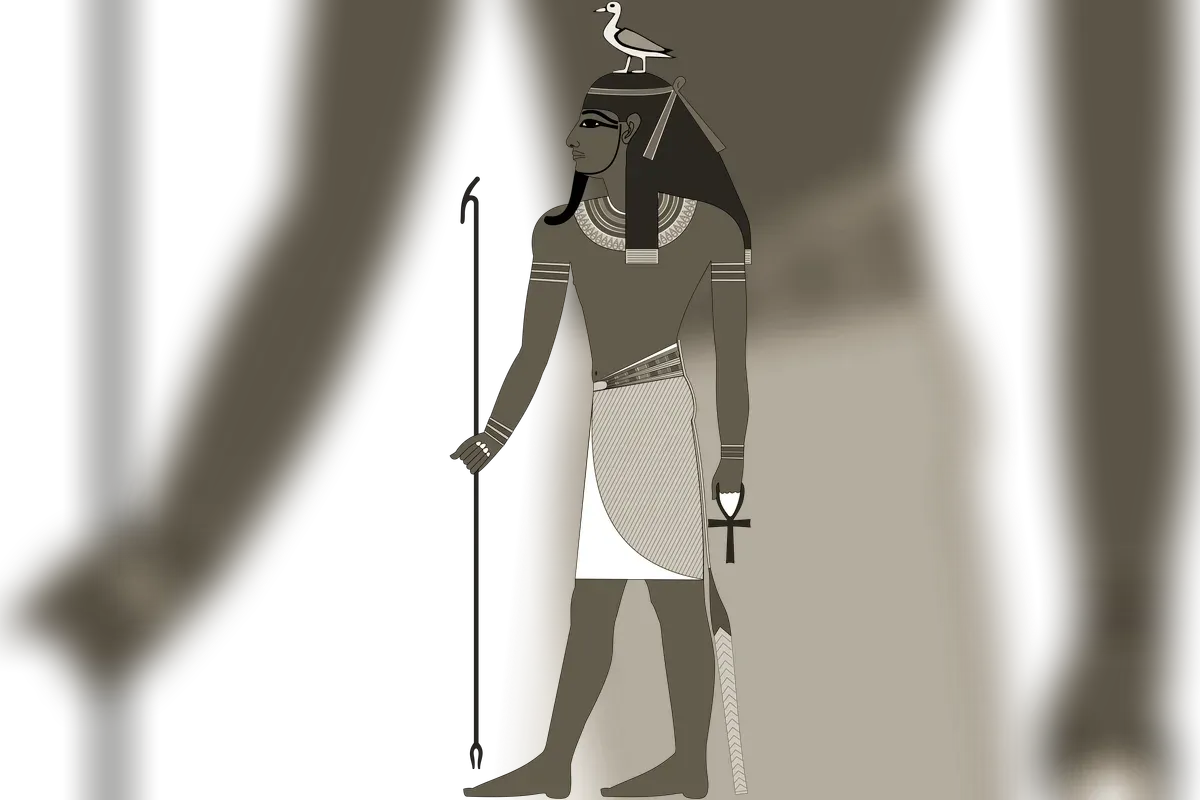
Geb, Egyptian god of the earth: son of Shu and Tefnut, husband of Nut, father of Osiris, Isis, Seth and Nephthys. The prince of gods from whom the pharaohs' throne derives.
Who is Geb?
Geb is the Egyptian god of the earth. Son of Shu, the air, and Tefnut, the moisture, he belongs to the third generation of the Great Ennead of Heliopolis. Where most cultures make the earth a feminine deity and the sky a masculine figure, Egypt reverses the scheme: Geb is the masculine soil and his sister-wife Nut is the feminine sky that arches above him. This singularity makes Geb a key figure for understanding the Egyptian conception of the world: the earth is not a passive matrix but a living, sovereign god whose body is the foundation of all existence.
Role, nature and domains
Geb is the soil in all its dimensions. He is the nourishing earth from which plants grow — which often earns him a green skin, that of vegetation — but also the mineral earth, the rock and the buried metals. He is likewise the funerary ground: it is in Geb’s body that the dead rest, and the texts say the earth ‘opens’ to receive them. In this respect Geb has an ambivalent face: bearer of the living, he can also hold the dead prisoner, and some funerary formulas seek to prevent ‘the jaws of Geb’ from closing on the deceased.
He is readily associated with the goose, his emblematic animal, sometimes perched on his head: Geb is the ‘Great Cackler’ whose primordial egg, in some traditions, contains the sun. Earthquakes and tremors are interpreted as the laughter of Geb.
Genealogy and place in the Ennead
Geb is born of the union of Shu and Tefnut, the first couple to issue from the creator Atum. With his sister Nut, he forms the second divine couple, that of earth and sky. From their tight embrace are born the four great deities of the Egyptian drama: Osiris, Isis, Seth and Nephthys — to whom some traditions add Horus the Elder. Geb is therefore the father of the actors of the Osirian cycle, the point where the abstract cosmogony gives way to the dramatic history of the gods.
Separated from Nut, united forever
The most visual myth in which Geb appears is that of his separation from Nut. In the beginning, earth and sky are so tightly entwined that no space distinguishes them. At the command of Ra — sometimes out of jealousy, sometimes to open up the world — Shu comes between them and lifts Nut high above Geb. The earth remains stretched below, its body sometimes arched with longing, while the sky stretches out as a starry vault beyond reach. Egyptian art fixed this scene in an unforgettable image: Geb reclining, Nut arched above, Shu standing between them. The separation is painful but fertile: it is what creates the habitable space and allows the birth of the stars and the gods.
Geb as king and judge of the gods
Beyond his cosmic nature, Geb plays a political role in Egyptian mythology. He is the third divine king to reign on earth, after Ra-Atum and Shu: the ‘throne of Geb’ is an expression that designates legitimate kingship itself. By passing this throne to Osiris, and then, after the murder, by presiding over the divine tribunal that pits Horus against Seth, Geb becomes the guarantor of dynastic succession. Every pharaoh presents himself as the earthly heir of Geb, anchoring the Egyptian monarchy in the very genealogy of the gods.
What the ancient sources say
Geb is attested from the Pyramid Texts, which name him ‘Prince of the Gods’ and evoke his role in receiving the dead king into the earth. The Coffin Texts and the Book of the Dead develop his funerary face and the formulas meant to appease him. The myth of the separation from Nut is richly illustrated on New Kingdom mythological papyri and on coffins, where the trio Geb-Shu-Nut is a recurring motif. Finally, the tales of the Contendings of Horus and Seth, notably Papyrus Chester Beatty I, cast Geb as judge of the succession. These sources depict a god at once elemental and institutional: the earth as the foundation of the world and of the royal order.
Further reading
For the sky of which Geb is the inseparable husband, read the page on Nut. For his parents, air and moisture, see Shu and Tefnut. For his children, at the heart of the great Egyptian drama, consult Osiris, Isis and Seth. For the heir whose legitimacy Geb arbitrates, read the page on Horus.
See also
Related entries
- Shu, Egyptian god of air who separates sky from earth
- Tefnut, Egyptian goddess of moisture and dew in mythology
- Osiris, god of the dead and resurrection in ancient Egypt
- Isis, goddess of magic and protection in ancient Egypt
- Seth, god of chaos and the desert in Egyptian mythology
- Nephthys, Egyptian funerary goddess and mourner of Osiris
- Nut, sky goddess who gives birth to the sun in Egyptian myth
Frequently asked questions
Who is Geb in Egyptian mythology?
Geb is the Egyptian god of the earth, son of Shu (air) and Tefnut (moisture). Husband of his sister Nut, the sky, he is the father of Osiris, Isis, Seth and Nephthys. As the personification of the soil, he bears the living and shelters the dead.
Why is Geb depicted lying down?
In Egyptian iconography Geb is shown stretched on the ground, often with his body arched or half-raised, while Nut, the sky, arches above him. This cosmic image shows the earth separated from the sky by Shu, the air, who holds the two lovers apart.
How is Geb linked to the kingship of the pharaohs?
Geb is the first god to reign on earth after Shu: the 'throne of Geb' is spoken of. By passing kingship to Osiris and then to Horus, he founds the dynastic legitimacy that every pharaoh claims as Geb's earthly heir.