Egyptian mythology · Gods & goddesses
Tefnut, Egyptian goddess of moisture and dew in mythology
Tefnut, Egyptian goddess of moisture: daughter of Atum, sister and wife of Shu, mother of Geb and Nut. Eye of Ra and rebellious lioness of the Distant Goddess myth.
Who is Tefnut?
Tefnut is the Egyptian goddess of moisture, dew and atmospheric water. With her brother and husband Shu, the air, she forms the very first couple to issue from the creator Atum: where Shu is the dry, luminous air, Tefnut is the humid element that completes him. Together they make up the atmosphere in its totality, the first polarity of matter after the surging forth of the demiurge. Yet Tefnut is not merely a cosmic abstraction: her leonine nature and her identification with the Eye of Ra also make her a fearsome goddess, capable of wrath and flight, whose appeasement conditions the fertility of the world.
Role, nature and domains
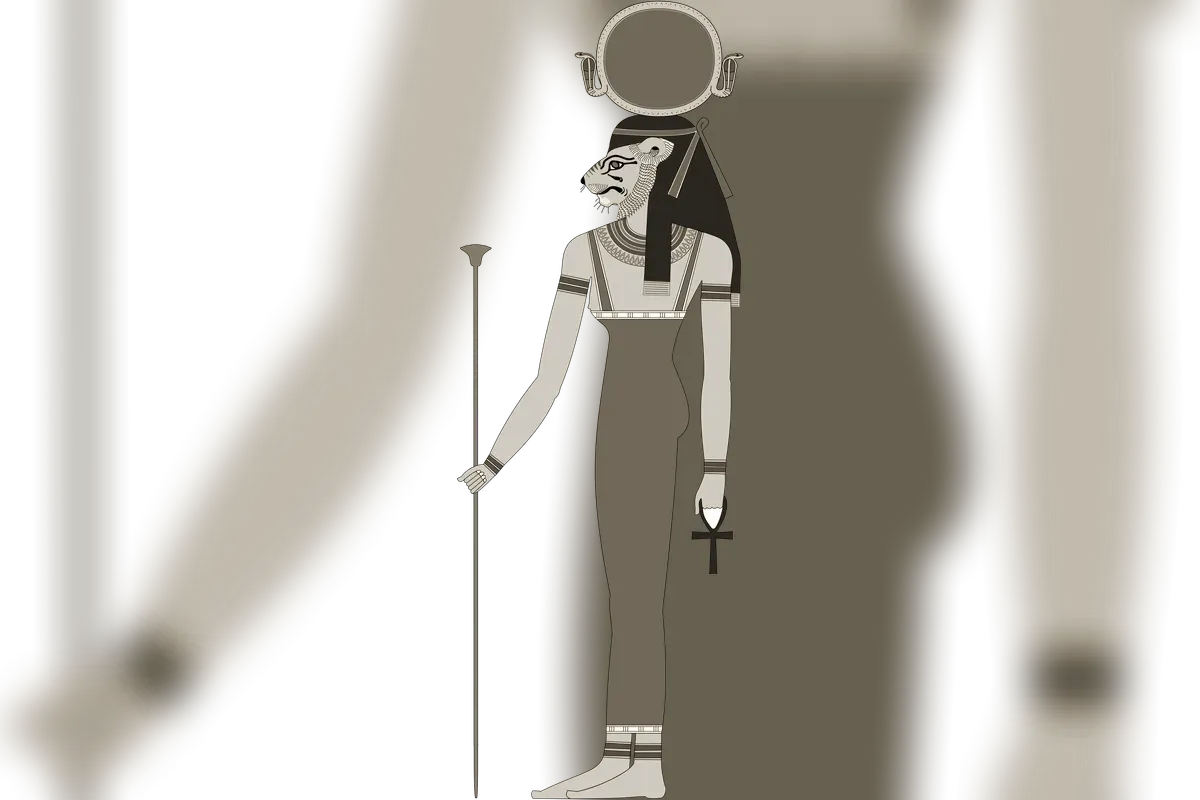
Tefnut personifies the water of the air: the morning dew, the mist, Egypt’s rare rain, the moisture that makes life possible in a land of drought. Her complementarity with Shu shapes Egyptian thought about the atmosphere as a balance between the dry and the humid. This discreet function nonetheless conceals a formidable power: Tefnut is frequently shown with a lioness head, crowned with the solar disc and the uraeus, in a posture that brings her close to the dangerous goddesses such as Sekhmet and Hathor.
This leonine character links her to the theme of the Eye of Ra, that feminine, burning hypostasis of the solar god, at once protective and destructive. Tefnut then embodies the solar heat that can nourish or devastate, depending on whether she is soothed or enraged.
Genealogy and place in the Ennead
Daughter of Atum, begotten without a mother in the first instant of creation, Tefnut belongs to the second generation of the Great Ennead of Heliopolis. The Pyramid Texts describe her birth at the same time as Shu’s, both produced by the creator’s breath or seed. Wife of Shu, she begets with him Geb, the earth, and Nut, the sky — from whom in turn will be born Osiris, Isis, Seth and Nephthys. Tefnut is thus the ancestress of all the great figures of the Osirian drama.
The myth of the Distant Goddess
The richest tale attached to Tefnut is that of the Distant Goddess. Angry with Ra — or simply weary of Egypt — Tefnut leaves the land for Nubia, in the south, where she roams in the form of a wild, bloodthirsty lioness. Her departure is a cosmic catastrophe: deprived of the moisture she embodies, Egypt dries up, and the Eye of Ra, its protective power, is missing from the sun itself.
Ra then sends Thoth, the god of wisdom, often accompanied by Shu, to find her and bring her home. Thoth does not fight her: he soothes her with words, telling her fables and parables that soften her fury, until the lioness is transformed into a benevolent goddess. Her return to Egypt, celebrated as a festival, restores to the land its moisture, its vegetation and its life. This myth, known chiefly from late Greco-Roman versions, articulates a profound insight: solar power becomes fertile only when tamed, and divine wrath is overcome not by force but by wisdom and gentleness.
Cult and syncretisms
Tefnut is worshipped from the Old Kingdom within the Heliopolitan cult, where the couple Shu-Tefnut holds a cardinal place. At Leontopolis, in the delta, she is honoured in her leonine form beside Shu. Her assimilation to the Eye of Ra brings her into a vast network of lioness goddesses — Sekhmet, Bastet, Hathor, Mut — all expressions of the same feminine solar energy, by turns destructive and appeased. This theological flexibility explains Tefnut’s relative discretion as an autonomous figure: her power is diffused throughout the whole pantheon of dangerous goddesses.
What the ancient sources say
Tefnut appears from the Pyramid Texts, which name her among the first gods born of Atum. The Coffin Texts develop her atmospheric role beside Shu. The myth of the Distant Goddess is transmitted chiefly by late documents, including the Leiden Papyrus I 384 (the ‘Myth of the Sun’s Eye’, in Demotic) and the scenes of the Ptolemaic temples of Philae and Kom Ombo. This late diffusion should not mislead: the theme of the solar goddess who flees and is recalled is far older and underpins an essential part of Egyptian theology.
Further reading
For the dry air of which Tefnut is the humid counterpart, read the page on Shu. For the creator who begets them both, see Atum. For the couple’s children, earth and sky, consult Geb and Nut. For the other faces of the Eye of Ra and the lioness goddess, read Sekhmet and Hathor; for the sage who soothes her, the page on Thoth.
See also
Frequently asked questions
Who is Tefnut in Egyptian mythology?
Tefnut is the Egyptian goddess of moisture, dew and atmospheric water. Daughter of Atum, sister and wife of Shu the air, she begets Geb (earth) and Nut (sky). Often lioness-headed, she is also one of the faces of the Eye of Ra.
Why is Tefnut called the Distant Goddess?
A myth tells how, in anger, Tefnut leaves Egypt for Nubia in the form of a wild lioness. Her flight strips the land of its fertility. Thoth, sent by Ra, soothes her with stories and brings her back: her return restores moisture and life to the world.
What is Tefnut's role in creation?
Tefnut forms with Shu the very first couple of creation, both born of Atum without a mother. She embodies moisture, he the dry air: together they make up the atmosphere and beget the next generation, Geb and Nut, earth and sky.