Egyptian mythology · Gods & goddesses
Osiris, god of the dead and resurrection in ancient Egypt
Osiris, Egyptian god of the dead: Seth's murder, Isis's reassembly of his body, resurrection as the first mummy, and judging souls in the Hall of Two Truths.
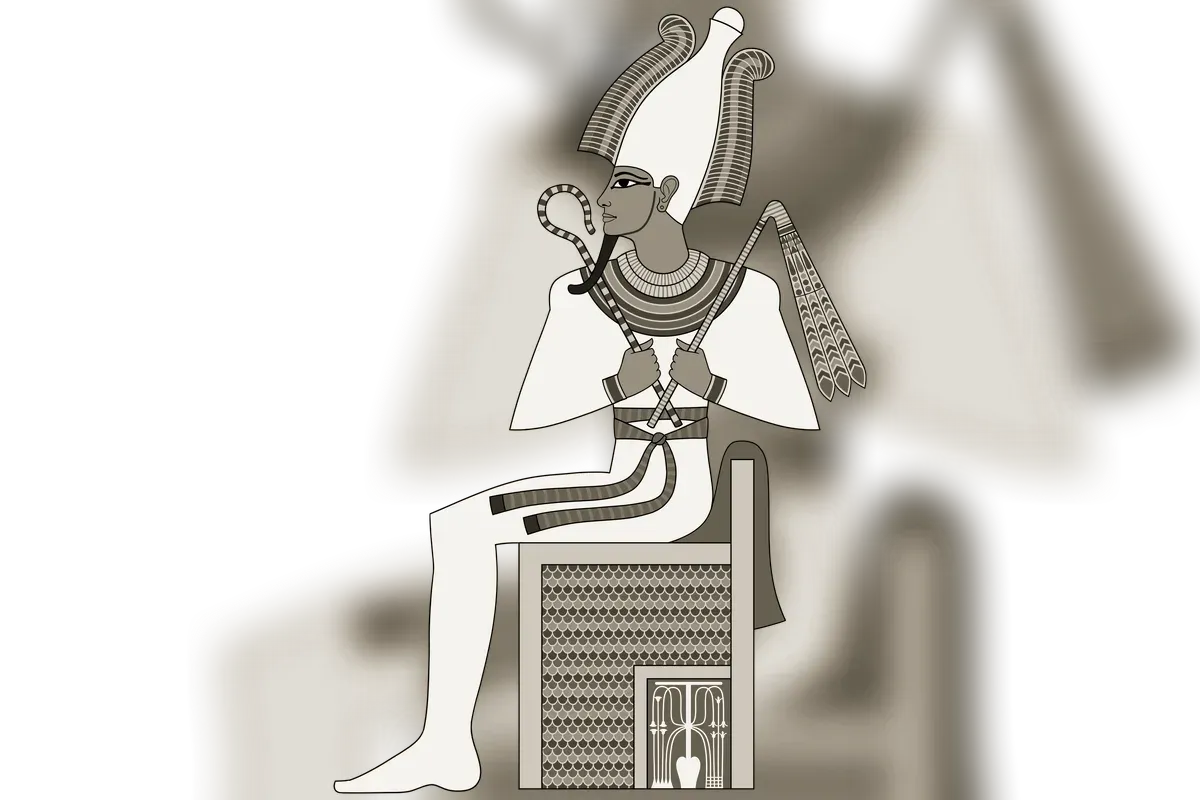
Who is Osiris?
Osiris is one of the most important deities in ancient Egypt and the central figure in all of Egyptian funerary theology. God of the dead, resurrection, vegetative renewal, and the judgment of souls, he embodies the Egyptian conviction that death is not an ending but a transformation toward a better existence. His myth — murder, dismemberment, reconstitution, resurrection — is the densest and most influential narrative in the entire Nilotic tradition.
Role, nature, and domains
Osiris is simultaneously king of the dead and the first resurrected mortal. Before his own death, texts describe him as Egypt’s first legendary pharaoh, who taught humanity agriculture, viticulture, and the law. His violent death followed by resurrection makes him the model for every deceased person hoping for an afterlife: “to become Osiris” is the ultimate goal of Egyptian funerary preparation.
His green skin symbolises vegetation and perpetual renewal — for Osiris is also a fertility deity, associated with the Nile floods that deposit life-giving silt on the riverbanks. His black skin evokes that same silt. Both colours coexist in the iconography depending on regional tradition and period.
Genealogy
Osiris is the son of Geb (god of the earth) and Nut (goddess of the sky). He is the elder brother of Seth, Nephthys, and his own wife Isis. Their union produces Horus, conceived miraculously after Osiris’s death — accounts vary: Isis takes the form of a kite to receive the vital breath from her mummified husband. This posthumous conception makes Horus a child of uniquely pure divine origin, charged with the right to avenge his father.
The myth of death and resurrection
The fullest version of the Osirian narrative is transmitted by Plutarch (De Iside et Osiride, 1st–2nd century CE), who compiled much older Egyptian sources. Its main stages are:
- The murder: Seth, jealous of Osiris’s power and prestige, tricks him into lying down in a coffin made to his exact measurements at a banquet. He seals it and throws it into the Nile.
- Isis’s quest: Isis traces the coffin to Byblos, where a tree has grown around it. She brings the body back to Egypt.
- The dismemberment: Seth discovers the body and cuts it into fourteen pieces (sometimes seventeen in variant tellings), scattering them across Egypt.
- The reassembly: Isis, aided by her sister Nephthys, retrieves every fragment and reconstitutes the body — except the phallus, swallowed by a Nile fish and replaced by Isis in gold.
- The provisional resurrection: Isis breathes the ka (vital energy) into the mummy and conceives Horus before Osiris descends permanently into the Duat.
- The kingship of the dead: Osiris becomes the first mummy, eternal king of the realm of the dead, presiding over the judgment of all souls.
The judgment of the dead
In the Hall of Two Truths (Maat), Osiris presides over a tribunal of forty-two divine assessors. The deceased’s heart is weighed on a scale against the feather of Maat — the symbol of cosmic truth and justice. Anubis, the jackal-headed god, oversees the balance. Thoth, god of writing, records the verdict.
If the heart is lighter than the feather, the soul is declared “true of voice” (maa-kheru) and admitted to the Fields of Iaru — the Osirian paradise. If the heart is too heavy, Ammit (the “Devourer,” part crocodile, part lion, part hippopotamus) consumes it, and the soul is annihilated forever. This moral judgment is one of the most sophisticated conceptions of divine justice in the ancient world.
Variants and cult
Osiris’s principal cult centre was Abydos, in Upper Egypt, held to be the burial site of his head. Annual Osirian festivals ritually re-enacted his murder, reconstitution, and resurrection, drawing pilgrims from across the land.
In the New Kingdom, Osiris partially merges with Ra as Osiris-Ra: the nocturnal encounter of the two gods in the Duat’s fifth hour symbolises the simultaneous regeneration of the sun and of the souls of the dead. The tradition also distinguishes Osiris-Sokar (fusion with the Memphite funerary deity Sokar) and various local aspects of the god in different nomes.
What the ancient sources say
The Pyramid Texts (c. 2400 BCE) are the earliest extensive attestations of the Osirian myth, narrating the dead pharaoh’s resurrection into Osiris. The Coffin Texts (c. 2000 BCE) democratised the hope of Osirian resurrection, formerly reserved for kings alone. The Book of the Dead (c. 1550 BCE) is the practical guide to surviving the Duat, containing magical spells to pass the weighing of the heart successfully. Plutarch’s De Iside et Osiride offers the most fully developed narrative version of the myth, albeit somewhat Hellenised.
Further reading
For the goddess who reassembles Osiris’s body and uses her magic to resurrect him, read the page on Isis. For the son whom Osiris fathers to avenge his death and reclaim his throne, see the page on Horus. For the brother who kills and dismembers Osiris, triggering the entire resurrection cycle, read the page on Seth. For the jackal-headed god who oversees the weighing of the heart and guides souls to the tribunal, see the page on Anubis. For the divine scribe who recites the resurrection formulae and records the verdicts at judgment, read the page on Thoth. For the creature who devours the heart of the unjust dead in Osiris’s tribunal, see the page on Ammit. The complete story of his death, dismemberment and resurrection is told in The Osiris Myth. For the rite of judgment that Osiris presides over in the Hall of Two Truths, see The Judgment of the Dead.
See also
Related entries
Stories featuring this entity
Comparisons
Frequently asked questions
How did Osiris die?
According to the most elaborate account — transmitted by Plutarch in the 1st–2nd century CE but rooted in far older Egyptian sources — Seth, Osiris's jealous brother, lures him into a coffin made to his exact measurements at a banquet, nails it shut, and throws it into the Nile. Later, after Isis recovers the body, Seth finds it again and dismembers it into fourteen pieces (seventeen in some variants), scattering them across Egypt.
What is the weighing of the heart?
The weighing of the heart is the central judgment of Egyptian funerary theology: the deceased's heart is placed on one pan of Osiris's scales against the feather of Maat (cosmic truth and justice). If the heart is lighter than the feather, the soul is admitted to eternal happiness. If it is too heavy — weighed down by wrongdoing — it is devoured by Ammit, the composite beast part crocodile, part lion, part hippopotamus, and the soul ceases to exist forever.
Why is Osiris depicted with green or black skin?
Green skin symbolises vegetation and resurrection: Osiris is linked to the Nile flood cycle and the germination of grain, dying and reborn each year like the harvest. Black skin evokes the fertile silt deposited by the Nile floods. Both colours express his dual nature as god of death and god of perpetual renewal.