Egyptian mythology · Gods & goddesses
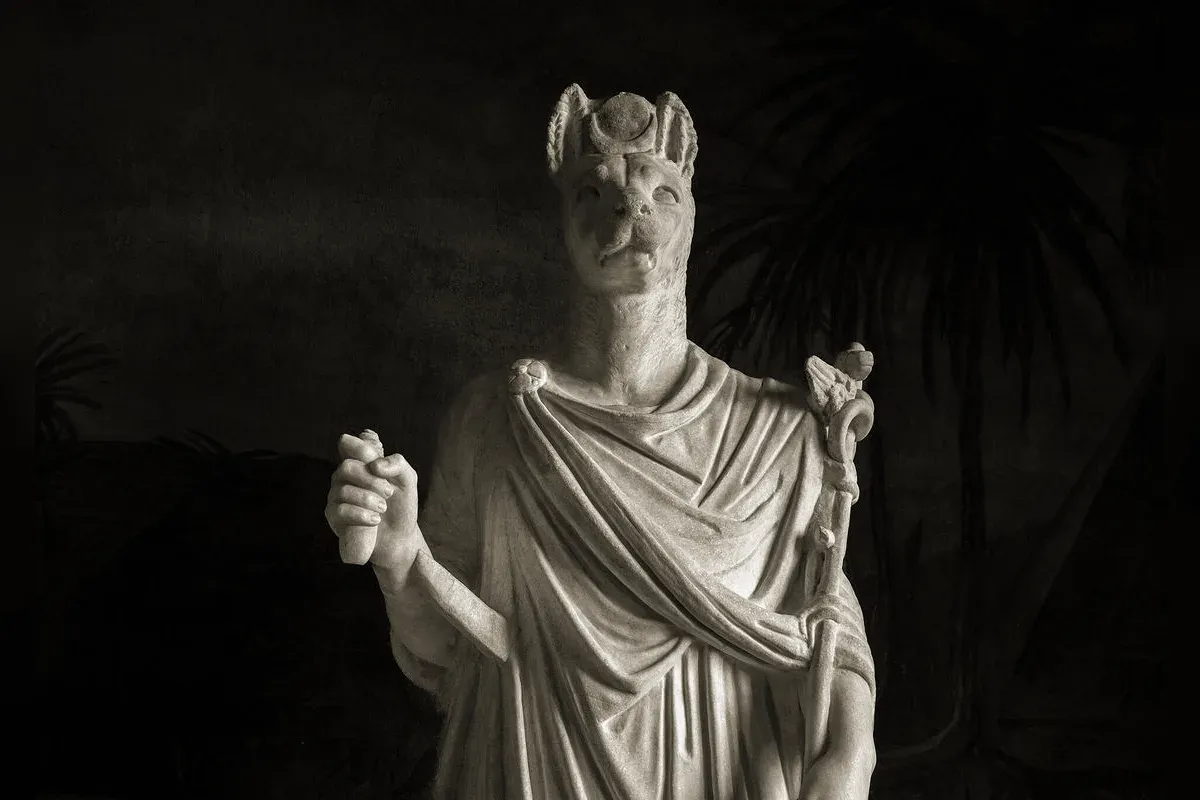
Anubis, jackal-headed guardian of the dead in Egyptian mythology
Anubis, the jackal-headed god of ancient Egypt: guardian of the dead, divine embalmer, guide of souls, and overseer of the weighing of the heart.
Who is Anubis?
Anubis is ancient Egypt’s most emblematic funerary deity and one of its most globally recognisable icons. Jackal-headed, with a human body and skin as black as the fertile Nile silt, he is the guardian of the dead, the divine embalmer, and the guide of souls on their passage through the Duat, the realm of the afterlife. His presence in Egyptian funerary practice is as old as the Old Kingdom itself — he is among the best-attested deities in the entire Nilotic tradition.
Role, nature, and domains
Anubis holds several central funerary functions:
Embalming: Anubis is mythology’s first embalmer. According to tradition, it is he who, aided by Isis and Nephthys, prepares the body of Osiris after his murder by Seth — thereby inaugurating the rite of mummification. Every embalmer-priest wore an Anubis mask during funerary ceremonies.
Guiding souls: Anubis leads the deceased through the Duat to the Hall of Two Truths where Osiris presides over judgment. He is ancient Egypt’s psychopomp — the functional counterpart of Hermes Psychopomp in Greek tradition.
The weighing of the heart: in Osiris’s tribunal, it is Anubis who holds and watches the scales where the deceased’s heart is placed against the feather of Maat. He ensures the weighing is precise and just.
Protection of tombs: Anubis is invoked to protect burial sites from grave robbers and malevolent forces. His image is painted at tomb entrances and on sarcophagi.
Genealogy and origins
Anubis’s genealogy shifts significantly across periods:
- In the Pyramid Texts (Old Kingdom, c. 2400 BCE), Anubis is presented as the son of Ra — an archaic tradition that treats him as a solar deity in his own right.
- From the Middle Kingdom onward, the dominant tradition makes him the son of Osiris and Nephthys (Isis’s sister), born of an illicit union: Nephthys disguised herself as Isis to unite with Osiris, and Anubis was born of this deception.
- In other variants, his mother is a divine cow or a local deity of the nome of Assiut.
This plurality of genealogies reflects the federative nature of Egyptian religion, which incorporated local traditions without necessarily harmonising them.
Anubis and mummification
The practice of mummification is inseparable from Anubis. Embalmer-priests wore a jackal-head mask during funerary ceremonies to embody the god and ensure that body preparation took place under his divine protection. The embalming ritual lasts seventy days — the duration associated with the heliacal period of Sirius, the Dog Star, itself linked to Anubis.
Anubis’s role is also to ensure that the ka (vital energy) and the ba (divine personality, depicted as a human-headed bird) remain bound to the mummified body: without this cohesion, the deceased’s identity would dissolve and all hope of an afterlife would vanish.
Anubis in the judgment of the dead
The scene of the weighing of the heart, depicted in hundreds of papyri from the Book of the Dead, places Anubis at the centre of the judgment:
- The deceased is led by Anubis into the Hall of Two Truths.
- The heart (ib) is placed on one pan of the scales.
- The feather of Maat — symbol of cosmic truth — occupies the other pan.
- Anubis holds the scales and observes the balance with absolute attention.
- Thoth records the result in his register.
- If the heart is lighter than the feather, Osiris declares the deceased “true of voice” (maa-kheru) and admits them to the Fields of Iaru.
- If the heart is too heavy, the composite creature Ammit devours it.
Anubis’s presence guarantees the impartiality of this judgment: as the keeper of the scales, he is the technical arbiter of divine justice.
Variants and cult
Anubis’s principal cult centre was Cynopolis (“city of the dog”) in Middle Egypt, but his worship was universal: every Egyptian necropolis was dedicated to him. The epithet Khenty-Amentiu (“Foremost of the Westerners,” meaning the dead) was originally applied to Anubis before being attributed to Osiris — evidence of Anubis’s ancient precedence in funerary theology.
In the Greco-Roman period, Anubis was assimilated with Hermes Psychopomp in the syncretic figure of Hermanubis, blending the Greek guide of souls with the Egyptian embalmer. Statuettes of Hermanubis — jackal head, Hermes body with caduceus — are found throughout the Roman Empire.
What the ancient sources say
The Pyramid Texts (c. 2400 BCE) invoke Anubis from the very first funerary spells: “May Anubis, who is before the divine tent, and who is upon his mountain, place the hands of (name of king) under you.” The Coffin Texts and the Book of the Dead systematise his role as keeper of the scales. New Kingdom funerary papyri invariably depict him holding the balance during the weighing of the heart, confirming his status as guarantor of equitable judgment.
Further reading
For the king of the dead before whom Anubis leads souls, read the page on Osiris. For the goddess whose magic assists Anubis in the mummification rite, see the page on Isis. For the divine scribe who records verdicts alongside Anubis at the judgment, read the page on Thoth. For the creature who devours the hearts of the unjust dead under Anubis’s watch, see the page on Ammit. The myth that founds the practice of mummification and the judgment of souls is told in The Osiris Myth. For the full account of the weighing of the heart in the Hall of Two Truths, see The Judgment of the Dead.
See also
Related entries
Stories featuring this entity
Comparisons
Frequently asked questions
Is Anubis the son of Osiris?
In the most widespread tradition of the Middle Kingdom and New Kingdom, Anubis is the son of Osiris and Nephthys, born of an extramarital union. Nephthys is said to have disguised herself as Isis to unite with Osiris, and Anubis was born of this deception. But in the Pyramid Texts (Old Kingdom), Anubis is presented as the son of Ra — an older tradition that reflects the theological evolution across millennia.
Why does Anubis have a jackal's head?
The jackal (or wild dog) was a nocturnal animal Egyptians observed prowling the cemeteries and deserts where the dead were buried. Rather than fearing this animal as a predator of the dead, they sacralised it as a guardian of tombs. Anubis's black skin is not the colour of real jackals (which are golden-brown) but symbolises the black silt of the Nile, regeneration, and successful mummification.
What is the difference between Anubis and Osiris in the judgment of the dead?
Osiris presides over the tribunal of the dead as supreme judge and king of the underworld. Anubis plays a technical and liturgical role: he holds and watches the scales during the weighing of the heart, guides the deceased to the tribunal, and ensures the judgment proceeds correctly. Thoth, god of writing, records the results. The three form a complementary functional trio in Egyptian funerary theology.