Egyptian mythology · Death and afterlife
The Judgment of the Dead in ancient Egyptian mythology
The Egyptian Judgment of the Dead: the Hall of Two Truths, the Negative Confession before forty-two divine assessors, and Anubis weighing the heart against Maat's feather.
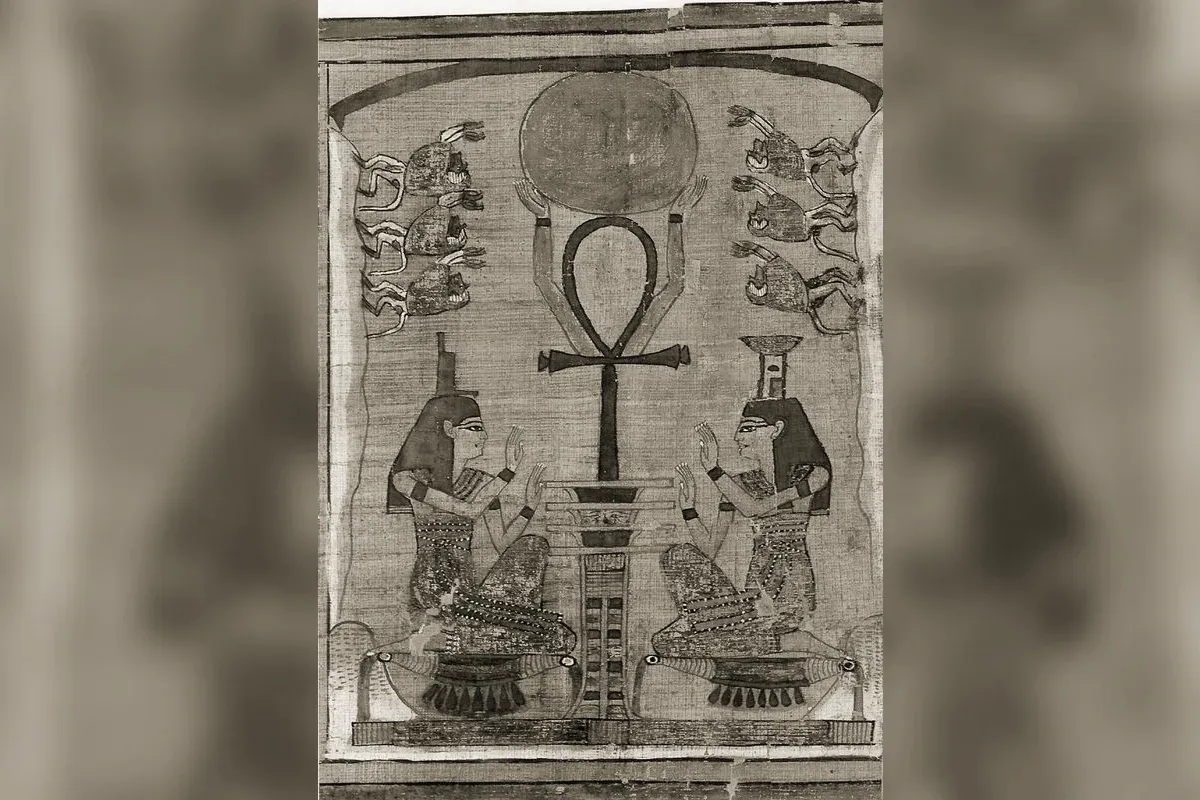
The central scene of divine justice
The Judgment of the Dead is the central ceremony of Egyptian funerary theology — the moment when every deceased person stands before the gods and accounts for their life. It takes place in the Hall of Two Truths (Maât Kherou, “the Hall of Maat”), in the Duat (the realm of the dead), under the presidency of Osiris.
This judgment is not a ritual curiosity: it is the ethical foundation of Egyptian civilisation. Because the acts of every living person will be weighed after death, life must be lived justly. The belief in judgment made morality a cosmic reality, written into the structure of the universe.
The deceased arrives in the Hall of Two Truths
After physical death, the deceased’s soul (ba and ka) traverses the Duat — guided by the spells of the Book of the Dead (Reu nu pert em hru, “the Book of Going Forth by Day”), a collection of magical texts and instructions that families had copied onto papyri placed in tombs.
The deceased arrives in the Hall of Two Truths, an immense celestial space where Osiris sits enthroned, surrounded by forty-two divine assessors — as many as there were nomes (provinces) in Egypt. Thoth, the god of writing and wisdom, stands ready to inscribe the verdict. Anubis, the jackal-headed god, prepares to hold the scale.
The Negative Confession: forty-two declarations of purity
Before the scale is even set up, the deceased must recite the Negative Confession — the text of Chapter 125 of the Book of the Dead, considered one of the most important moral documents of antiquity.
Facing each of the forty-two divine assessors (each bearing a name that reveals a specific wrongdoing), the deceased declares not to have committed it. Among the most significant affirmations:
- “I have not committed sins against men.”
- “I have not oppressed the members of my family.”
- “I have not spoken falsehood in the place of truth.”
- “I have not deprived the poor of their food.”
- “I have not slaughtered cattle consecrated to the gods.”
- “I have not diverted irrigation water.”
- “I have not caused the gods to weep.”
This list reveals what Egyptian society considered the fundamental vices: violence, lying, economic injustice, sacrilege, cruelty to the weak.
The weighing of the heart
The central moment is the weighing of the heart (wAg). Anubis places the deceased’s heart — seat of conscience, thought, and emotion in Egyptian theology — on one pan of a precision balance. On the other pan is placed the feather of Maat, goddess of justice, truth, and cosmic balance.
If the heart is as light as the feather — if the life lived was just — the two pans balance. The deceased is declared maa-kheru (“true of voice”, “justified”), their dossier is pure.
If the heart is heavier — burdened by uncommitted confessions, unjust acts, wicked thoughts — it is not pure. The fate awaiting the deceased is total destruction.
Thoth inscribes the verdict
Thoth, the ibis-headed god, closely observes the weighing and inscribes the result on his tablets. He guarantees the objectivity of the judgment: he is the celestial scribe, keeper of divine memory, impossible to corrupt.
His presence is a guarantee of neutrality. The verdict cannot be contested or influenced: it is engraved in cosmic reality by the hand of the most precise god in the Egyptian pantheon.
Ammit the Devourer
Near the scale waits Ammit (“She who devours”), the composite creature most feared in the Duat: crocodile head, lion’s chest and forelegs, hippopotamus hindquarters — the three most dangerous animals of Egypt combined into one being.
Her role is to wait for the verdict. If the heart is impure, Ammit devours it immediately.
This devouring constitutes the second death (mwt mwt) — not the death of the body, which has already occurred, but the death of the soul: the annihilation of the personality, the consciousness, everything that made the deceased’s identity. There is no rebirth possible after this. It was the fate Egyptians feared above all else.
The Fields of Iaru: the Egyptian paradise
The deceased declared maa-kheru is led by Horus before Osiris, who sits on his throne in the Duat. Osiris pronounces the deceased’s admission into the Fields of Iaru (Sekhet Iaru — “Field of Reeds”), the Egyptian paradise.
The Fields of Iaru are an idealised version of the Nile Delta: fertile land, abundant harvests, living waters, the presence of family and loved ones. The deceased lives there as on earth — but in perfection, without suffering, without the possibility of death. They become Osiris — taking the god’s name, his condition, his dignity.
From royal privilege to democratisation
One of the most important evolutions in Egyptian theology concerns access to this judgment and to resurrection.
In the Old Kingdom (3rd millennium BCE), only the pharaoh was considered a divine being destined to “become Osiris”. The Pyramid Texts, carved in royal burial chambers, were reserved for royalty.
In the Middle Kingdom, the Coffin Texts spread among the nobility and officials: the hope of resurrection widened to the ruling classes.
In the New Kingdom, the Book of the Dead became accessible to anyone who could pay a scribe to copy it. The Judgment of the Dead was now universal: any Egyptian who had lived justly and knew the formulae could aspire to the Fields of Iaru. This democratisation of the afterlife is one of the most profound silent revolutions in the history of religion.
What the ancient sources say
The Book of the Dead — and particularly Chapter 125, devoted to the Negative Confession and the weighing of the heart — is the primary source. The Papyrus of Ani (Dynasty XIX, c. 1275 BCE, housed in the British Museum) is its most celebrated and illustrated version, with detailed vignettes depicting the judgment scene. The Coffin Texts (Middle Kingdom) provide an earlier, more fragmentary version. The Pyramid Texts (Old Kingdom, c. 2400 BCE) constitute the earliest attestation of the post-mortem Osirian journey.
Further reading
For the central figure of the tribunal of the dead, see the page on Osiris. For the god who holds the scale and guides the dead, read the page on Anubis. For the goddess whose feather measures the truth of a life, see the page on Maat. For the creature who devours the heart of the unjust dead, see the page on Ammit. For the full cycle that grounds this judgment, read the story of the Osiris myth.
Story beats
- 01The deceased arrives in the Hall of Two Truths
- 02The Negative Confession before the forty-two divine assessors
- 03Anubis weighs the heart on the scale against the feather of Maat
- 04Thoth inscribes the verdict on his tablets
- 05The pure deceased is declared maa-kheru and admitted to the Fields of Iaru
- 06If the heart is too heavy, Ammit devours it — the definitive second death
Ancient sources
- Book of the Dead (New Kingdom, c. 1550–50 BCE)
- Coffin Texts (Middle Kingdom, c. 2000 BCE)
- Pyramid Texts (Old Kingdom, c. 2400 BCE)
- Papyrus of Ani (Dynasty XIX, c. 1275 BCE)
See also
Related entries
- Anubis, jackal-headed guardian of the dead in Egyptian mythology
- Osiris, god of the dead and resurrection in ancient Egypt
- Thoth, Egyptian god of wisdom, writing and the moon
- Maat, Egyptian goddess of truth and cosmic order
- Ammit, the devourer of unjust souls in Egyptian mythology
- The Duat: the underworld of the dead in Egyptian mythology
Frequently asked questions
What is the Negative Confession?
The Negative Confession (Chapter 125 of the Book of the Dead) is a list of forty-two wrongs that the deceased declares they have not committed — one for each divine assessor. They state: 'I have not killed', 'I have not stolen', 'I have not committed adultery', 'I have not oppressed the poor', and so on. It is not a confession of sins committed but a declaration of purity — an assertion that the life lived was just.
What happens if the heart is heavier than Maat's feather?
If the deceased's heart is too burdened with wrongdoing, Ammit — the creature with the head of a crocodile, the chest of a lion, and the hindquarters of a hippopotamus — immediately devours it. This devouring constitutes the second death (the death of the soul, the annihilation of the personality), with no possibility of rebirth. It was the fate ancient Egyptians feared most.
Was the Judgment of the Dead reserved for pharaohs?
No — and this is one of the most important evolutions in Egyptian religion. In the Old Kingdom, only the pharaoh was considered a divine being destined to 'become Osiris' and hope for resurrection. With the Coffin Texts (Middle Kingdom) and then the Book of the Dead (New Kingdom), judgment and the possibility of becoming Osiris became democratised: any deceased person who had lived justly and knew the magical formulae could aspire to the Fields of Iaru.