Egyptian mythology · Gods & goddesses
Isis, goddess of magic and protection in ancient Egypt
Isis, Egyptian goddess of magic: reassembly of Osiris, protection of Horus, mystery cult in the Roman Empire, and her enduring symbolic legacy worldwide.
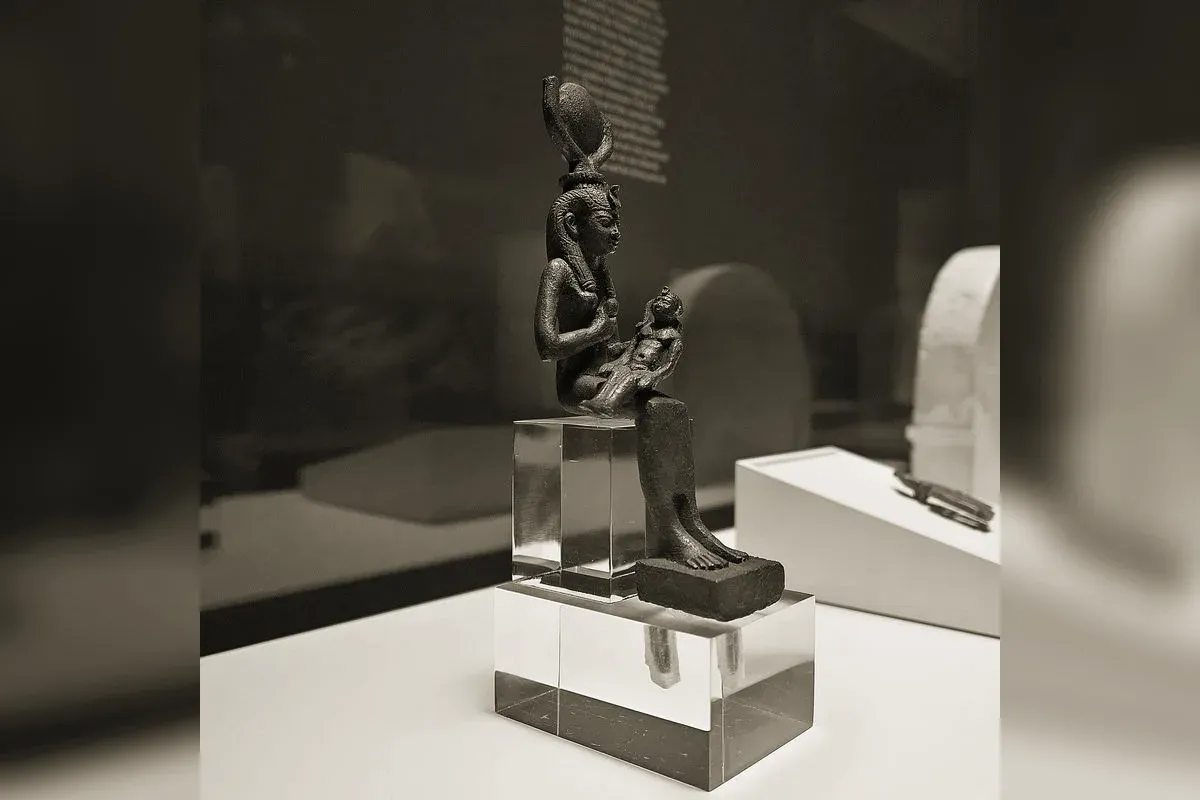
Who is Isis?
Isis is one of the most widely venerated deities in all of antiquity — not only in ancient Egypt, but across the entire Mediterranean world until the end of late antiquity. Goddess of magic, motherhood, and protection, she is above all the embodiment of a conjugal and maternal love capable of overcoming death itself. Her ancient Egyptian name, Aset, probably means “the throne”: Isis is the power that founds and legitimises kingship — for Osiris whom she resurrects, and for Horus whom she protects.
Role, nature, and domains
Isis is the mistress of heka (magic), defined by the Egyptians not as an occult art but as the primordial force through which the gods maintain world order. She is the only deity in the pantheon whose magic can accomplish what the gods themselves cannot: resurrect a dead being, conceive a child posthumously, and force Ra himself to reveal his secret name.
Her hieroglyph is a throne: Isis is the royal throne, the divine legitimacy upon which the pharaoh sits. She is the mother of Horus, the model for every living pharaoh — and therefore the symbolic mother of each king of Egypt.
Genealogy
Isis is the daughter of Geb (god of the earth) and Nut (goddess of the sky), sister of Osiris, Seth, and Nephthys. Her union with Osiris — a sibling marriage, standard in Egyptian royal theology — produces Horus, conceived after Osiris’s death through Isis’s magic.
Key myths
The reconstitution and resurrection of Osiris
Isis’s central myth is inseparable from the Osirian cycle. When Seth murders and dismembers Osiris, it is Isis who undertakes the quest to find all the body’s fragments — fourteen pieces scattered across Egypt according to Plutarch, with her sister Nephthys as companion in mourning. The Lamentations of Isis and Nephthys (Papyrus Bremner-Rhind, c. 310 BCE) describe this mourning with rare poetic beauty: two sisters calling the dead man, searching for his body, refusing to accept the irremediable.
Once the body is reconstituted — except for the phallus, which she magically replaces — Isis takes the form of a kite and beats her wings over the corpse to breathe in his vital force. From this posthumous union, Horus is conceived.
The secret name of Ra
In a separate myth, Isis fashions a venomous serpent to bite Ra and refuses to cure him unless he reveals his secret name — for knowing a god’s true name means mastering his power. Ra yields: Isis thereby acquires magical authority superior to that of the supreme solar deity. This narrative, preserved in several New Kingdom papyri, explains why Isis is called “more cunning than all the gods.”
The protection of Horus
After conceiving Horus, Isis takes refuge in the marshes of the Nile Delta to shelter her son from Seth’s attacks. She raises him in secret in the papyrus thickets of Khemmis (Chemmis), protecting him from serpents, scorpions, and Seth’s machinations. This period is illustrated by hundreds of magical stelae (cippi of Harpocrates) where the child Horus masters dangerous animals — a symbol of magical victory over evil.
Variants and syncretisms
From the Ptolemaic period onward, Isis gradually absorbed the attributes of most of Egypt’s major goddesses:
- Isis-Hathor: she adopts the solar disk flanked by cow horns, the attribute of Hathor, goddess of love and motherhood.
- Isis-Selkis: healer against poisons, associated with the scorpion.
- Isis Pelagia: goddess of sailors, protector of Mediterranean seafarers.
In the Roman world, her mystery cult expanded extraordinarily from the 1st century BCE onward: isiacea (Isiac sanctuaries) are attested from Roman Britain to Central Asia. Her image as a nursing mother (Isis Lactans) feeding the infant Horus directly fed into early Christian iconography of the Virgin and Child in the first centuries of the common era.
What the ancient sources say
The Pyramid Texts (c. 2400 BCE) are the earliest attestations of Isis’s role alongside Osiris. The Coffin Texts and the Book of the Dead develop her magical protective formulae. The Turin Papyrus contains the “Myth of the Eye of Ra” in which Isis plays a central role. Apuleius (The Golden Ass, 2nd c. CE) provides in Book XI one of the most vivid testimonies of the Roman Isis cult, through the narrator’s initiation into the mysteries.
Further reading
For the god whom Isis resurrects and whose funerary cult she sustains, read the page on Osiris. For the son she protects and raises to avenge his father, see the page on Horus. For the divine scribe who recites the resurrection formulae alongside her, read the page on Thoth. The complete narrative of the Osirian cycle is told in The Osiris Myth.
See also
Frequently asked questions
Why is Isis the goddess of magic?
Isis embodies magic (Heka) in its most complete form because she is the only deity capable of resurrecting a dead person: she reconstitutes Osiris's dismembered body, breathes his ka back into it, and conceives Horus posthumously. The Pyramid Texts call her 'more cunning than all the gods' — a magical intelligence that surpasses even Ra's, whom she compels to reveal his secret name.
How did the cult of Isis spread through the Roman world?
The Isis cult developed in Ptolemaic Egypt (3rd–1st centuries BCE), then spread through Mediterranean trading ports. In Rome, the cult — initially banned, then tolerated — became a highly popular mystery religion by the 1st century CE, competing with early Christianity. Its temples were found from Scotland to Afghanistan.
What is the connection between Isis and the Virgin Mary?
Several early Christian iconographies of the Virgin and Child bear striking similarities to depictions of Isis nursing Horus (Isis Lactans). This resemblance is not coincidental: the earliest Christian communities in Egypt inherited a deeply Isiac iconographic context. Most historians of religion see a gradual symbolic transfer rather than deliberate copying — a living image that was gradually rechristened.