Egyptian mythology · Gods & goddesses
Horus, falcon god and king of the sky in Egyptian mythology
Horus, the Egyptian falcon god: son of Osiris and Isis, his contest with Seth for the throne, the Eye of Horus, and his divine embodiment of the pharaoh.
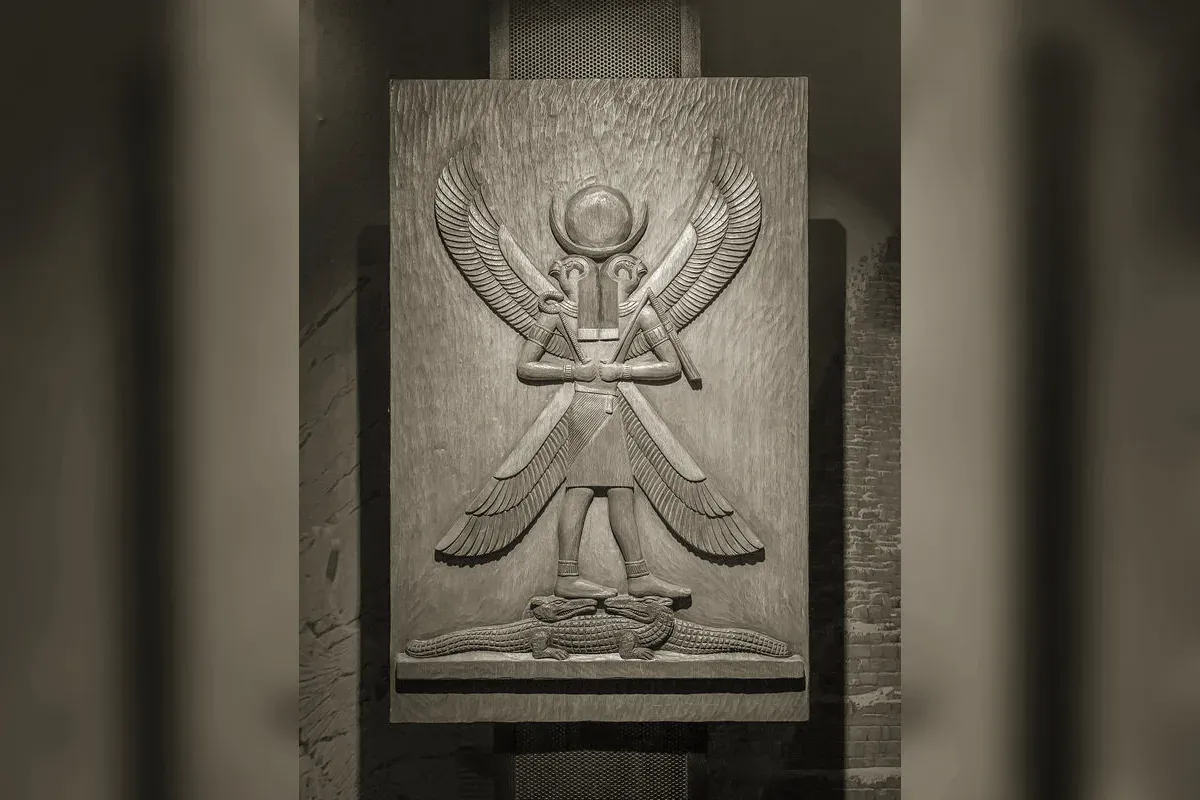
Who is Horus?
Horus is one of the most anciently attested deities in Egypt and the central figure in Egyptian royal theology. Falcon god of the sky, son of Osiris and Isis, he embodies the legitimacy of power and the victory of order (Maat) over chaos (Isfet). His myth of vengeance against Seth and the recovery of the throne establishes the Egyptian conception of kingship as a perpetual act of maintaining cosmic order.
Role, nature, and domains
Horus is above all the god of the sky and the rightful king. His right eye is the sun, his left eye is the moon — he is himself the luminous celestial vault. His identification with Ra in the form of Ra-Horakhty (“Ra-Horus of the Horizon”) makes him the solar power at its zenith.
The Egyptian royal theology, developed from the earliest dynasties (c. 3000 BCE), holds that every living pharaoh is Horus: in reigning, the king embodies the son of Osiris who maintains world order. At his death, the pharaoh “becomes Osiris” — he passes from living kingship to the kingship of the dead — and his successor in turn takes up the role of Horus.
Genealogy and birth
Horus is the posthumous son of Osiris and Isis, conceived after his father’s death through his mother’s magic. Isis raises him in secret in the marshes of the Nile Delta to protect him from Seth’s attacks. This hidden childhood makes him a divine child of miraculous origin — Harpocrates, “Horus the Child,” depicted with a finger at his lips, a gesture misread by the Greeks as a sign of silence but actually indicating royal childhood.
The Horus-Seth contest for the throne
The struggle between Horus and Seth for Egypt’s kingship is the most complex and most extensively treated mythological narrative in Egyptian sources. Papyrus Chester Beatty I (Ramesside, c. 1180 BCE), known by the modern title “The Contendings of Horus and Seth,” offers the most fully developed narrative version, blending accounts of battles, stratagems, divine trials, and deliberations of the gods’ tribunal.
The main stages:
- The contested inheritance: Horus claims the throne as Osiris’s legitimate heir; Seth disputes this, arguing from his own strength and his role as Ra’s protector against Apophis.
- The combats: the two gods fight in successive transformations — hippopotamuses, sea creatures, humans — each seeking to wound or humiliate the other.
- The mutilation of the eye: Seth tears out or destroys Horus’s left eye. The eye is restored by Thoth and becomes the wedjat (“the Intact One”), a universal symbol of healing and protection.
- The judgment of the divine tribunal: the gods deliberate for eighty years (symbolically). Neith, Thoth, and others argue for Horus; Seth invokes his martial strength. Finally, the tribunal — and Osiris from the realm of the dead — rule in Horus’s favour.
- The reconciliation: Horus ascends to Egypt’s throne. Seth, in some versions, is integrated into Ra’s solar barque as a guardian against Apophis — reclaimed as a force necessary to the cosmos rather than destroyed.
The Eye of Horus — the wedjat
The wedjat (Egyptian: wḏ3t, “the Intact One”), also called the “Eye of Horus,” is one of the most widespread symbols of ancient Egypt and of world civilisation. Representing Horus’s mutilated left eye, restored after the contest with Seth, it symbolises:
- healing and protection against evil
- wholeness and integrity regained after violation
- knowledge (the all-seeing eye)
- measurement: the graphic components of the wedjat were used in medical prescriptions and astronomical texts to express fractions of the heqat (a grain measure)
Thousands of wedjat amulets have been found in tombs and on mummies across Egypt. The symbol persists in modern popular culture as one of the most recognisable icons of ancient Egypt.
Multiple aspects and forms
- Horus the Elder (Haroeris): a primordial solar deity, Osiris’s brother in some traditions — a persistent theological tension in the sources.
- Harpocrates (Horus the Child): the divine child protected by Isis, depicted seated or standing and mastering venomous animals. Very widespread in the Greco-Roman period.
- Ra-Horakhty: fusion with Ra as the midday solar deity, shown with a falcon head and solar disk.
- Harendotes: Horus avenger of his father — a martial aspect linked to the reconquest of the throne.
- Horus of Behdet: a winged falcon-headed warrior deity protecting the pharaoh in battle scenes.
What the ancient sources say
The Pyramid Texts attest Horus as royal deity from the Old Kingdom; the deceased pharaoh “rises to Horus” and “unites his ka with him.” The Coffin Texts extend the Osirian myth and Horus’s role as avenger. Papyrus Chester Beatty I (New Kingdom) offers the fullest narrative of the contest with Seth. The Contendings of Horus and Seth is simultaneously a theological and literary text, blending cosmic gravity and comic register — evidence of the stylistic richness of the Nilotic tradition.
Further reading
For the father whom Horus avenges and whose resurrection his victory justifies, read the page on Osiris. For the mother who raises and protects Horus from birth, see the page on Isis. For the adversary Horus faces in the founding conflict of Egyptian kingship, read the page on Seth. For the solar deity with whom Horus fuses as Ra-Horakhty, read the page on Ra. For a full overview of the Egyptian pantheon, see the Egyptian mythology hub.
See also
Frequently asked questions
What is the difference between Horus the Elder and Horus son of Osiris?
Horus the Elder (Haroeris) is a primordial solar deity, an independent member of the Great Ennead in some traditions, associated with the sky and sun since the earliest dynasties. Horus son of Osiris is a later theological development — the posthumous son of Osiris and Isis, the legitimate heir to the throne. These two aspects gradually merged in classical Egyptian theology, with Horus becoming simultaneously a primordial celestial king and an avenger of his father.
How did Horus lose his eye?
In the contest between Horus and Seth for the throne of Egypt, Seth tears out or destroys Horus's left eye during battle. The eye is later retrieved and restored — by Thoth in some versions, or offered to Osiris in others. This restored eye, the wedjat ('the Intact One'), becomes a universal symbol of healing, protection, and wholeness.
Why is the pharaoh identified with Horus?
The equation pharaoh = living Horus dates to the earliest dynasties (c. 3000 BCE). Horus, the son of Osiris, is the legitimate heir to the cosmic throne; the pharaoh, as living sovereign, embodies this rightful son who maintains world order. At death, the pharaoh 'becomes Osiris' — the resurrected dead father — while his successor takes up the role of Horus. This death/resurrection/succession cycle is the theological matrix of Egyptian kingship.