Egyptian mythology · Gods & goddesses
Ra, the Egyptian sun god: creator, solar cycle and Amun-Ra
Ra, the Egyptian sun god: creator deity, nightly journey through the Duat battling Apophis, syncretisms (Amun-Ra, Ra-Horakhty), and cult at Heliopolis.
Who is Ra?
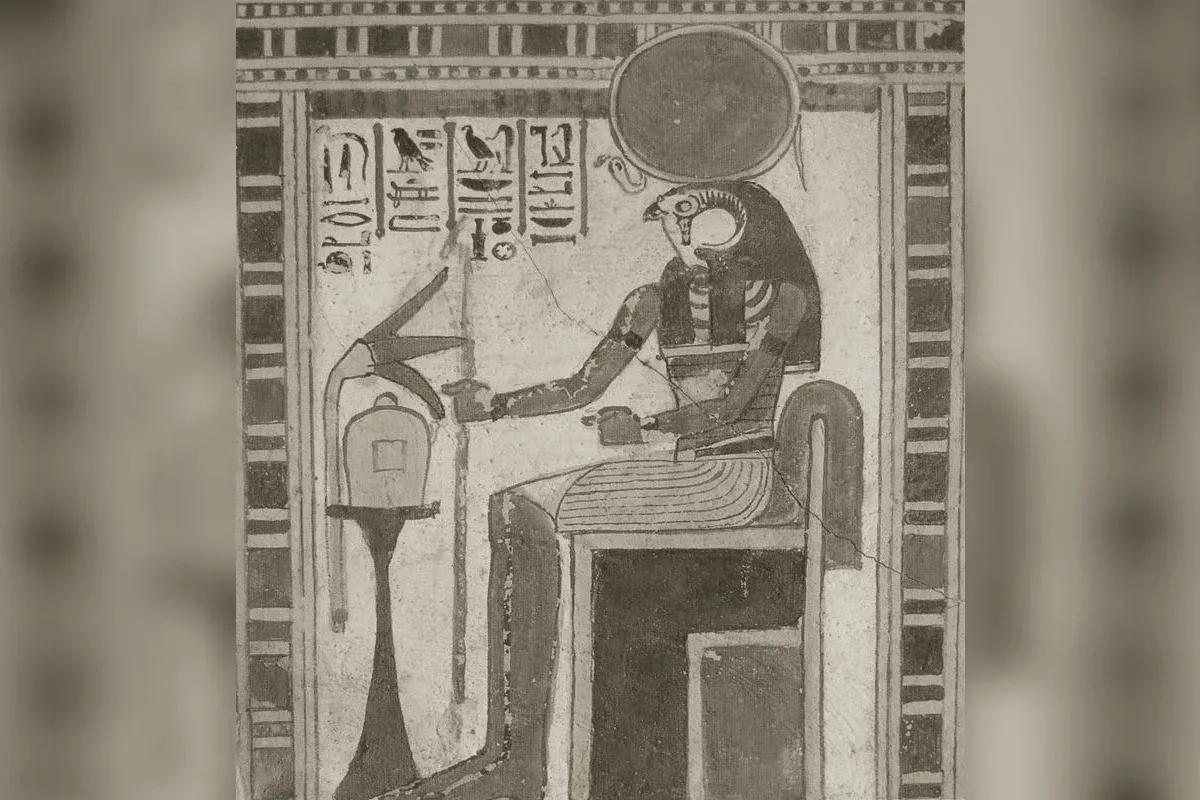
Ra is the pre-eminent solar deity of Egyptian mythology and one of the most anciently attested gods in the ancient world. Venerated from the earliest dynasties (before 3000 BCE), he embodies the sun in motion — not a god who governs the sun from afar, but a divine power that is the sun itself in its daily cycle. For several centuries Ra held the rank of supreme deity in the Egyptian pantheon before gradually being absorbed or supplemented by Osiris in funerary theology and by Amun in royal theology.
Role, nature, and domains
Ra is simultaneously creator and sovereign. At Heliopolis, his principal cult centre, the canonical myth places Atum — an ancient hypostasis of Ra — at the origin of all things: emerging from Nun (the primordial chaotic ocean) on a mound of primeval earth, he creates Shu (air) and Tefnut (moisture) through his breath alone, setting in motion the genealogical chain that will produce earth (Geb), sky (Nut), and ultimately Osiris, Isis, Seth, and Nephthys.
The Pyramid Texts designate him “lord of the sky” and directly link the dead pharaoh to his celestial journey: to die, for an Egyptian king, is to board Ra’s barque and navigate the eternal heavens.
The multiple forms of the solar god
Ra does not appear in a single form but in a tripartite cycle that structures the Egyptian conception of time:
- Khepri (the scarab): Ra of the morning, the rising sun that becomes of itself — the root kheper means “to become,” “to transform.” The dung beetle rolling its ball evokes the sun pushing its luminous sphere above the horizon.
- Ra or Ra-Horakhty (the solar falcon): Ra at noon, at the zenith of his power, typically shown with a falcon head crowned by the solar disk circled with the uraeus cobra. The fusion with Horus — “Horus of the Horizon” — signals that the royal god and the solar god share the same celestial essence.
- Atum (the aging man at sunset): Ra of the evening, the solar power withdrawing into the Duat to prepare its own nocturnal regeneration.
This triple manifestation affirms that the sun does not repeat itself mechanically: it dies each evening and is reborn each morning after traversing the realm of the dead — a direct parallel to the Osirian resurrection cycle.
The nocturnal journey through the Duat
Each evening the solar barque (Mesektet, barque of the night) enters the Duat, the underworld divided into twelve nocturnal hours corresponding to twelve chambers or kingdoms. The Amduat — “Book of What Is in the Underworld,” composed from the New Kingdom onward — describes each of these stations: auxiliary deities, gates guarded by serpents, rituals required to pass each threshold.
At the heart of the fifth nocturnal hour, Ra momentarily fuses with Osiris: this encounter between the solar god and the god of the dead generates the regenerative energy essential to both their resurrections. It is here that Ra takes on the mummified form necessary for his own renewal.
The central danger is Apophis (Apep): a colossal serpent, personification of absolute chaos, which attempts every night to swallow the solar barque. Ra is defended by a divine host including Seth (here a guardian, not an adversary), Isis, and the forty-two assessors of Osiris. His nightly victory ensures sunrise and the continuity of creation.
The great syncretism: Amun-Ra
During the 18th Dynasty, the growing power of the Amun priesthood at Thebes led to the fusion of the two deities as Amun-Ra: the hidden, invisible power (Amun, whose name means “the Hidden One”) identified with the visible solar power (Ra). This synthesis became the dominant divine figure of the New Kingdom; pharaohs such as Thutmose III and Ramesses II declared themselves sons of Amun-Ra.
The Amarna reform of Akhenaten (c. 1353–1336 BCE) is the only attempt at solar monotheism in Egyptian history: the pharaoh imposed the exclusive cult of Aten (the bare solar disk, without Ra’s personalisation), closed all other temples, and proscribed the names of other gods. His immediate successors, including Tutankhamun, restored the cult of Amun-Ra and systematically erased the Amarna reliefs.
What the ancient sources say
The Pyramid Texts (c. 2400 BCE), inscribed in the burial chambers of Fifth and Sixth Dynasty pharaohs, are the earliest extended attestations of Ra’s cult. They assert the dead king’s ascent into the sky and his fusion with the solar barque. The Leiden Papyrus (Leiden I 350, New Kingdom) contains one of the most elaborate solar hymns, presenting Amun-Ra as the single divine substrate behind all the gods’ multiple names. The Amduat and the Litany of Ra (New Kingdom) provide the most complete account of the nocturnal journey, illustrated in the royal tombs of the Valley of the Kings.
Further reading
To understand the god who rules the realm of the dead and whom Ra encounters each night in the Duat, read the page on Osiris. For the goddess who protects Ra on his nocturnal journey and resurrects the dead, see the page on Isis. For the son of Osiris who shares with Ra the form of Ra-Horakhty, read the page on Horus. For a full overview of the Egyptian pantheon, see the Egyptian mythology hub.
See also
Frequently asked questions
What is the difference between Ra and Amun-Ra?
Ra is the solar deity of Heliopolis, while Amun is the hidden, invisible god of Thebes. During the New Kingdom (c. 1550–1070 BCE), their fusion as Amun-Ra produced Egypt's most powerful deity, combining Ra's visible solar force with Amun's transcendent mystery. This synthesis reflected the growing authority of the Theban priesthood under the 18th Dynasty pharaohs.
What is the Eye of Ra?
The Eye of Ra is an independent female divine entity — the vengeful aspect of Ra, identified in different contexts with Hathor, Sekhmet, or Bastet. When Ra sends his Eye to punish humanity, it is Sekhmet, the lioness-headed goddess, who unleashes destruction. The term also refers to the uraeus, the protective cobra on the god's and pharaohs' foreheads.
Why does Ra travel through the Duat at night?
Each evening, the solar barque enters the Duat, the underworld divided into twelve nocturnal hours. Ra faces Apophis, the serpent of chaos, which attempts to swallow the barque and prevent sunrise. His nightly victory guarantees the return of dawn and the continuity of the created world.