Norse mythology · Gods & goddesses
Odin, Allfather and ruler of Valhalla in Norse mythology
Odin, the Allfather of Norse mythology: his sacrifice for runic wisdom, his ravens, his gathering of warriors for Ragnarök, and his rule of Valhalla.
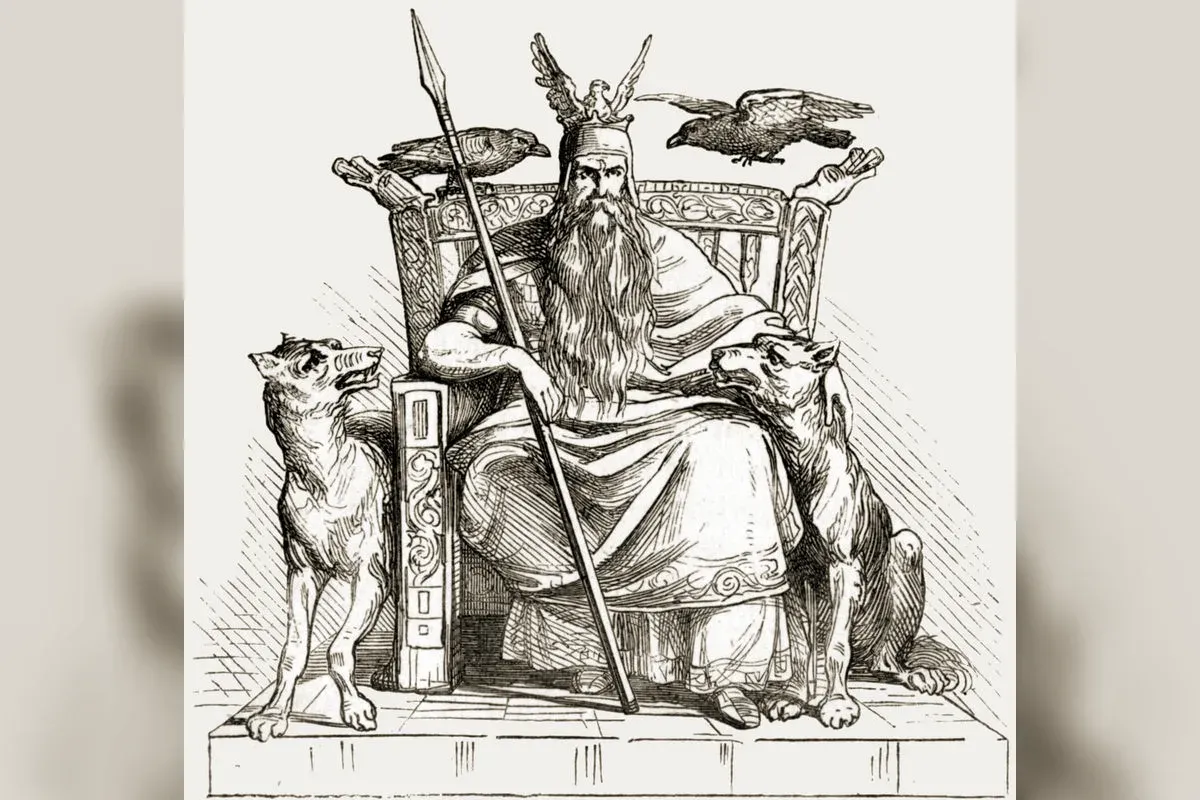
Who is Odin?
Odin is the supreme deity of the Norse pantheon — the Allfather (Alföðr), king of the Aesir, ruler of Valhalla, and guardian of cosmic balance until the hour of Ragnarök. God of wisdom, war, magic, and poetry, he is a radically different figure from the divine rulers of other traditions: Odin is neither omniscient nor omnipotent — he is an insatiable seeker of knowledge who mutilates himself, sacrifices himself, and wanders in disguise to acquire the understanding that might allow him to delay the world’s end.
Role, nature, and domains
Odin rules from Asgard, the home of the Aesir, from his throne Hliðskjálf from which he can survey all nine worlds. He is not a god of military victory in the simple sense: he presides over warfare as a process of selection, choosing which warriors will die so that they may swell the ranks of the Einherjar in Valhalla.
His two ravens Huginn (thought) and Muninn (memory) travel the nine worlds each day, reporting back everything that takes place in the universe. His two wolves Geri and Freki guard his throne. His horse Sleipnir, with eight legs, is the fastest of all mounts — born of Loki transformed into a mare.
Odin’s shamanic dimension is fundamental: he practises seiðr, a form of magic traditionally associated with women in Norse cosmology, learned from Freyja — an act that grants him the ability to see the future, alter destinies, and cross boundaries between worlds.
The quest for wisdom: the eye and the runes
Odin is the god who pays the highest price for knowledge.
The sacrifice of the eye: to drink from the well of Mimir, source of cosmic wisdom, Odin offers his right eye as pledge to Mimir, its keeper. He thus becomes “the One-Eyed” — a voluntary mutilation symbolising that deep wisdom always demands sacrifice.
The discovery of the runes: according to the Hávamál (Odin’s sayings, in the Poetic Edda), Odin hangs himself from Yggdrasil for nine nights and nine days, pierced by his own spear Gungnir, without food or water — a self-sacrifice to wrest the runes from the cosmic abyss. At the end of this ordeal, the runes reveal themselves to him from the depths of Hvergelmir’s well.
These two acts make Odin a uniquely shamanic deity in world mythology: he does not receive wisdom as a gift — he conquers it through suffering.
Valhalla and the Einherjar
One of Odin’s central preoccupations is preparing for Ragnarök. Knowing that the gods’ end is inevitable, he seeks to maximise the Aesir’s chances in the final battle.
Valhalla (the Hall of the Slain) is his principal instrument: every warrior who dies bravely in battle is carried by the Valkyries (his servants and messengers) to this hall in Asgard. There they train in combat each day — dying and reviving through Valhalla’s magic — and feast on meat and mead served by the Valkyries. These warriors, the Einherjar, are the army Odin assembles for the final confrontation with Fenrir and the forces of Muspelheim.
Odin as god of poetry
Odin is also the god of skalds — protector of poets. According to the myth of the Mead of Poetry (Kvasir), he obtains by cunning the mead brewed from the blood of the sage Kvasir, which grants any who drink it the gift of poetry. He brings this mead to the Aesir, keeping a share for himself, and distributes it to human poets — making poetry a divine gift.
For the Norse, poetry is a form of magical power: a well-forged poem can wound, heal, protect, or seduce. Odin is its source.
Odin the wanderer
In the myths, Odin frequently disguises himself as an elderly traveller in a wide-brimmed hat and blue cloak to cross Midgard incognito. He tests mortals, rewards generosity and courage, and punishes arrogance and refused hospitality. This face of Odin — the god present among men under a cloak of anonymity — is one of the most religiously significant: an encounter with an unknown old man might be an encounter with the god himself.
Odin’s fate at Ragnarök
The prophecy of the Völuspá is unambiguous: at Ragnarök, Fenrir — the monstrous wolf, Loki’s son, long kept in chains — breaks free and devours Odin. His son Vidar immediately avenges the killing by crushing Fenrir’s jaws or transfixing it with his spear. Odin has known this fate from the beginning — the seeress whose spirit he awakens at the opening of the Völuspá reveals it to him — and his entire existence is shaped by this awareness of approaching death.
This paradox — a supreme god who knows and accepts his own death — lies at the heart of Norse ethics: courage does not consist in denying death but in facing it, prepared and stoic.
What the ancient sources say
The Völuspá (Poetic Edda, 11th–12th century, compiled in the 13th) is the central text: a seeress (völva) awakened by Odin recites the history of the cosmos from creation to Ragnarök. The Hávamál delivers wisdom maxims and the account of the runic sacrifice. Snorri Sturluson’s Prose Edda (c. 1220) systematises Odinic mythology, though with a Christian perspective that partially rationalises the narratives. Saxo Grammaticus (Gesta Danorum, c. 1200) offers a euhemerised version of Odin, presented as a divinised human king — a useful perspective for tracing the evolution of the traditions.
Further reading
For Odin’s most famous and widely venerated son, read the page on Thor, god of thunder and protector of mankind. For the trickster bound to Odin by blood-oath — both companion and architect of his doom — see the page on Loki. For the Vanir goddess who teaches him the magic of seiðr, consult the page on Freya. For his beloved son whose death, engineered by Loki, triggers the chain of events leading to Ragnarök, read the page on Baldr. For the queen of Asgard, Odin’s wife and Baldr’s mother, see the page on Frigg. For the last legendary hero of the Volsung line descended from Odin, whose father’s sword he himself shatters to make way for the son’s fate, read the page on Sigurd. For the unerring spear that is his signature weapon, from the runes on its point to his last stand against Fenrir, read the page on Gungnir. For the account of the gods’ final battle that Odin has prepared for since the beginning, see Ragnarök.
See also
Frequently asked questions
Why did Odin sacrifice his eye?
According to Snorri Sturluson's Prose Edda, Odin sacrificed his right eye at Mimir's well in exchange for a drink of its waters, which grant infinite wisdom. Mimir, the well's keeper, set this as the price. Odin accepted: his hunger for total knowledge surpassed his physical wholeness. This act illustrates the fundamental paradox of Odin — a god who conquers wisdom through suffering and voluntary sacrifice.
What are the runes to Odin?
The runes are not mere letters: they are cosmic symbols carrying magical forces. According to the Völuspá and the Hávamál, Odin discovered them by hanging himself from Yggdrasil for nine nights, wounded by his own spear, without food or water — a self-sacrifice to pierce the secret of the cosmos. The runes grant him powers of healing, death, protection, and knowledge.
Will Odin die at Ragnarök?
Yes. The prophecy is clearly established in the Völuspá and confirmed in the Prose Edda: at Ragnarök, the wolf Fenrir (Loki's son) devours Odin. His son Vidar immediately avenges his death by crushing Fenrir's jaws or transfixing it with his spear. Odin knows this fate from the beginning and devotes much of his existence to preparing for it — gathering slain warriors in Valhalla to form his final army.