Norse mythology · Creatures
Sleipnir, Odin's Eight-Legged Horse in Norse Mythology
Sleipnir, Odin's eight-legged horse in Norse mythology: born from Loki shapeshifted as a mare, he crosses all nine worlds and carries his master between the living and the dead.
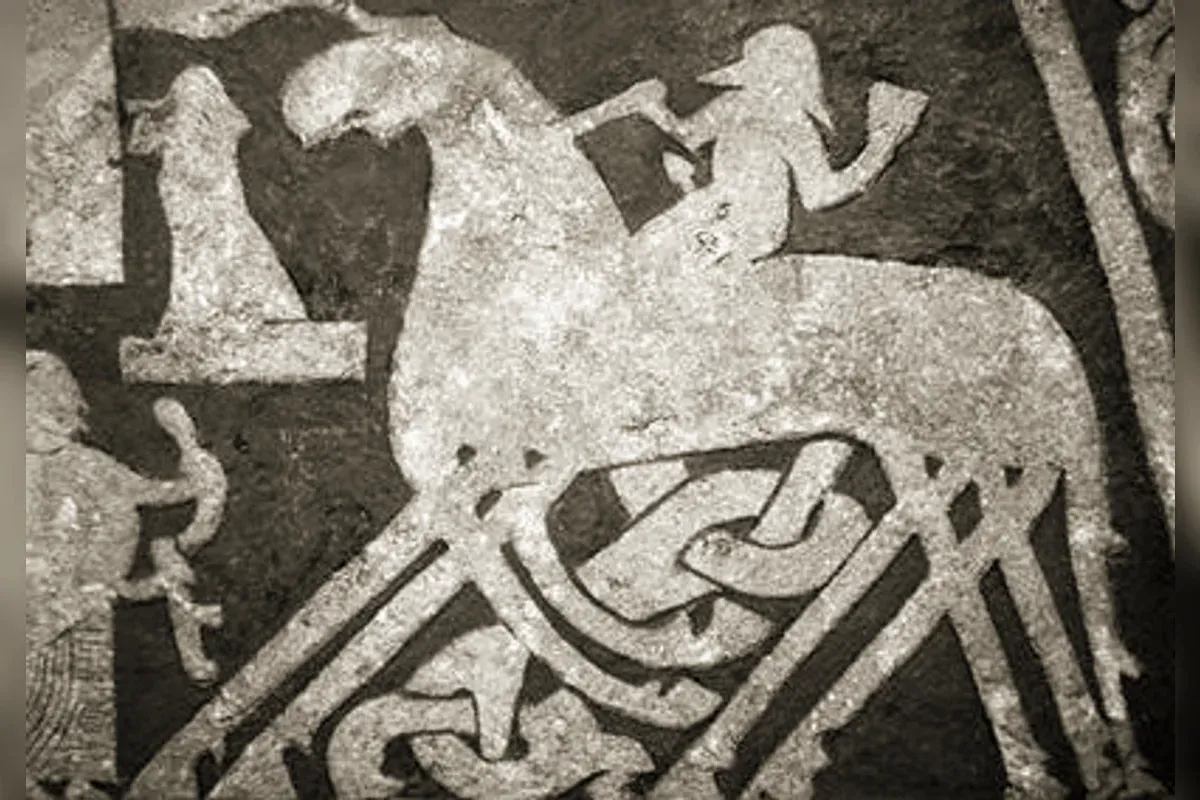
What Is Sleipnir?
Sleipnir is the eight-legged horse of Odin, the most extraordinary mount in all of Norse mythology. Born of a union as improbable as it is central to the mythic cycle — that of Loki shapeshifted as a mare and the stallion Svaðilfari — Sleipnir surpasses in speed every horse in the nine worlds and can cross the boundaries between the living and the dead. He is less an animal than a cosmic instrument: the mount that allows Odin to traverse every frontier of the universe.
Birth: The Building of Asgard’s Walls and Loki’s Trick
The story of Sleipnir’s birth begins with a rash promise from the Aesir. A giant builder offers to construct the walls of Asgard in a single winter, in exchange for the sun, the moon, and the goddess Freya as his wife. The gods agree on the condition that he works without any human help, certain the feat is impossible. But the giant has an unexpected ally: his stallion Svaðilfari, of prodigious strength, who hauls enormous boulders by himself.
When it becomes clear the construction will be completed on time, Loki — who had proposed the original bargain — is compelled by the gods to find a solution. He shapeshifts into a mare and appears before Svaðilfari in the evening, luring the stallion away from the site. The stallion, distracted, abandons his master and pursues the mare through the forest all night.
The giant, robbed of his stallion, cannot finish the wall in time and is killed by Thor. Loki, meanwhile, disappears into the woods for several months in the form of a mare. When he returns to Asgard, he brings with him a grey foal with eight legs: Sleipnir. He gives the colt to Odin.
The Eight Legs: A Cosmic Symbol
Sleipnir’s eight legs go unexplained in the Norse texts — their meaning is implicit and has generated many interpretations.
The most widespread reading sees in the eight legs an evocation of the boundaries between worlds: four legs in the realm of the living, four in the realm of the dead. Sleipnir is as much a psychopomp horse as a war mount. His morphology reflects his role: he can go where no other horse can.
Other readings connect the eight legs to a funeral bier carried by four bearers — eight hands, eight legs — evoking the ritual passage of the dead to the afterlife. This interpretation aligns well with Sleipnir’s function as the mount of Odin, lord of the gloriously dead.
Sleipnir in Myth: Messenger Between Worlds
Sleipnir’s primary role in the narratives is to enable Odin to cross spaces inaccessible to other gods.
The most fully developed account involves the Death of Baldr: after the death of the beloved god Baldr, Odin rides Sleipnir to the grave of a dead seeress to wake her spirit and ask whether Baldr can return from the dead. Sleipnir is here clearly a horse capable of crossing the border between the living and the dead.
In another tradition recorded in the poetic sources, it is Hermóðr — a son or servant of Odin — who rides Sleipnir down into Helheim to negotiate Baldr’s release with the goddess Hel. This journey to the realm of the dead, accomplished in a matter of days on Sleipnir’s back, confirms the horse’s unique capacity to cross cosmic boundaries.
Sleipnir and Loki’s Monstrous Family
Sleipnir is one of Loki’s most unusual children — the only one born from the trickster’s own transformation into a female animal. He joins the monstrous constellation that Loki sires:
- Fenrir — the monstrous wolf prophesied to devour Odin at Ragnarök
- Jörmungandr — the World Serpent that encircles Midgard
- Hel — the goddess of the ordinary dead, ruler of Helheim
But unlike his siblings — creatures of cosmic destruction — Sleipnir is a beneficial being: he is not an enemy of the gods but their instrument. This difference comes from his mother: while Fenrir and Jörmungandr share the nature of sons of Loki, Sleipnir was born of a voluntary, ritualized union of Loki himself, not a hidden liaison with the giantess Angrboða. Sleipnir is Loki’s gift to Odin — the trickster’s only child who serves order rather than chaos.
What the Sources Say
The account of Sleipnir’s birth appears primarily in the Gylfaginning of Snorri Sturluson (Prose Edda, c. 1220), which describes the episode of Asgard’s wall-building in detail. The Grímnismál (Poetic Edda) names Sleipnir as the best of all horses. The Sigrdrífumál alludes to his eight legs in a runic context. The Hyndluljóð lists Sleipnir among Loki’s children. These scattered references, internally consistent, confirm that Sleipnir was a well-established figure in Norse cosmology.
Further Reading
For the master who rides Sleipnir across all frontiers, read the page on Odin. For Sleipnir’s father and the Norse trickster who gave him to Odin, read the page on Loki. For the narrative that sends Sleipnir on his most famous journey into the realm of the dead, read The Death of Baldr. For Sleipnir’s cosmic brother, the wolf destined to devour Odin, see the page on Fenrir. For the final battle at which Odin rides for the last time to face his fate, read Ragnarök.
See also
Related entries
Stories featuring this entity
Frequently asked questions
Why does Sleipnir have eight legs?
The Eddas never explicitly explain Sleipnir's eight legs. Interpretations vary: they may symbolize supernatural speed (two horses fused), the crossing of boundaries (four legs in the living world, four in the dead), or evoke a funeral bier carried by four bearers. Snorri offers no explanation — the detail is accepted as a marker of Sleipnir's cosmic nature.
How did Loki become Sleipnir's mother?
To help Asgard, Loki shapeshifted into a mare and lured the stallion Svaðilfari away from a construction site, preventing a giant builder from finishing Asgard's walls on time. The union of Loki-as-mare and Svaðilfari produced Sleipnir, whom Loki then gave to Odin. This episode — the most transgressive in Norse mythology — makes Loki the mother of a war god's greatest tool.
What happens to Sleipnir at Ragnarök?
The Norse sources do not explicitly describe Sleipnir's fate at Ragnarök. Odin is devoured by Fenrir during the final battle, but what becomes of his horse is left unspoken. The silence may indicate that the tradition was lost, or that Sleipnir, born outside ordinary cosmic laws, simply falls outside the apocalyptic narrative.