Norse mythology · Mythical places
Yggdrasil, the World Tree of Norse Mythology
Yggdrasil, the cosmic world tree in Norse mythology: the nine realms it connects, its guardian creatures, Odin's sacrifice for the runes, and its role at Ragnarök in the Eddas.
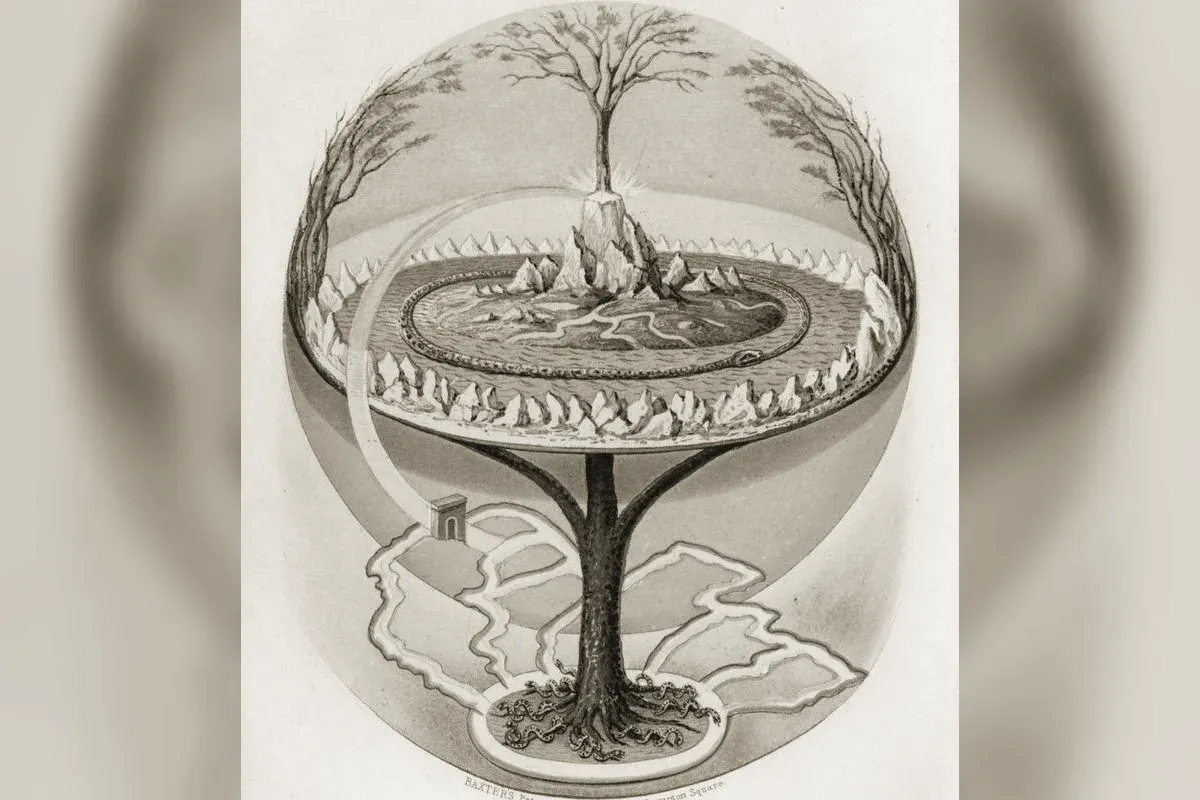
What Is Yggdrasil?
Yggdrasil is the cosmic world tree of Norse mythology — a vast ash whose roots plunge into the foundations of the universe and whose branches hold the nine worlds. It is not merely a sacred tree: it is the axis of the Norse cosmos (axis mundi), the backbone of all creation, without which the universe would collapse. To understand Yggdrasil is to understand the fundamental architecture of Norse cosmology.
The Three Roots and Three Wells
Yggdrasil grows from three roots, each descending toward a different realm — and each root plunges into a well of particular cosmic importance.
The first root extends to Asgard, home of the Aesir. Beneath it lies the Well of Urðr (Urðarbrunnr), tended by the three Norns — Urðr (What Was), Verðandi (What Is), and Skuld (What Shall Be). These goddesses of fate water the roots of Yggdrasil daily with the sacred water of the well and lay white clay around them to nourish the tree. This is where the Aesir hold their daily council of justice.
The second root reaches Jötunheimr, the realm of the giants. There lies the Well of Mimir (Mímisbrunnr), the source of all wisdom and knowledge. Odin sacrificed his right eye here for the right to drink from this well — the price of infinite wisdom is always a sacrifice.
The third root descends into Niflheim, the realm of primordial mist and the ordinary dead. It draws from the well Hvergelmir, the source of all rivers in the world. This is where the dragon Níðhöggr gnaws ceaselessly at the roots of Yggdrasil from below.
The Creatures of the Tree
Yggdrasil is inhabited by a constellation of beings who maintain or threaten its existence.
Níðhöggr, the dragon (or cosmic serpent), gnaws relentlessly at the roots of the tree from Niflheim. Countless serpents assist him. This permanent degradation gives Yggdrasil a tragic character: the world tree is itself condemned to be slowly consumed by the forces below.
At the top of the tree lives an unnamed eagle of prodigious size, with the hawk Veðrfölnir perched between its eyes. This eagle and Níðhöggr are permanent enemies — and it is the squirrel Ratatöskr who races up and down the trunk between them, carrying insults and feeding their hostility. This vertical conflict between eagle (height, order) and dragon (depth, chaos) is a metaphor for the fundamental cosmic tension.
Four stags — Dáinn, Dvalinn, Duneyrr, and Duraþrór — graze on the branches and nibble its shoots. Below, Níðhöggr and his serpents gnaw the roots. Yggdrasil regenerates under the Norns’ constant care — but it is always on the edge of collapse.
Odin’s Sacrifice and the Runes
The myth of Odin’s self-sacrifice on Yggdrasil is one of the most significant in Norse mythology, found in the Hávamál (Poetic Edda):
Odin hangs himself from Yggdrasil, pierced by his own spear Gungnir, with no food or water, for nine nights and nine days. This ordeal is a voluntary sacrifice of himself to himself — myself given to myself, in the words of the Hávamál. At the end of this shamanic ritual, the runes appear to him in the depths of the tree. He seizes them, cries out, and falls back from the tree enriched with the most powerful knowledge in the cosmos.
This myth makes Yggdrasil far more than a backdrop: it is the site of ultimate revelation, the liminal space between death and knowledge, between sacrifice and power. Loki himself will later be bound to a rock in a scene that echoes this ordeal — hanging from the tree as a foundational cosmic act.
Yggdrasil in the Cosmology of the Nine Worlds
Yggdrasil is not only a tree: it is the communication network between all the worlds. The gods travel through the tree to pass from Asgard to Midgard. Messengers of the Aesir use its branches as transit routes. The Norns read destinies there. The souls of the dead pass through it toward their respective destinations.
The tree connects notably:
- Midgard (the human world) to Asgard (the gods) — via the Bifröst, the rainbow bridge leading from Asgard
- Midgard to Helheim — via the roots descending into Niflheim
- The worlds of giants (Jötunheimr) to the worlds of elves and dwarves
Jörmungandr, the World Serpent, son of Loki, lies in the ocean that encircles Midgard — he is the aquatic counterpart of Níðhöggr, gnawing at the world’s foundations from the waters just as Níðhöggr gnaws from the roots.
Ragnarök and the Tree’s Survival
At Ragnarök, Yggdrasil trembles and groans. The Völuspá describes its convulsions as the forces of chaos are unleashed. Fenrir breaks his chains, Jörmungandr rises from the ocean, Surtr crosses the seas with his flames.
But Yggdrasil survives — at least in part. Two humans, Líf (Life) and Lífþrasir (Life’s Survivor), hide within the tree during the apocalypse and emerge when the world is reborn from the waters. They are the ancestors of the new humanity. Yggdrasil is therefore both the witness of the end and the cradle of the new beginning.
What the Sources Say
The Gylfaginning of Snorri Sturluson (Prose Edda, c. 1220) gives the most systematic description of Yggdrasil: its three roots, three wells, and their inhabitants. The Völuspá (Poetic Edda) evokes the tree in connection with the fate of the gods and its own anguish at Ragnarök. The Hávamál contains the account of Odin’s sacrifice and his discovery of the runes. The Grímnismál describes the four stags and the creatures dwelling in the tree. The consistency among these texts confirms that Yggdrasil was a genuine and ancient conception of Norse cosmology, not a late invention of Snorri’s.
Further Reading
For the god whose very name is embedded in the tree’s name, and who sacrificed himself upon it to obtain the runes, read the page on Odin. For the cosmic serpent who encircles Midgard and represents the aquatic counterpart to Níðhöggr’s gnawing, see the page on Jörmungandr. For Loki’s son whose chaining prefigures his liberation at Ragnarök, read the page on Fenrir. For the final cosmic upheaval in which Yggdrasil itself trembles, see Ragnarök. For Odin’s great hall in Asgard whose goat grazes on the leaves of Yggdrasil, see the page on Valhalla. For the account of the birth of the cosmos ordered around the world-tree, read the Norse creation myth.
See also
Stories featuring this entity
Frequently asked questions
What are the nine worlds connected by Yggdrasil?
The nine worlds (níu heimar) include Asgard (the Aesir gods), Vanaheim (the Vanir gods), Álfheimr (light elves), Midgard (humans), Jötunheimr (giants), Svartálfaheimr (dwarves), Niflheim (primordial mist), Múspellsheim (primordial fire), and Helheim (the ordinary dead). Their precise arrangement varies by source, but Yggdrasil is always their central axis.
Why does Odin hang from Yggdrasil?
According to the Hávamál (Poetic Edda), Odin hangs himself from Yggdrasil for nine nights and nine days, pierced by his own spear, with no food or water — a sacrifice of himself to himself. At the end of this voluntary ordeal, the runes appear to him in the depths of the tree. This shamanic ritual grants him knowledge of the runes and their magical powers.
What happens to Yggdrasil at Ragnarök?
The sources describe Yggdrasil trembling and groaning at Ragnarök as the forces of chaos are unleashed. Some traditions suggest that the tree's survival — at least partial — allows the world to be reborn after the catastrophe. Two humans, Líf and Lífþrasir, hide within the tree and emerge to repopulate the new world.