Norse mythology · Heroes & mortals
Sigurd, the dragon-slayer of Norse mythology
Sigurd Fafnisbane in Norse mythology: the reforged sword Gram, Andvari's cursed gold, the slaying of the dragon Fafnir, and the waking of the valkyrie Brynhild.
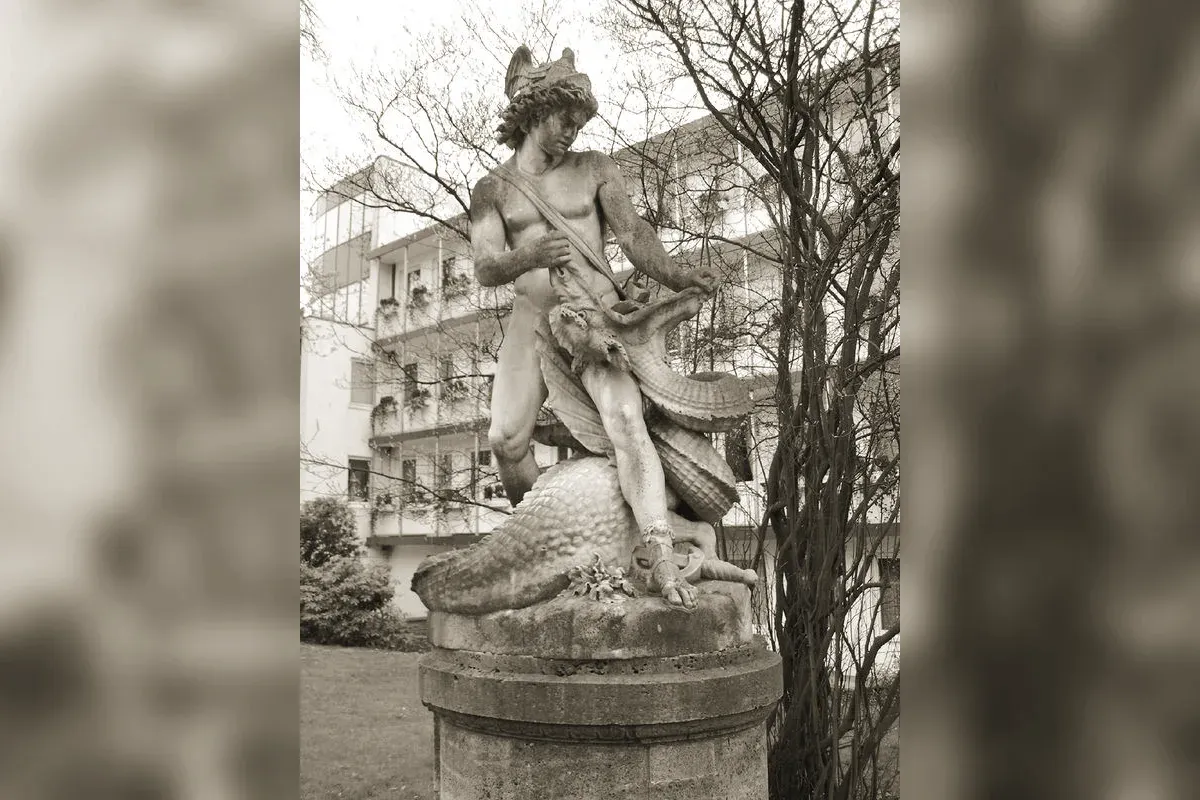
Who is Sigurd?
Sigurd is the greatest legendary hero of the Norse tradition — the last descendant of the Volsung line, whose ancestry traces back to Odin himself. Slayer of the dragon Fafnir, unwitting heir to a cursed treasure, and tragic lover of the valkyrie Brynhild, his story occupies a distinct place in Norse mythology: unlike myths that feature the gods themselves, Sigurd’s saga belongs to the legendary register of human heroes — yet it is told with the same cosmic gravity as Ragnarök.
The Volsung line and the broken sword
Sigurd is the son of Sigmund, a Volsung king descended from Odin, and Hjördís. Before his birth, Sigmund dies in battle after Odin himself — disguised as a one-eyed old man — shatters his sword with a blow of his spear, ending the father’s fate to make way for the son’s. Hjördís keeps the shards of the broken blade and passes them on to her son.
Sigurd is raised at the court of King Hjálprek by Regin, a dwarf smith of extraordinary skill, who becomes his tutor. At Sigurd’s request, Regin reforges the fragments of his father’s sword into a new blade: Gram, sharp enough to split an anvil and cut a tuft of wool floating on a stream.
Andvari’s cursed gold
Regin has hidden reasons for helping Sigurd. His brother Fafnir guards a colossal hoard, the product of an old debt: Regin, Fafnir, and their father Hreidmar had once demanded payment in gold from the gods Loki, Odin, and Hœnir, after Loki killed their brother Ótr, who had taken the shape of an otter. To pay the debt, Loki had seized the treasure of the dwarf Andvari, including his magic ring Andvaranaut — and Andvari, furious, cursed the entire hoard: it would bring death to whoever possessed it.
Consumed by greed, Fafnir kills his own father to claim the treasure alone, then transforms into a dragon to guard it in the wilderness of Gnitaheiðr. Regin, left with nothing, raises Sigurd for the sole purpose of using him against his brother and reclaiming the gold for himself.
The slaying of Fafnir
On Regin’s advice, Sigurd digs a pit along the path Fafnir takes to drink. Hidden in the pit, he waits for the dragon to crawl overhead, then pierces its belly — its only vulnerable spot — with Gram. Dying, Fafnir reveals to Sigurd the curse attached to the gold and warns him of Regin’s imminent treachery.
The dragon’s blood and Regin’s betrayal
Regin asks Sigurd to roast Fafnir’s heart for him. Testing whether it is cooked, Sigurd burns his finger and puts it to his mouth — unwittingly tasting the dragon’s blood. At once, he understands the speech of birds: nuthatches perched nearby warn him that Regin is about to kill him to keep all the gold for himself. Sigurd strikes first and beheads Regin, then eats part of the dragon’s heart himself and takes the entire hoard, including the ring Andvaranaut — becoming Fafnisbane, “the slayer of Fafnir.”
The waking of Brynhild
Riding his horse Grani (a descendant of Sleipnir), Sigurd crosses a wall of flame on Mount Hindarfjall and discovers a sleeping warrior woman, sealed inside armor impossible to remove. He cuts the metal with Gram and wakes Brynhild, a valkyrie punished by Odin — in some versions identified with Sigrdrífa — for disobeying him by granting victory to the wrong side in a battle. She teaches Sigurd the wisdom of the runes, and the two swear eternal love.
Tragedy at the court of the Gjukungs
Sigurd arrives at the court of King Gjúki, where Queen Grímhild, skilled in magic, gives him a potion of forgetfulness that erases his memory of Brynhild. He marries Gudrun, Gjúki’s daughter, and helps his brother-in-law Gunnar win Brynhild by crossing the wall of flame himself in Gunnar’s shape — the deception that seals the coming catastrophe.
When Brynhild discovers the truth, her fury and sense of betrayal bring about Sigurd’s death: he is murdered in his bed by Guttorm, Gunnar’s brother, driven to the killing by the schemes of Grímhild and her sons. Brynhild takes her own life soon after to join Sigurd on his funeral pyre — the conclusion of a tragedy in which Andvari’s cursed gold keeps striking long after the dragon’s death.
Variants: the Völsunga saga and the continental tradition
The Völsunga saga (Iceland, 13th century) and several poems of the Poetic Edda — Reginsmál, Fáfnismál, Sigrdrífumál — form the most detailed Norse version of the cycle. The continental Germanic tradition, recorded in the Nibelungenlied (Germany, c. 1200), tells a related story under the name Siegfried, with notable differences: the role of Kriemhild (Gudrun) becomes central after the hero’s death, and Brynhild’s runic, shamanic dimension is largely erased in favor of a courtly, feudal plot.
Legacy: runestones and the Ring of the Nibelung
Sigurd’s fight against Fafnir is one of the most frequently depicted motifs in Viking art: several Swedish runestones (including the famous Ramsund carving, 11th century) engrave the full scene — the pit, the sword, the roasted heart, the birds, the beheaded Regin — proof of the legend’s immense popularity well before it was set down in writing. In the 19th century, Richard Wagner drew directly on this cycle for his opera The Ring of the Nibelung, where Sigurd becomes Siegfried and Andvari’s cursed ring becomes a ring of universal power.
What the ancient sources say
The Völsunga saga (Iceland, 13th century) offers the most complete prose account of the cycle, from the Volsung line to Gudrun’s final revenge. The Poetic Edda preserves several poems centered on this episode: the Reginsmál (the forging of Gram and Andvari’s gold), the Fáfnismál (the fight and the dragon’s death), the Sigrdrífumál (the valkyrie’s runic teaching). Snorri Sturluson’s Prose Edda summarizes the cycle in the Skáldskaparmál. The Nibelungenlied (c. 1200) transmits the continental Germanic version under the name Siegfried.
Further reading
For the supreme god from whom the Volsung line descends and who shatters Sigurd’s father’s sword, read the page on Odin. For the cunning god whose theft of Andvari’s treasure sets off the curse, see the page on Loki. For Sigurd’s horse, descended from the fastest of all Norse steeds, consult the page on Sleipnir.
Editorial debt: pages for Regin, Fafnir, Brynhild, and Gudrun are not yet published in English; links to these characters will be activated once they are published, along with a dedicated story about Sigurd’s fight against Fafnir.
Frequently asked questions
Are Sigurd and Siegfried the same hero?
They are two versions of the same legendary figure with a shared Germanic origin. Sigurd is the Norse form, transmitted through the Völsunga saga and the Poetic Edda in Iceland. Siegfried is the continental form, popularized by the German Nibelungenlied (c. 1200). Both share the reforged sword, the cursed treasure, and the slain dragon, but the Icelandic Eddas develop the Brynhild episode and the runic wisdom inherited from the dragon far more fully.
Why does Fafnir's blood let Sigurd understand birds?
While roasting the dragon's heart for Regin, Sigurd burns his finger and instinctively puts it in his mouth to soothe it. This contact with the dragon's blood — a creature of ancient wisdom in Norse cosmology — opens his mind to the speech of birds. That is how he understands the nuthatches warning him that Regin is about to betray him, which saves his life.
What happens to Andvari's cursed gold after Sigurd's death?
Andvari's curse keeps striking: the treasure passes to Gunnar and the Gjukungs after Sigurd's death, bringing about their own ruin later in the legendary cycle (Gunnar's death in Atli's snake pit). The cursed gold thus becomes the connecting thread of the entire saga, directly inspiring Richard Wagner's opera cycle *The Ring of the Nibelung* in the 19th century.