Norse mythology · Mythical places
Valhalla, the Hall of Fallen Warriors in Norse Mythology
Valhalla in Norse mythology: Odin's great hall for the battle-slain, the Einherjar who train daily for war, Valkyries as choosers of the slain, and their purpose at Ragnarök.
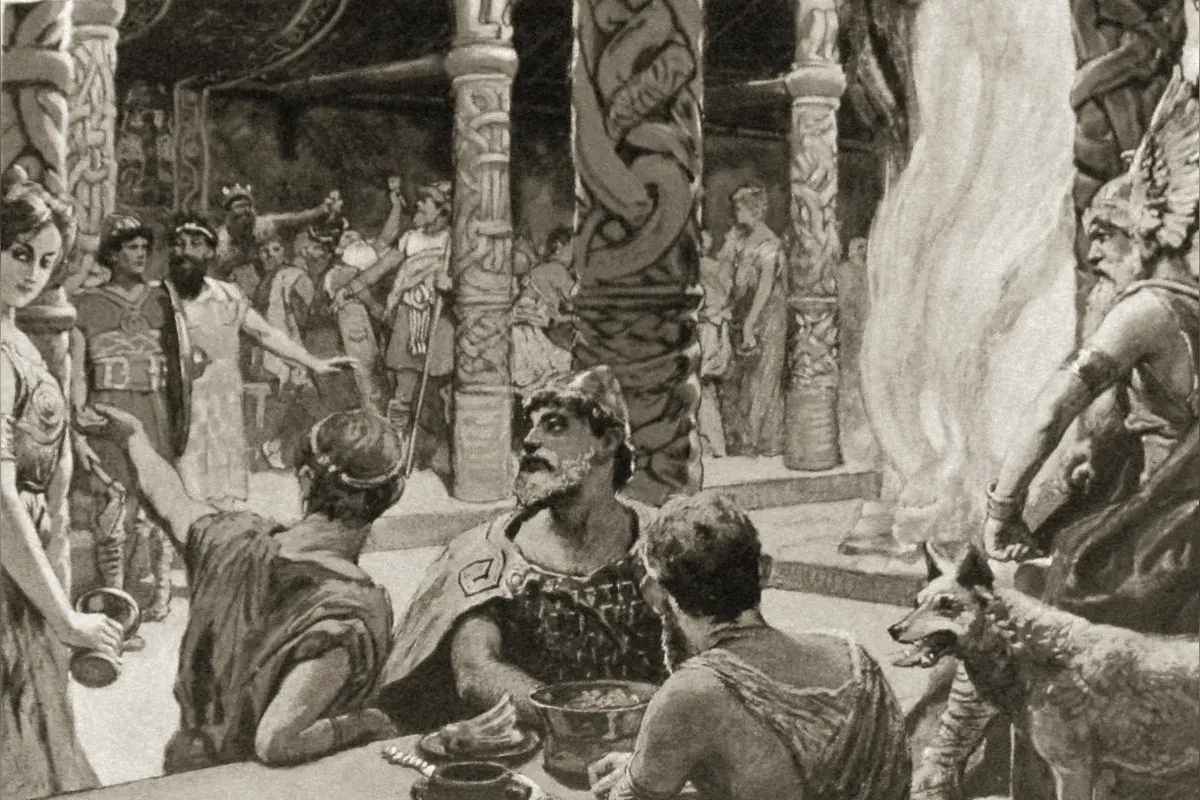
What Is Valhalla?
Valhalla (Valhöll in Old Norse, “hall of the battle-slain”) is the great hall of Odin in Asgard, the city of the Norse gods. There he receives, after their death in combat, the finest warriors — the Einherjar — to prepare them for the final battle of Ragnarök. Valhalla is not a place of rest: it is a transcendent barracks where the greatest fighters in human history battle daily, die and are reborn, until the forces of chaos unleash the apocalypse.
Architecture and Description
Norse texts describe Valhalla as an overwhelmingly grand structure. According to the Grímnismál (Poetic Edda), the hall has 540 doors, each wide enough for 800 warriors to march through abreast — a total of 432,000 fighters who could pour out simultaneously to face Fenrir and the armies of the giants.
The roof is made of golden shields, the rafters of spears. At the entrance stands a wolf; an eagle perches above the gate. The great hall is lit not by fire but by the sheen of weapons themselves. These architectural details are not decorative: every element signals that Valhalla is a space of transcendent warfare, a temple of combat, not a banquet hall.
The Valkyries: Choosing the Slain
The Valkyries (valkyrjur, “choosers of the slain”) are the servants and messengers of Odin. On every battlefield in Midgard, they hover unseen, designating which warriors will die — and which among those dead will be worthy of Valhalla.
Freya, the great Vanir goddess, holds a prerogative explicitly attested in the Eddas: she receives half of all battle-slain into her own domain, Fólkvangr. Odin takes the other half. Valhalla is therefore not the sole destination of the glorious dead — it is Odin’s destination, the one he uses to build his final army.
Selection is not based on bravery alone: Odin needs the most formidable fighters possible for the end of days. A mediocre warrior who survived by luck will not be chosen; a hero who died young in glory will be. Once chosen by a Valkyrie, the dead warrior is escorted to Valhalla.
The Life of the Einherjar: Fight and Feast
Life in Valhalla follows a ritualized, endless cycle: fight by day, feast by night.
Each morning the Einherjar arm and meet in a great melee on the plains of Asgard. Wounds and deaths are real during the day — but at sunset everyone is resurrected, their wounds healed. This daily death-and-resurrection cycle is itself cosmic training: the Einherjar learn to die without fear, until that fear disappears entirely.
In the evening the great hall comes alive. The boar Sæhrímnir is roasted by the cook Andhrímnir — a beast that is resurrected each night to be killed and eaten again the next day. The goat Heiðrún, which grazes on the leaves of Yggdrasil, gives mead in inexhaustible quantities from her udders. The Einherjar drink, recount their deeds, and are served by the Valkyries.
Ragnarök: The Purpose of Valhalla
Valhalla has one purpose alone: to assemble the greatest army possible for Ragnarök.
Odin has known from the beginning — the seeress of the Völuspá revealed it to him — that the end of the gods is inevitable. Fenrir will break his chains. The army of giants will sail on Naglfar, the ship made from dead men’s nails. And the Aesir — Odin, Thor, Tyr — will face these forces with the Einherjar beside them.
The outcome is known in advance: most of the gods will fall. But Odin does not act in resignation — he acts as a strategist. Valhalla is his investment in the apocalypse: by gathering the greatest human warriors in all of history, he gives transcendent meaning to an end he cannot prevent.
The death of Baldr — the first sign that Ragnarök is approaching — sets in motion the chain of events that will free Fenrir and Jörmungandr. This is told in the story of the Death of Baldr.
Cultural Significance and Legacy
Valhalla expresses something essential about Norse cosmology: in a universe condemned to perish, the only honorable response is to prepare and fight. Death in battle is not a punishment or an end — it is an election. It means Odin has judged you worthy of his cause.
This vision stands in sharp contrast to paradises of rest in other traditions. The ethics of drengskapr (Norse warrior honor) and the Icelandic sagas are partly rooted in this cosmology: dying in one’s bed was regarded with a certain sorrow, dying weapon in hand was the ideal death — not out of bloodlust, but because it opened the gates of Valhalla.
The concept of Valhalla has persisted far beyond the Viking Age. It appears in Wagner’s Ring cycle, in 19th-century Romantic art, in contemporary film and video games — a measure of how compellingly the idea of a hall where the dead train for a final battle captures the imagination.
What the Sources Say
The Grímnismál (Poetic Edda) provides the most precise physical description of Valhalla: 540 doors, roof of shields, rafters of spears, wolf guardian, eagle above the gate. The Völuspá places Valhalla within the overall cosmological structure — Odin prepares for Ragnarök there. The Gylfaginning of Snorri Sturluson (Prose Edda, c. 1220) synthesizes these accounts, adding details about Sæhrímnir, Heiðrún, and the Einherjar’s daily life. Skaldic kennings routinely use Valhalla as a poetic reference point for Odin and his function as lord of the slain.
Further Reading
For the master of Valhalla and his unending quest for wisdom, read the page on Odin. For the monstrous wolf who, at Ragnarök, devours Odin outside the gates of Valhalla, see the page on Fenrir. For the goddess who receives the other half of the battle-slain in her domain of Fólkvangr, read the page on Freya. For the death that starts the countdown to Ragnarök, read The Death of Baldr. For the final battle to which Valhalla devotes all its preparation, see Ragnarök.
See also
Stories featuring this entity
Frequently asked questions
Who enters Valhalla in Norse mythology?
Only warriors who died valiantly in battle, chosen by the Valkyries on the battlefield, enter Valhalla. Those who die of illness, old age, or drowning go to other realms — most often the domain of Hel. Freya also claims half of all battle-slain warriors for her own domain, Fólkvangr, before Odin takes his share.
What do the Einherjar do in Valhalla each day?
Every morning the Einherjar arm themselves and fight a great battle on the plains of Asgard. Those killed during the day are resurrected at sunset, fully healed. Every evening they feast in the great hall: the boar Sæhrímnir, resurrected each night, is roasted by the cook Andhrímnir, while the goat Heiðrún yields an inexhaustible supply of mead from her udders.
Is Valhalla a paradise in Norse mythology?
Valhalla is a reward, but not a paradise of rest: it is a divine barracks where warriors train relentlessly for the final battle of Ragnarök. The daily cycle of death and resurrection is a training tool, not a punishment. It is the Norse answer to what gives meaning to death in battle.