Norse mythology · Mythical objects
Mjolnir: Thor's hammer in Norse mythology
Mjolnir, Thor's hammer in Norse mythology: forged by the dwarves Brokkr and Sindri, its handle shortened by Loki's sabotage, and its central role at Ragnarök.
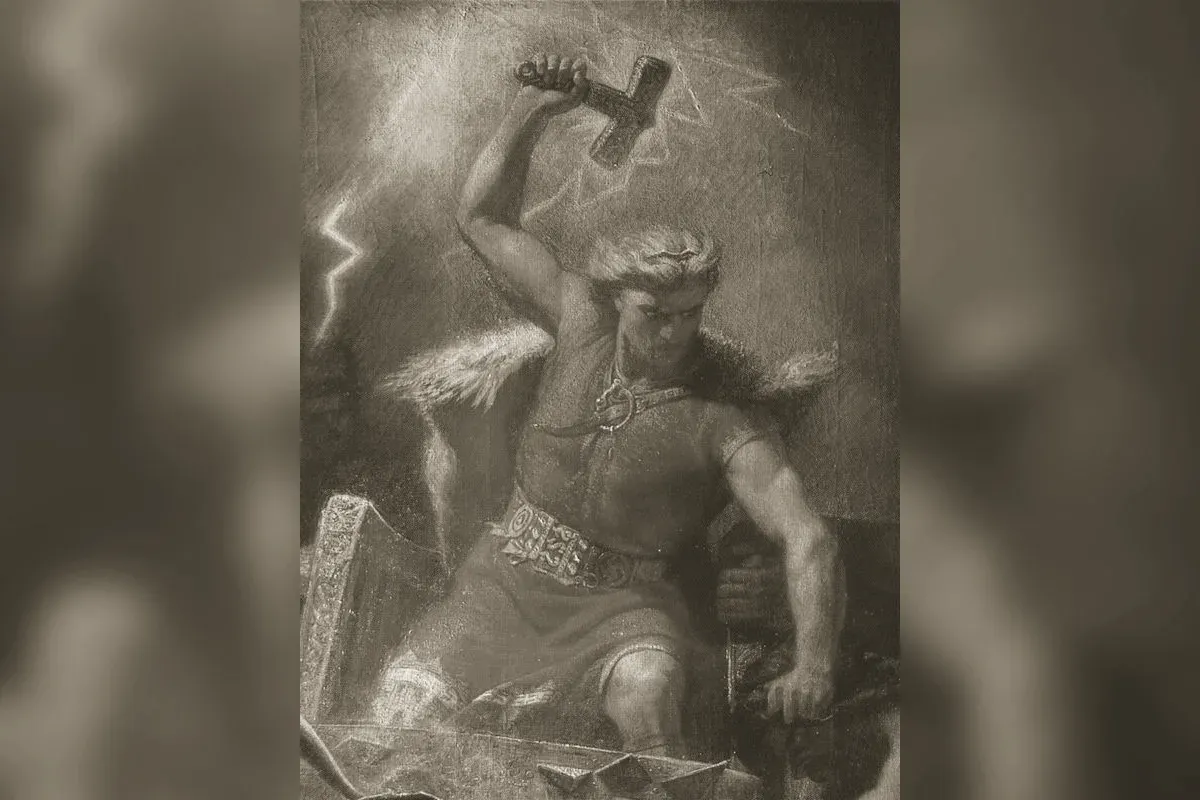
What is Mjolnir?
Mjolnir is the sacred hammer of Thor, the most famous and feared magical object in all of Norse mythology. Far more than a mere weapon, it embodies the protection of Asgard and Midgard against the Giants (Jötnar) and carries divine authority into human rites as well — blessings, weddings, and funerals. Its manufacturing flaw, a handle that is too short, never dented its reputation: the gods themselves regard it as the most precious of all the treasures the dwarves ever forged.
The forging of Mjolnir
The story of Mjolnir’s creation is told in the Skáldskaparmál of the Prose Edda. Loki, after maliciously cutting off the golden hair of Sif, Thor’s wife, must make amends by obtaining new hair from the dwarves along with other compensatory treasures. He challenges two dwarf brothers, Brokkr and Sindri (or Eitri in some versions), to forge gifts even more admirable than those already promised by the Sons of Ivaldi — wagering his own head on the outcome of the contest.
While Sindri works the bellows and Brokkr shapes the metal, Loki, transformed into a fly, does everything he can to sabotage their work and avoid losing his bet. He stings Brokkr on the eyelid at the decisive moment of forging the hammer, forcing him to briefly stop pumping. The result: Mjolnir’s handle comes out too short — a permanent flaw, never corrected.
Despite this imperfection, the gods gathered as judges — Odin, Thor, and Freya — judge Mjolnir superior to all the other gifts, including Odin’s spear Gungnir and the ring Draupnir. The reason: its ability to protect the gods against the Giants outweighs every other consideration, including appearance.
Powers and attributes
Mjolnir combines several properties that make it the most powerful weapon in the Norse pantheon:
- it always returns to Thor’s hand after being thrown, no matter the distance;
- it can reduce a mountain to dust with a single blow;
- it can shrink small enough to be hidden under a tunic — Thor carries it this way when disguised as a bride in the story of the theft of Mjolnir;
- it also serves as an instrument of ritual consecration: Thor uses it to bless weddings, funerals, and newborns, a role that goes well beyond its function as a weapon.
To wield it fully, Thor must wear the iron gloves Jarngreipr, essential for gripping the too-short handle, along with the belt of strength Megingjord, which doubles his power at the moment of the throw.
A talisman feared by the Giants
In Norse stories, the mere sight of Mjolnir is enough to send the Jötnar fleeing. When the giant Thrym steals the hammer and demands Freya’s hand in marriage in exchange for its return, the gods categorically refuse to hand her over — choosing instead to send Thor himself, disguised as a bride, to recover his weapon rather than leave Mjolnir in enemy hands. This story, told in the Þrymskviða of the Poetic Edda, shows just how much the hammer’s possession is a cosmic stake: without it, Asgard loses its principal defense against chaos.
Mjolnir-shaped amulets, worn as pendants, are among the most widespread pieces of jewelry from the Viking Age. They functioned as a pagan counterpart to the Christian cross, and their spread toward the end of the Viking Age is generally read as an identity-driven reaction to Scandinavia’s gradual Christianization.
Mjolnir at Ragnarök
Mjolnir’s ultimate fate is decided at Ragnarök: Thor uses it to shatter the skull of the cosmic serpent Jormungandr, his lifelong enemy, in their final duel. It is the perfect fulfillment of the hammer’s function as the ultimate anti-monster weapon — but the victory is bitter: Thor, poisoned by the dying serpent’s venom, manages only nine steps before collapsing dead. The sources say nothing about what becomes of Mjolnir after its wielder’s death, a silence that has fueled countless speculations in the myth’s modern reception.
What the ancient sources say
The Skáldskaparmál of Snorri Sturluson’s Prose Edda (c. 1220) recounts in detail the forging of Mjolnir by Brokkr and Sindri and Loki’s sabotage. The Þrymskviða, a poem of the Poetic Edda, depicts the theft of the hammer by the giant Thrym and its recovery by a disguised Thor. The Völuspá mentions the deaths of Thor and Jormungandr at Ragnarök without explicitly naming the hammer, but later tradition — notably the Gylfaginning — confirms that it is indeed Mjolnir that fells the serpent. Numerous archaeological hammer-shaped amulets, found throughout Viking Scandinavia, confirm the object’s cultic importance beyond the literary texts.
Further reading
For the god who wields the hammer and protects Midgard, read the page on Thor. For the trickster whose sabotage explains the too-short handle, see the page on Loki. For the goddess whose hand was demanded in exchange for the stolen hammer, consult the page on Freya. For the full story of the hammer’s theft and recovery, read The Theft of Mjolnir. For the cosmic serpent Mjolnir kills at the cost of Thor’s life, see the page on Jormungandr.
See also
Frequently asked questions
Why is Mjolnir's handle so short?
While the dwarves Brokkr and Sindri forge the hammer, Loki, transformed into a fly, stings Brokkr on the eyelid to distract him and sabotage the work. Brokkr misses a beat of the bellows at the critical moment: the handle comes out of the forge shorter than intended. Despite this flaw, the gods judge Mjolnir superior to all the other gifts made by the dwarves, largely because it always returns to Thor's hand after being thrown.
Why does Thor need gloves and a belt to use his hammer?
The iron gloves Jarngreipr are needed to firmly grip Mjolnir's abnormally short handle, while the belt of strength Megingjord doubles Thor's physical power at the moment of the throw. Without these two attributes, even the god of thunder could not fully wield his weapon — a detail underscoring that Thor's strength, though immense, still depends on complementary magical objects.
What happens to Mjolnir at Ragnarök?
At Ragnarök, Thor uses Mjolnir to kill the cosmic serpent Jormungandr with a fatal blow to the head. It is the ultimate fulfillment of the hammer's role as the supreme anti-giant, anti-monster weapon. But the victory is hollow: Thor, poisoned by the dying serpent's venom, collapses nine steps later. The sources say nothing about what becomes of the hammer after its wielder's death.