Norse mythology · Metamorphoses
The Theft of Mjolnir: Thor disguised as a bride in Norse mythology
The theft of Mjolnir by the giant Thrym: Thor's disguise as a bride, Loki's scheme, and the bloody vengeance that closes the most comic story in the Eddas.
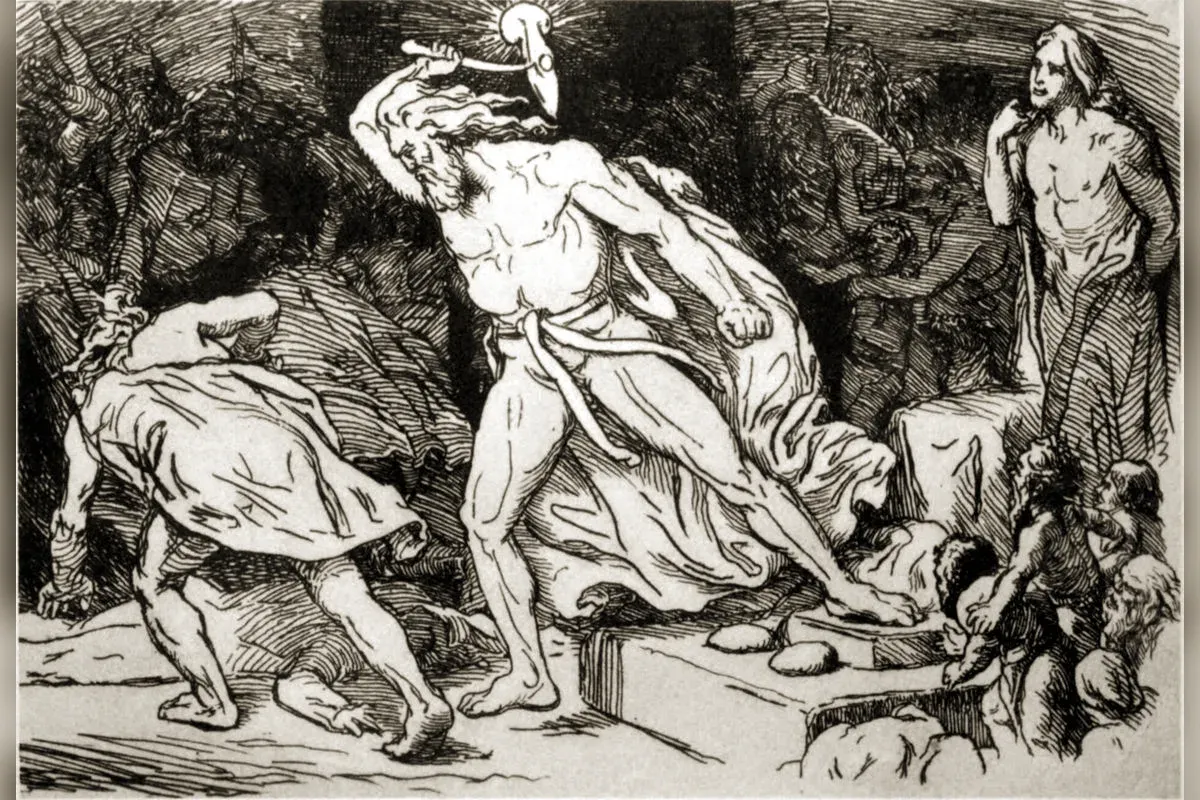
The most comic story in the Eddas
The theft of Mjolnir — told in the poem Þrymskviða of the Poetic Edda — is one of the few Norse stories to treat a major cosmic stake in an openly comic register. It shows Thor forced to disguise himself as a bride to recover his stolen hammer, with Loki’s help. For the full biography of the hammer at the heart of this plot, see the page on Mjolnir; this story details how the scheme itself unfolds.
The vanished hammer
Thor wakes up one morning to discover that Mjolnir has vanished. His reaction is immediate and disproportionate: his hands shake with rage, his beard bristles — a god deprived of his weapon is a god deprived of his protective function. He rushes to Loki to announce the disaster: without the hammer, Asgard no longer has any serious defense against the Giants.
Loki flies to Jotunheim
To locate the hammer, Loki borrows Freya’s falcon-feather cloak, which she lends without hesitation — “I would give it to you even if it were made of gold, even if it were made of silver,” she tells him according to the poem. Transformed, Loki flies across the sky to Jotunheim, the realm of the Giants.
There he finds Thrym, king of the Giants, sitting calmly on a mound, braiding gold collars for his dogs and grooming his horses’ manes — an image of almost insolent serenity. Thrym admits without hesitation: he has buried Mjolnir eight leagues underground, and he will only return it on one condition — obtaining Freya’s hand in marriage.
Freya’s refusal
Loki returns to Asgard and delivers Thrym’s demand. When Freya learns she must marry a giant so that Thor can recover his weapon, her fury is such — the poem says — that the entire hall of the Aesir shakes and the famous necklace Brísingamen snaps clean off her chest. She refuses categorically: she will never consent to this marriage.
Heimdall’s counsel and Loki’s scheme
Faced with the impasse, the Aesir gather in council. Heimdall, the keen-sighted guardian, proposes a radical solution: that Thor himself go to Thrym, disguised as Freya. Thor first refuses vehemently — the idea of wearing a bridal gown and passing as a woman seems an unbearable humiliation for the most virile god in the pantheon.
It is Loki who convinces him, with an unanswerable argument: without Mjolnir, the Giants will soon settle in Asgard itself. Thor gives in. Loki offers to accompany him, disguised as a maidservant, to steer the scheme through to the end.
The disguise and the banquet at Thrym’s hall
Thor is dressed in a bridal gown, crowned with a wedding veil, adorned with the Brísingamen necklace, and hung with the keys of a lady of the house — the complete regalia of a noble Norse bride. Loki, disguised as a maidservant, accompanies him to Jotunheim.
At Thrym’s hall, the wedding feast begins. The “bride” devours an entire ox by herself, eight salmon, and all the delicacies prepared for the women, then washes it down with three casks of mead. Thrym, astonished, wonders aloud at this extraordinary appetite. Loki, the watchful maidservant, immediately explains: Freya has eaten nothing for eight days, so great was her impatience to reach Jotunheim.
When Thrym lifts the veil to kiss his betrothed, he recoils, terrified by the blazing gaze that pierces through the fabric — eyes that seem to burn like embers. Loki explains again: Freya has not slept for eight nights, so consumed is she by her desire for this marriage.
Mjolnir laid on the “bride’s” lap
Reassured by Loki’s explanations, Thrym orders that Mjolnir be brought out to bless the union according to custom: the hammer must be laid on the bride’s lap as a pledge of fertility and the marriage’s legitimacy.
The moment the hammer touches his lap, Thor closes his hands around it. The disguise falls away: he rises to his full divine stature and slaughters Thrym and every Giant present at the banquet, including Thrym’s sister, who had rashly demanded a wedding gift. The story ends with this lightning revenge: Thor returns to Asgard, his hammer recovered, his honor restored by the very violence that closes out the scheme.
The story’s significance
Beneath its openly comic tone — unusual within the generally solemn Eddic corpus — the Þrymskviða asserts a serious cosmological truth: Mjolnir is not a mere decorative attribute, it is the very condition of Asgard’s safety. Its loss, even temporary, justifies any sacrifice of dignity, even for the proudest god in the pantheon. The story also shows a rarer side of Loki: the usually destructive trickster here puts his ingenuity loyally at the service of the Aesir, with no apparent ulterior motive — a reminder that his mythological role, before Baldr’s death, swings between complicity and sabotage.
What the ancient sources say
The Þrymskviða (“The Lay of Thrym”), a poem of the Poetic Edda preserved in the Codex Regius (13th century) but likely composed earlier, is the only complete source for this story — one of the most narrative and accessible poems in the collection, often cited as an example of the humor distinctive to Norse literature. No parallel version appears in Snorri Sturluson’s Prose Edda, which does not explicitly reference it, suggesting the story belonged to a popular oral tradition independent of the great cosmogonic cycles.
Further reading
For the object at the heart of this plot and its full history, read the page on Mjolnir. For the god who must temporarily sacrifice his dignity to protect Asgard, see the page on Thor. For the trickster whose cunning saves the Aesir here rather than ruining them, consult the page on Loki. For the goddess whose hand was nearly promised to a giant, read the page on Freya.
Story beats
- 01Thor wakes up and discovers that Mjolnir has vanished
- 02Loki borrows Freya's feather cloak to fly to Jotunheim
- 03The giant Thrym admits he has buried the hammer and demands Freya's hand in exchange
- 04Freya categorically refuses to marry a giant
- 05Loki convinces Thor to disguise himself as the bride to infiltrate Thrym's banquet
- 06Thor, veiled, devours an entire feast and frightens Thrym with his blazing eyes
- 07Mjolnir is laid on the 'bride's' lap for the blessing; Thor seizes it and slaughters every giant present
Ancient sources
- Þrymskviða (Poetic Edda, 11th-13th century)
- Gylfaginning, Snorri Sturluson's Prose Edda (c. 1220), indirect references
See also
Frequently asked questions
Why does Thor agree to disguise himself as a bride?
He first refuses categorically — the humiliation feels unbearable to him. It is Loki who convinces him by pointing out that there is no other option: without Mjolnir, the Giants would soon invade Asgard itself. Thor therefore accepts a sacrifice of personal dignity to preserve the gods' cosmic safety, a logic of necessity that overrides his usual pride.
Why doesn't Thrym recognize Thor under his disguise?
The Þrymskviða plays on situational comedy: Thrym, blinded by his desire to marry Freya, interprets every suspicious sign — the 'bride's' devouring appetite, her fiery gaze piercing the veil — as proof of Freya's romantic impatience rather than a warning sign. Loki, disguised as a maidservant, supplies a reassuring explanation each time that dispels his doubts.
Does this story carry a more serious meaning beneath the comedy?
Beneath its farcical tone, the Þrymskviða asserts a serious cosmological truth: Mjolnir is the only truly effective defense Asgard has against the Giants, to the point that losing it, even temporarily, justifies any humiliation for the proudest god in the pantheon. The story also reminds us that Loki, often the architect of chaos, can put himself loyally at the service of the Aesir when their collective survival is at stake.