Greek mythology · Heroes & mortals
Priam, last king of Troy in Greek mythology
Priam of Troy: the boy ransomed by his sister, the father of fifty sons, and the night he kissed the hands of the man who killed Hector.
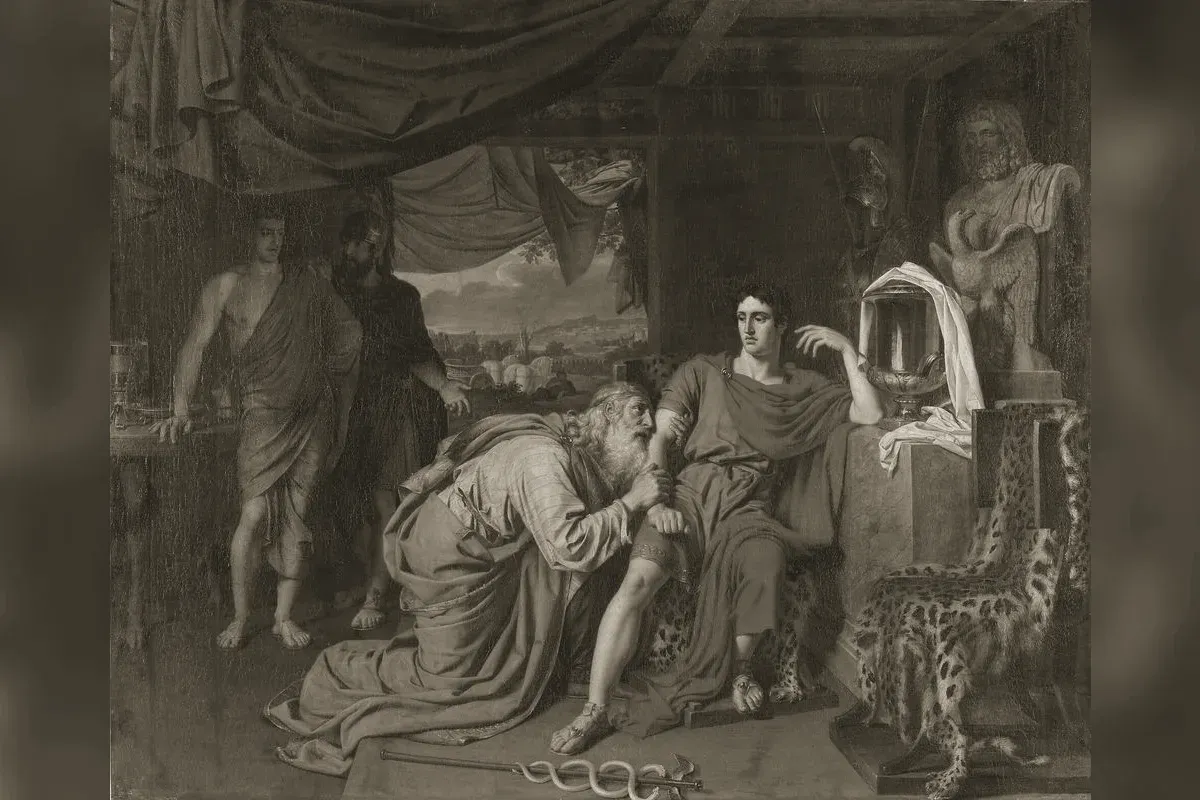
Priam is the last king of Troy, husband of Hecuba, father of Hector, and the man the Iliad saves for its final scene. Homer had twenty-four books in which to end his poem with a battle, a victory, or a death. He ended it with an old man asking for a body back.
The boy who was bought
Priam is not born a king and is not born with that name. He is Podarces, youngest son of Laomedon, when Heracles sacks Troy over a broken promise and kills the king and all his sons but one.
His sister Hesione is given the right to choose one captive to free. She chooses her brother. Heracles rules that he must first be sold as a slave, so she takes off her veil and hands it over as the purchase price. From that day, the tradition says, he is called Priam — from priamai, “I buy”. The etymology is almost certainly a Greek folk explanation of a genuinely Anatolian name, but the story stuck because it is a good one: the king who will spend his last night buying back a corpse began his life being bought.
He rebuilds. By the time the Iliad opens, Troy is rich again and Priam has fifty sons, nineteen of them by Hecuba — a household so large that Homer describes its colonnaded courtyards room by room.
An old man on the wall
Priam does not fight. He is too old, and the poem uses that: while others act, he watches, which makes him the Iliad’s designated witness to loss.
From the Scaean Gate he identifies the Greek champions for Helen, courteously and without reproach. From the same wall, in Book 22, he watches Achilles run his eldest son down, and begs Hector to come inside — tearing his hair, offering arguments, describing his own future death among his dogs. Hector stays. Priam watches him die, and then watches the body dragged behind a chariot.
Book 24
Twelve days later he loads a wagon with treasure and drives it alone, at night, into the camp of the army besieging his city, guided by Hermes past the sentries. He walks into the shelter of the man who has killed most of his sons, and no one sees him enter.
Then he does the thing the whole poem has been moving toward. He takes Achilles’ hands and kisses them — Homer says it precisely: the terrible man-slaying hands that had killed so many of his sons. He asks Achilles to think of his own father, Peleus, who is also old, also waiting for a son he will not see again.
Achilles weeps for Peleus and for Patroclus; Priam weeps for Hector; and they weep in the same room, together, until Achilles raises him from the floor. He gives back the body, has it washed out of Priam’s sight so the old man will not break down and provoke him, and grants a truce of eleven days for the funeral.
The Iliad — a poem about rage, announced in its first word — ends with the funeral of Hector, tamer of horses, made possible because two enemies recognised each other as men who had lost someone.
The altar
Homer stops there. The rest of the tradition does not.
In the sack of Troy, told in the lost Iliou Persis and given its definitive form by Virgil, Priam sees his son Polites cut down in front of him, puts on armour he can no longer carry, throws a spear that barely reaches its target, and is killed by Neoptolemus, Achilles’ son, at the altar of Zeus in his own courtyard — dragged through his son’s blood and struck down at the hearth of the household god of guests and suppliants.
Virgil ends the scene with a line that Roman readers understood as an epitaph for empire: a huge trunk lying on the shore, a head torn from the shoulders, a body without a name.
Ancient sources
- Homer, Iliad, 3.161-244; 22.25-92; 24.468-676
- Virgil, Aeneid, 2.506-558
- Apollodorus, Library (3.12.3-5) and Epitome, 5.21
See also
Related entries
Stories featuring this entity
Frequently asked questions
What happens when Priam goes to Achilles' tent?
He drives a wagon of treasure alone, at night, into the camp of the army besieging his city, guided past the sentries by Hermes. Then he takes Achilles' hands and kisses them — Homer says it precisely: the terrible man-slaying hands that had killed so many of his sons — and asks him to think of his own father. They weep in the same room until Achilles raises him from the floor, returns the body and grants eleven days of truce.
How does Priam die?
Homer stops before the sack, so his death belongs to the lost Iliou Persis and, definitively, to Virgil. He sees his son Polites cut down in front of him, puts on armour he can no longer carry, throws a spear that barely reaches its target, and is killed by Neoptolemus at the altar in his own courtyard — the hearth of the god who protects guests and suppliants.