Greek mythology · Heroes & mortals
Hector, prince of Troy and champion of the Trojans in Greek mythology
Hector, son of Priam, defender of Troy, his fatal duel with Achilles, and why Homer's most human hero embodies duty, love, and tragic fate.
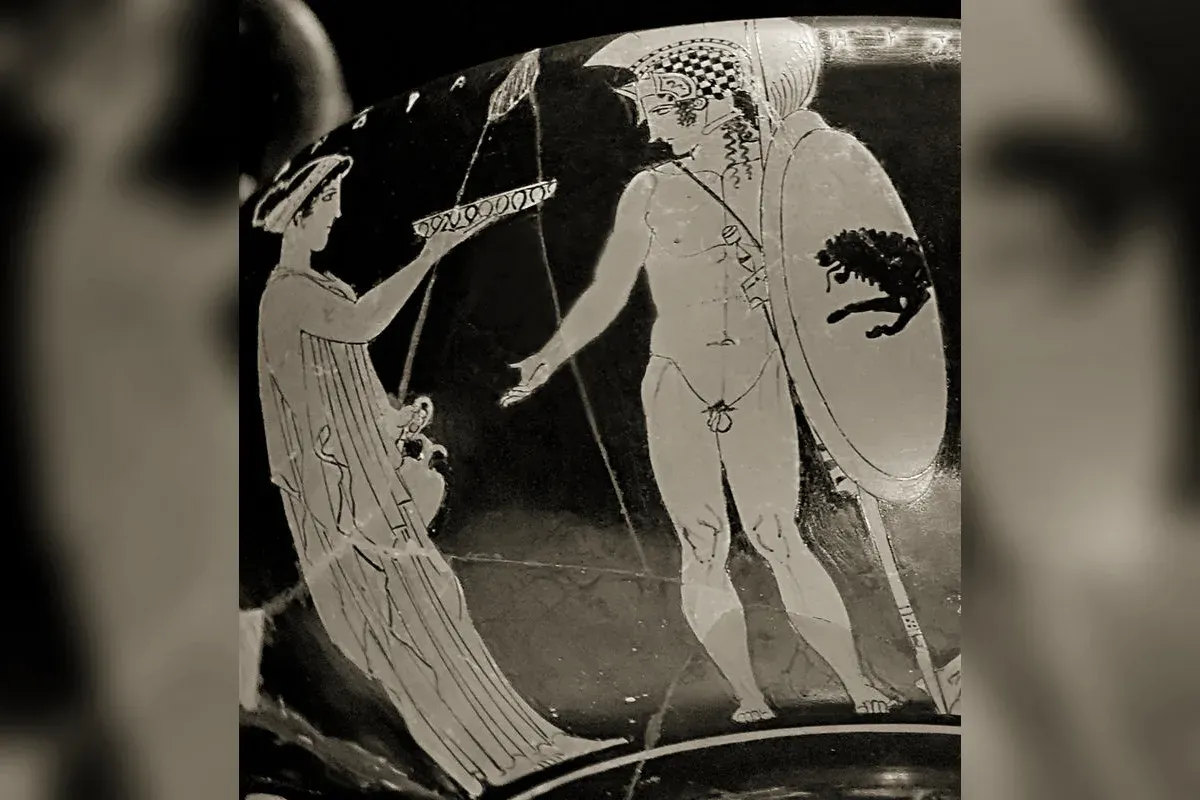
Hector is not the hero of the Iliad. That role belongs to Achilles. But Hector is the figure around whom the poem’s deepest humanity collects. He is the prince of Troy, the greatest warrior on the Trojan side, the husband of Andromache, the father of the infant Astyanax — and the man who dies at the poem’s centre while carrying the full weight of a city he knows cannot be saved. If Achilles embodies Greek heroism in its most radiant and terrifying form, Hector embodies something harder to name but more recognisable: the ordinary human obligation to stand one’s ground in the face of certain defeat.
Birth and role in Troy
Hector is the eldest son of Priam, king of Troy, and Hecuba. He is the crown prince of one of the wealthiest and most powerful cities in the Aegean world — a city whose walls, built by Poseidon and Apollo themselves in some versions, have never been breached. He commands the Trojan forces: a capable, disciplined general respected by allies and enemies alike.
He is married to Andromache, daughter of the king of Cilician Thebes — a woman whose entire family has already been killed by Achilles in raids. Their union is tender, and Homer gives it unusual prominence in an epic dominated by martial fury. Their son Astyanax — “lord of the city” — is an infant during the Trojan War, a child too young to understand what is happening but whose future Homer makes devastatingly clear through Hector’s own prayers.
Hector’s character in the Iliad is defined by a paradox: he is the war’s most effective commander on the Trojan side, yet he is also the figure most aware of its futility. He knows that Troy will fall. He says so, directly, to Andromache. He continues fighting not out of any illusion of victory but because his identity — as prince, as husband, as warrior — is inseparable from the obligation to defend what he loves.
Paris’s fault, Hector’s burden
The Trojan War begins not because of anything Hector does but because of his younger brother Paris, who takes the Spartan queen Helen back to Troy — whether by seduction, persuasion, or abduction, the sources differ — and refuses to return her when the Greeks demand it. Priam and the Trojan council might theoretically hand Helen back and end the war before it begins. They do not.
Hector’s position throughout the poem is therefore one of inherited responsibility. He did not start this war. He told Paris it was madness. Yet the war is happening in his city, on his watch, with his people paying in blood for a brother’s caprice. His duty does not allow him to step away.
He is harshest with Paris precisely because he understands the disproportion. In one scene he berates Paris with barely concealed contempt for skulking in his chamber with Helen while Trojan men die outside the walls on his account. Yet when Paris puts on his armour and returns to battle — always a graceful and deadly archer, if never a committed fighter — Hector welcomes him back without withdrawing the judgement. This is the texture of Hector’s moral world: clear-eyed about weakness, still holding the line.
Hector in the Iliad: the Trojan champion
In the Iliad’s central books, Hector reaches the height of his power in his aristeia — the extended passage of supreme individual combat that Homer assigns to each major warrior. Hector’s aristeia is among the most spectacular in the poem: he leads the Trojan charge to the Greek ships, breaks through the great defensive wall with his bare hands and a single thrown stone, and comes within moments of burning the fleet.
His greatest act in these central books is the killing of Patroclus — Achilles’s closest companion, who has entered battle wearing Achilles’s armour to revive Greek morale. Apollo strips Patroclus of divine protection, leaving him vulnerable, and Hector delivers the killing blow. He strips Patroclus of the armour and puts it on — Achilles’s own divine armour, a detail that both marks Hector’s triumph and seals his doom, since Zeus watches and knows what it means.
Ares, the god of war, favours the Trojans at moments during the poem, but Hector’s martial excellence is not simply divine backing. He is a skilled and courageous commander who leads from the front in a way that Agamemnon — the Greek king who commands from the middle — rarely does. His troops follow him because he is always already where the fighting is worst.
The fatal duel with Achilles
When Achilles returns to battle after learning of Patroclus’s death, the change in the Greek forces is instantaneous and total. The Trojans, who had been pressing them to the ships, break and flee. Hector alone remains outside the Scaean Gate.
King Priam and Queen Hecuba stand on the walls and beg their son to come inside. Priam tears his white hair and describes in precise, harrowing terms what will happen to Troy when Hector dies. Hecuba bares her breast — the breast that nursed him — and pleads with him as a mother. Hector waits.
And then, when Achilles comes, Hector runs. Homer gives him a moment of terror that commentators have argued about for centuries: is this cowardice? Homer refuses the easy answer. Hector runs as a man runs when something inhuman approaches — something that has moved beyond the human scale of warrior against warrior into a force of divine grief and rage. He runs three times around the walls of Troy, Achilles always behind him, before Athena intervenes.
Athena — who has favoured the Greeks throughout — appears to Hector in the form of his brother Deiphobus, promising to stand beside him. Deceived into thinking he has an ally, Hector stops and turns to face Achilles. He proposes a compact: the loser’s body to be returned to his people. Achilles refuses. There is no treaty here, only killing.
Hector throws his spear — it glances off Achilles’s divine armour. He reaches for a second weapon and finds nothing: Deiphobus has vanished, and he understands. Athena has deceived him. He is alone, without a second spear, facing the greatest warrior alive.
Hector charges. It is his last act of will. Achilles drives his spear through the gap in the armour at Hector’s throat. As Hector dies, he asks that his body be returned to his father. Achilles refuses again. Hector’s last words are a prophecy: you too will die here, at Paris’s hand, guided by Apollo.
The desecration and restoration
What follows Hector’s death is one of the most disturbing sequences in Homer. Achilles ties the body behind his chariot by the ankles and drags it around the walls of Troy, in full view of the watching Trojans, every morning for twelve days. Hecuba tears her veil. Priam throws himself into the dust. Apollo preserves the body from corruption and disfigurement — divine protection from beyond death — but the act itself is a violation of the sacred obligations around the dead that the Greeks took with absolute seriousness.
Zeus finally intervenes. He sends Thetis to tell Achilles to relent, and sends Hermes to escort old Priam safely through the Greek camp. Priam’s arrival in Achilles’s tent — the old king who has lost his finest son kissing the hands of the man who killed him and asking for the body back — is the Iliad’s closing movement, and Homer stages it as perhaps the most extraordinary act of grace in the poem. Achilles weeps. He returns the body. He grants a truce of eleven days for Hector’s funeral rites.
The Iliad ends with Hector’s burial, not with Greek triumph. The last word belongs to the man the poem most mourns.
The tragic figure par excellence
Hector’s place in the Western literary tradition is unusual: the supreme tragic hero of an epic whose cultural allegiance should lie with his opponents. Homer’s sympathy for him is unmistakable, and generations of readers have found in him what Achilles’s blazing excellence cannot offer: a mirror for ordinary human obligation and ordinary human love.
The scene in which Hector, returned briefly from the battlefield, reaches out to take his son Astyanax — and the child recoils, terrified by the bronze crest of his father’s helmet — is among the most celebrated in all ancient literature. Hector removes the helmet, and the child comes to him laughing. The moment is pure and devastating: the warrior-father must remove the armour of war to be recognised as a man. And the armour goes back on when he returns to the walls.
Zeus watches him go to his death and says he grieves for Hector — a man who never failed to honour the gods with sacrifice. Even divine sympathy cannot alter the Fate that pulls the balance of lives toward death.
Hector’s legacy
Hector’s fame in antiquity extended well beyond the Greek world. The Romans, who traced their descent to Troy through Aeneas, honoured him as a founding ancestor. Medieval romances included him among the Nine Worthies — the nine greatest warriors in history — alongside Achilles and Julius Caesar. Shakespeare’s Troilus and Cressida gives him a dignity that most other characters lack.
His name has become, across European cultures, a synonym for the noble defender: the man who fights not for glory or plunder but for home. In the tradition of war-god comparisons across mythologies, Hector stands apart: he is not a god of war, not an embodiment of martial violence, but a mortal warrior whose heroism consists entirely of choosing duty over survival.
What makes him permanent in the literary imagination is precisely what makes him tragic: he knows what is coming, he chooses to meet it, and the full weight of what is lost — a child who will be thrown from the walls, a wife who will become a slave — is registered in the poem before the catastrophe occurs. He dies not in ignorance but in full knowledge, carrying everything he loves into the dark.
Further reading
For the complete story of the siege of Troy, the Greek assembly, the combats in the plain, and the destruction of the city, read The Trojan War. For Achilles, the man who kills him, see the dedicated page. For Apollo, who protects Hector’s body after death and guides the arrow that will kill Achilles in turn, read his page. For Ares, the god of war whose favouritism shifts between the armies, see his page. For the comparison of war-deity traditions across mythologies that Hector’s human heroism complicates, see the war-gods comparison.
See also
Stories featuring this entity
Comparisons
Frequently asked questions
Why is Hector considered the noblest hero in the Iliad?
Hector is the only major figure in the Iliad who fights for something other than personal glory: he fights for his city, his family, and the people under his protection. Unlike Achilles, who withdraws from battle over wounded pride, or Agamemnon, who fights for power and plunder, Hector goes to war knowing he will lose, knowing Troy is doomed, and choosing to stand anyway. His farewell to Andromache and their son Astyanax — in which he prays for the child while already hearing the future weeping of women taken into slavery — is the single most humanly moving scene in the poem.
How does the duel between Hector and Achilles unfold?
When Achilles returns to battle after the death of Patroclus, the Trojans flee in terror — all except Hector, who waits alone outside the Scaean Gate. At the last moment, Hector's nerve fails and he runs. Achilles pursues him three times around the walls of Troy before Athena appears to Hector disguised as his brother Deiphobus and tricks him into stopping and turning. Hector fights and is killed. His last act is a curse: he prophesies Achilles's own imminent death before the walls of Troy.
Why does Achilles desecrate Hector's body?
The desecration is an expression of Achilles's grief pushed beyond grief. Patroclus — Achilles's closest companion, arguably his beloved — was killed by Hector. The standard heroic ritual was to strip a fallen enemy of his armor as a trophy; what Achilles does goes far beyond that: he ties Hector's body to his chariot and drags it around the walls of Troy every morning for twelve days, in full view of Priam, Hecuba, and the Trojan people. It is a violation of the divine obligation to give the dead proper burial — an act that even the gods find excessive — and Zeus eventually orders Achilles to relent.