Greek mythology · Heroes & mortals
Aeson, father of Jason and rightful king of Iolcus
Aeson: the king deposed by Pelias, the child smuggled to Chiron, and the rejuvenation by Medea that Ovid turns into a manual of magic.
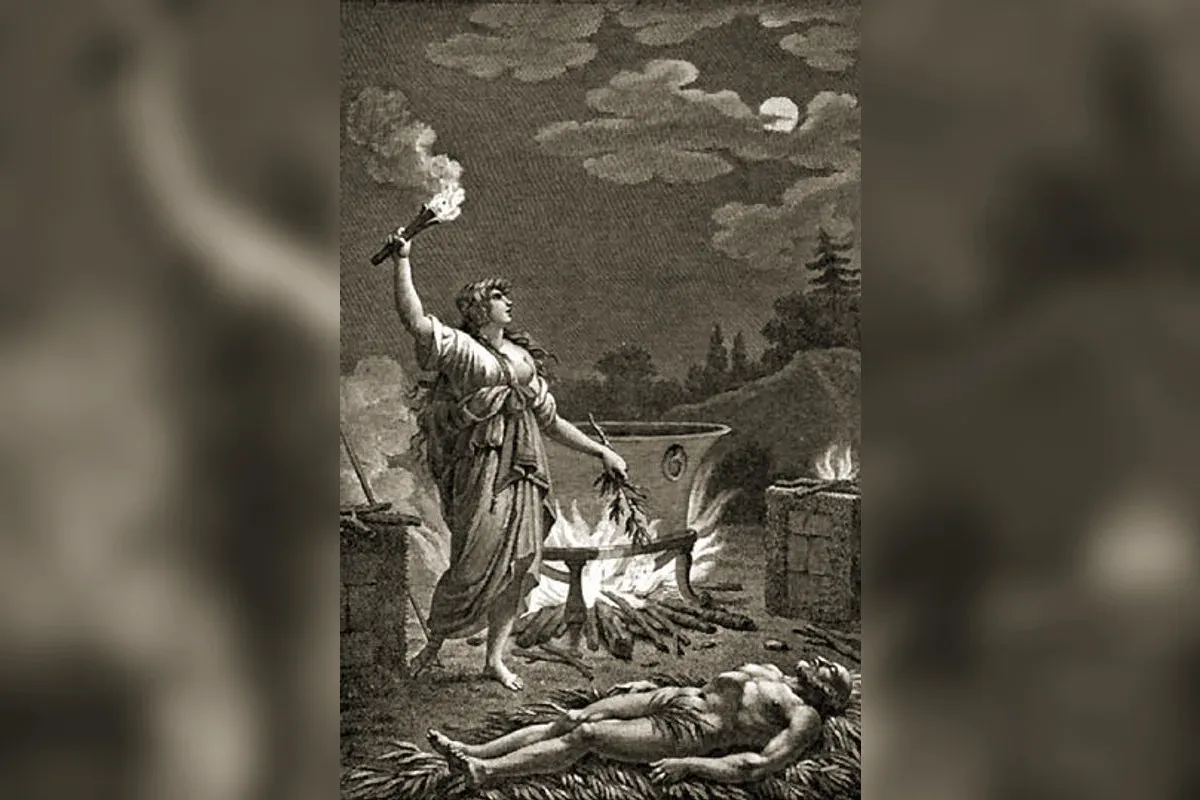
Aeson is the rightful king of Iolcus in Thessaly, displaced by his half-brother Pelias, and the father of Jason. He does almost nothing in the story he sets in motion — and then becomes the subject of the longest description of a magical ritual anywhere in Latin poetry.
A throne taken
Aeson inherits Iolcus and loses it to Pelias, son of Poseidon and Tyro, who seizes power and keeps his half-brother alive but confined. When Aeson’s son is born, the parents conclude the child will not survive infancy in the palace.
The versions differ on the method. In the most common, they stage a mourning — women wailing over the newborn as though he had died — and smuggle him out by night to Mount Pelion, where the centaur Chiron raises him. Jason returns at twenty to claim his inheritance, arriving with one sandal, which fulfils the oracle warning Pelias about a man with a single shoe. Pelias, unable to refuse openly, sends him after the Golden Fleece instead.
Aeson’s function in the plot is therefore purely generative: his dispossession is the reason the Argonautica happens. Apollonius gives him a few lines of farewell and little else.
Two incompatible endings
What happens to Aeson while his son is away depends entirely on which author you read, and the two traditions cannot be reconciled.
Apollodorus reports that Pelias, believing the expedition lost, forces Aeson to kill himself. Aeson asks to die by drinking bull’s blood — held in antiquity to be instantly fatal — and does so; Jason’s mother hangs herself, and the infant brother left in the palace is murdered. Jason returns to a family that has been erased, which supplies the motive for what Medea then does to Pelias.
Ovid, and the tradition he follows, keeps Aeson alive but broken by age, and has Jason ask Medea to take years from his own life and give them to his father.
The rejuvenation
Ovid refuses the exchange and stages something far stranger. Medea works for nine nights under a full moon, in a chariot drawn by winged serpents, gathering herbs from across Thessaly. She builds two altars — one to Hecate, one to Youth — digs trenches, and cuts the throat of a black ram.
Then she opens Aeson’s throat, drains the old blood out entirely, and pours in a boiled decoction containing hoar-frost gathered by moonlight, screech-owl flesh, the entrails of a werewolf, the skin of a Libyan water-snake, the liver of a stag, and the head of a crow that had lived nine generations. His beard and hair darken. His wrinkles fill. He is forty years younger, and reportedly bewildered.
The passage runs well over a hundred lines and is the fullest technical account of witchcraft Roman literature produced — the direct model for Shakespeare’s weird sisters, by way of Golding’s translation. Medea then uses the demonstration as bait: she shows the daughters of Pelias the same trick performed on a ram, and persuades them to cut their father up on the same promise. That time she withholds the herbs.
Ancient sources
- Apollonius of Rhodes, Argonautica, 1.247-305
- Apollodorus, Library, 1.9.16, 1.9.27
- Ovid, Metamorphoses, 7.159-293
- Diodorus Siculus, 4.50
See also
Stories featuring this entity
Frequently asked questions
How does Medea rejuvenate Aeson?
Ovid gives it over a hundred lines. She works nine nights under a full moon gathering herbs, builds two altars — one to Hecate, one to Youth — and cuts the throat of a black ram. Then she opens Aeson's throat, drains the old blood entirely, and pours in a decoction containing hoar-frost gathered by moonlight, screech-owl flesh, a Libyan water-snake's skin and the head of a crow that had lived nine generations.
Why does that rejuvenation matter to the plot?
Because Medea uses it as bait. She performs the same trick on a ram in front of the daughters of Pelias, really turning it back into a lamb, and persuades them the process will restore their father's youth. They cut Pelias up and boil him. That time she withholds the herbs. Aeson is therefore both the beneficiary of the only successful rejuvenation in Greek myth and the sales demonstration that kills his usurper.