Greek mythology · Heroes & mortals
Medea, sorceress of Colchis in Greek mythology
Medea: the princess who wins Jason the Fleece, the children's deaths Euripides may have invented, and the Corinthian rite that remembered them.
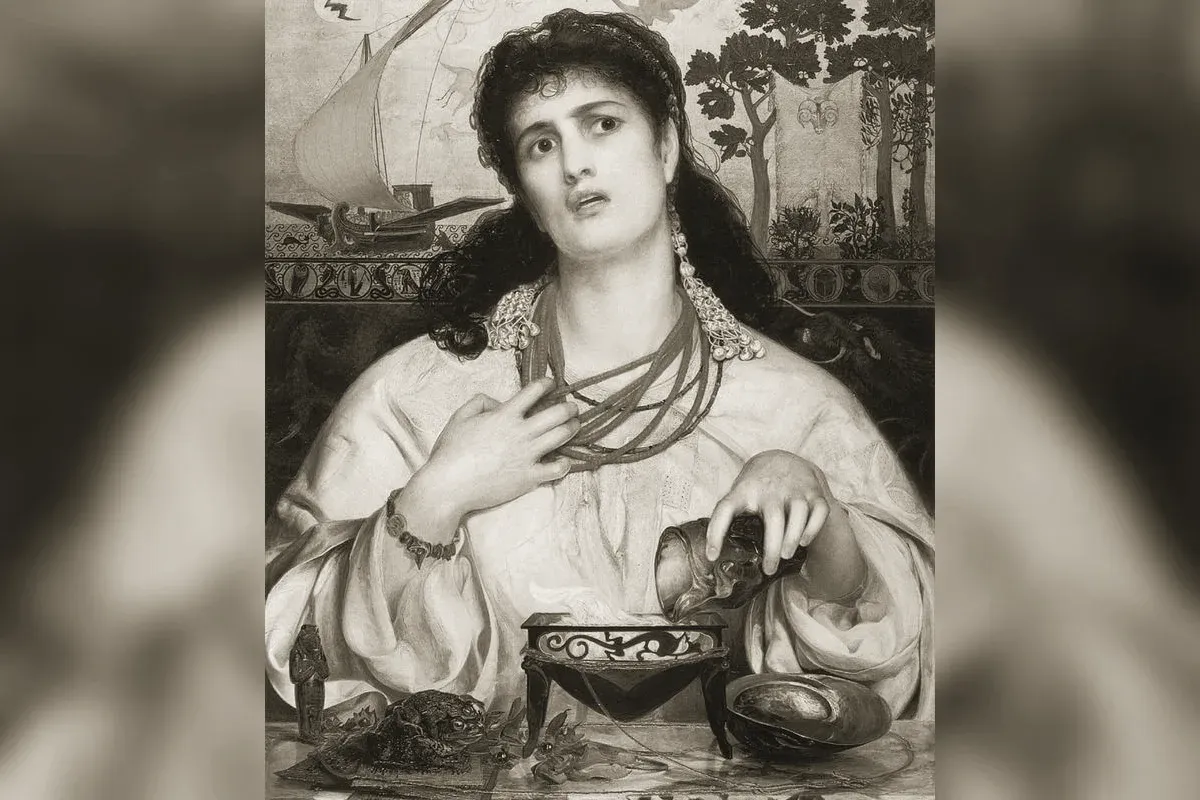
Medea is a princess of Colchis, granddaughter of Helios, and the most technically accomplished practitioner of drugs and ritual in Greek myth. She gives Jason the Golden Fleece, dismantles her own family to escape with him, and is discarded for a younger bride in Corinth. What she does next is the single most contested episode in Greek mythology — because there is real evidence she did not originally do it at all.
What she does for Jason
Medea’s help is not incidental to the quest; it is the quest. She gives Jason an ointment that makes him fireproof for a day so he can yoke the bronze-hoofed bulls. She tells him to throw a stone among the warriors sprung from the dragon’s teeth so they destroy each other. She drugs the sleepless serpent guarding the Fleece.
Her escape is worse than her assistance. In the harshest version she takes her young brother Apsyrtus aboard, kills him, and scatters his dismembered body behind the ship so that her father must stop to gather the pieces for burial. Every subsequent act of the story is prefigured here: she calculates precisely, she uses what an opponent holds sacred, and she pays any price.
At Iolcus she persuades the daughters of Pelias to butcher and boil their father on the promise of rejuvenating him — having first demonstrated the trick on a ram, which she really does turn back into a lamb. The demonstration works. The father does not survive.
Did Euripides invent the murder?
Euripides staged his Medea in 431 BCE and finished last of three. The play has since become the definitive version: Jason abandons her for the king of Corinth’s daughter, she kills the bride and her father with a poisoned robe, and then kills her own two sons to leave Jason with nothing.
Older traditions tell it differently. In one, the children die in the sanctuary of Hera Akraia, where Medea has hidden them believing the goddess will make them immortal — a failed immortalisation, not a murder, of a type Greek myth uses elsewhere. In another, the Corinthians kill the children themselves in reprisal for the death of their king, and Medea is blameless. An ancient scholion on the play preserves the accusation that the Corinthians paid Euripides five talents to shift the guilt onto her, which is almost certainly gossip but tells us the ancients themselves considered the version novel.
The safest statement is this: a tradition in which the children die at Corinth is older than Euripides, and a tradition in which their mother kills them deliberately, knowingly, and as an act of revenge against their father may not be. If so, the most famous mother in Western literature was made a murderer by one dramatist in one afternoon.
The rite at Corinth
Something happened at Corinth, whoever did it. Pausanias, travelling in the second century CE, was shown the tomb of Medea’s children and told the local story — and reports a rite performed for them every year, in which Corinthian children were dressed in black and had their hair cut, until the Romans destroyed the city in 146 BCE and the practice lapsed.
This is unusually solid ground. It gives the myth a real cult site, a real ritual, and a real end date, and it suggests the story existed to explain an obligation the Corinthians already had: an annual atonement for dead children, in Hera’s sanctuary, for which a cause had to be supplied.
The ending nobody expects
Euripides’ last scene breaks the form. Medea appears above the stage, out of reach, holding the bodies, in a chariot drawn by winged serpents sent by her grandfather the Sun. She refuses Jason the bodies, refuses him burial rites, predicts his squalid death, and leaves.
The position she occupies — elevated, unreachable, dictating terms and pronouncing the future — is the position Greek tragedy reserves for a god arriving to settle the ending. Euripides puts the child-killer in it, and gives the wronged husband the floor-level human role. Nothing in the play punishes her.
She goes to Athens, where King Aegeus has already promised her asylum in exchange for a cure for childlessness. Later Athenian myth has her attempt to poison his son Theseus and flee once more.
Ancient sources
- Apollonius of Rhodes, Argonautica, 3-4
- Euripides, Medea (431 BCE) and the scholion on line 9
- Pausanias, Description of Greece, 2.3.6-7
- Apollodorus, Library, 1.9
See also
Stories featuring this entity
Frequently asked questions
Did Euripides invent the killing of the children?
Possibly. Older traditions tell it differently: in one the children die in Hera's sanctuary where Medea has hidden them believing the goddess will make them immortal; in another the Corinthians kill them in reprisal for their king's death. An ancient scholion even preserves the accusation that Corinth paid Euripides five talents to shift the guilt onto her. A tradition in which they die at Corinth is older than Euripides; deliberate maternal murder may not be.
Why does Medea leave in a chariot?
Because Euripides breaks the form deliberately. She appears above the stage, out of reach, holding the bodies, in a chariot drawn by winged serpents sent by her grandfather the Sun. That elevated position — dictating terms and pronouncing the future — is the one Greek tragedy reserves for a god arriving to settle the ending. Euripides puts the child-killer in it, and nothing in the play punishes her.