Greek mythology · Gods & goddesses
Pasiphae, queen of Crete and mother of the Minotaur in Greek mythology
Pasiphae, solar goddess and queen of Crete: her own sorcery against Minos, the curse Poseidon aimed at her husband, and her dream-oracle in Laconia.
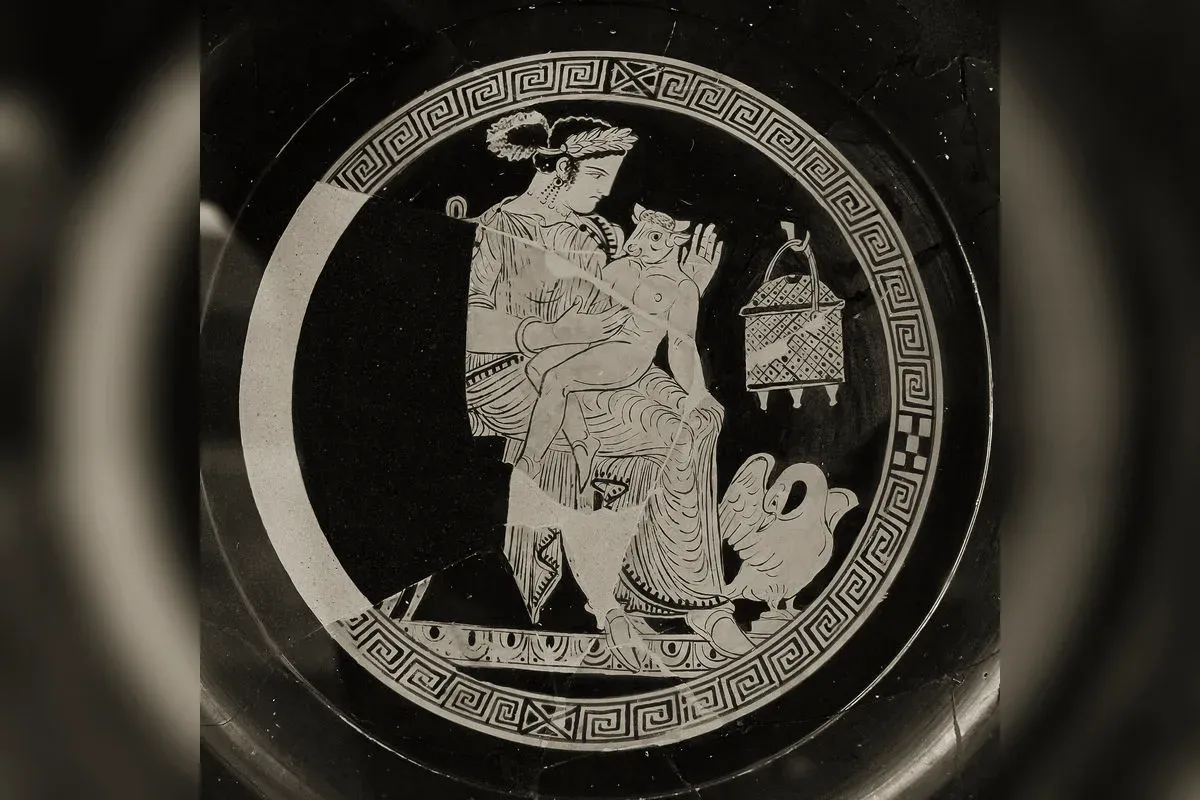
Pasiphae is the queen of Crete, wife of Minos, daughter of Helios, and the mother of the Minotaur. She is usually reduced to a single episode she did not choose. The sources actually present a goddess in her own right, and a formidable one — the sister of Circe and aunt of Medea, from the family in which magic runs.
Not a mortal queen
Apollodorus makes her a daughter of Helios and the Oceanid Perse — the same parents as Circe and Aeetes — which puts her in the most dangerous family in Greek myth and makes her, in most accounts, immortal.
Her name means “shining on all” or “all-illuminating”, from pas and phaos, and it belongs to the solar vocabulary of her father’s line. Some traditions treat Pasiphae as a moon goddess in her own right rather than as a character in Minos’ household, and the Cretan material generally points that way.
Her own sorcery
Before the bull, she performs a piece of magic that is rarely retold and considerably grimmer than what happens to her.
Minos is chronically unfaithful. Pasiphae puts a spell on him so that when he lies with any other woman he discharges scorpions, serpents and millipedes into her, killing her. The curse runs for years; the Athenian Procris eventually cures him with a counter-drug, on terms.
The episode matters because it reverses the usual reading. Pasiphae is not a passive victim of divine spite from beginning to end. She is a solar goddess capable of weaponising her husband’s own body against him, and that is who Poseidon’s punishment is aimed at.
The bull, and whose fault it is
Minos asks Poseidon for a sign confirming his right to rule. The god sends a magnificent bull from the sea on condition it be sacrificed back. Minos keeps it and substitutes another animal.
Poseidon’s retaliation is not directed at Minos. He afflicts Pasiphae with an overwhelming desire for the bull — punishing a man through his wife, in a pattern Greek myth uses often and never examines. She goes to Daedalus, who builds a hollow wooden cow covered in hide. From the union comes Asterius, called the Minotaur.
Two things follow that are worth stating plainly. The offence is Minos’. And Pasiphae raises the child: Apollodorus says she nursed him herself, until he became unmanageable and Minos had the Labyrinth built to hide what his own broken promise had produced.
An oracle in Laconia
Her cult survived where the myth does not lead you to expect it. At Thalamae in Laconia there was a small oracle of Pasiphae, and it worked by incubation: enquirers slept in the sanctuary and received answers in dreams.
Pausanias saw it, and both Plutarch and Cicero record that it was consulted by the Spartan authorities — the ephors slept there, and the oracle features in the constitutional crisis around the reforming kings Agis and Cleomenes in the third century BCE. Some locals, Pausanias notes, identified this Pasiphae with the moon rather than with the wife of Minos.
That is the correction the mythographic version most needs. A goddess consulted by the magistrates of Sparta on matters of state is not primarily the woman in the wooden cow, and her most famous story is one that a god inflicted on her to punish her husband.
Ancient sources
- Apollodorus, Library, 3.1.2-4, 3.15.1
- Antoninus Liberalis, 41
- Pausanias, Description of Greece, 3.26.1
- Plutarch, Agis (9) and Cleomenes, 7
- Ovid, Ars Amatoria, 1.289-326
- Euripides, Cretans, fragments
See also
Related entries
Stories featuring this entity
Frequently asked questions
Whose fault is the Minotaur?
Minos's. He asked Poseidon for a sign confirming his right to rule and promised to sacrifice whatever the god sent; when a magnificent bull came out of the sea he kept it and substituted another animal. Poseidon's retaliation was not aimed at Minos but at his wife, who was struck with desire for the bull — a man punished through a woman's body, a pattern Greek myth uses often and never examines.
What did Pasiphae do to Minos?
She cursed him, and the episode is rarely retold. Minos was chronically unfaithful, so Pasiphae laid a spell on him such that whenever he lay with another woman he discharged scorpions, serpents and millipedes into her, killing her. The curse ran for years until the Athenian Procris cured him with a counter-drug, on terms. She is not a passive victim of divine spite from beginning to end.