Greek mythology · Journeys & quests
Theseus and the Minotaur: the labyrinth, Ariadne's thread, and the founding of Athens
The Theseus and Minotaur myth: the labyrinth built by Daedalus, Ariadne's thread, the hero's victory over the monster, and its role in the founding myth of Athenian democracy.
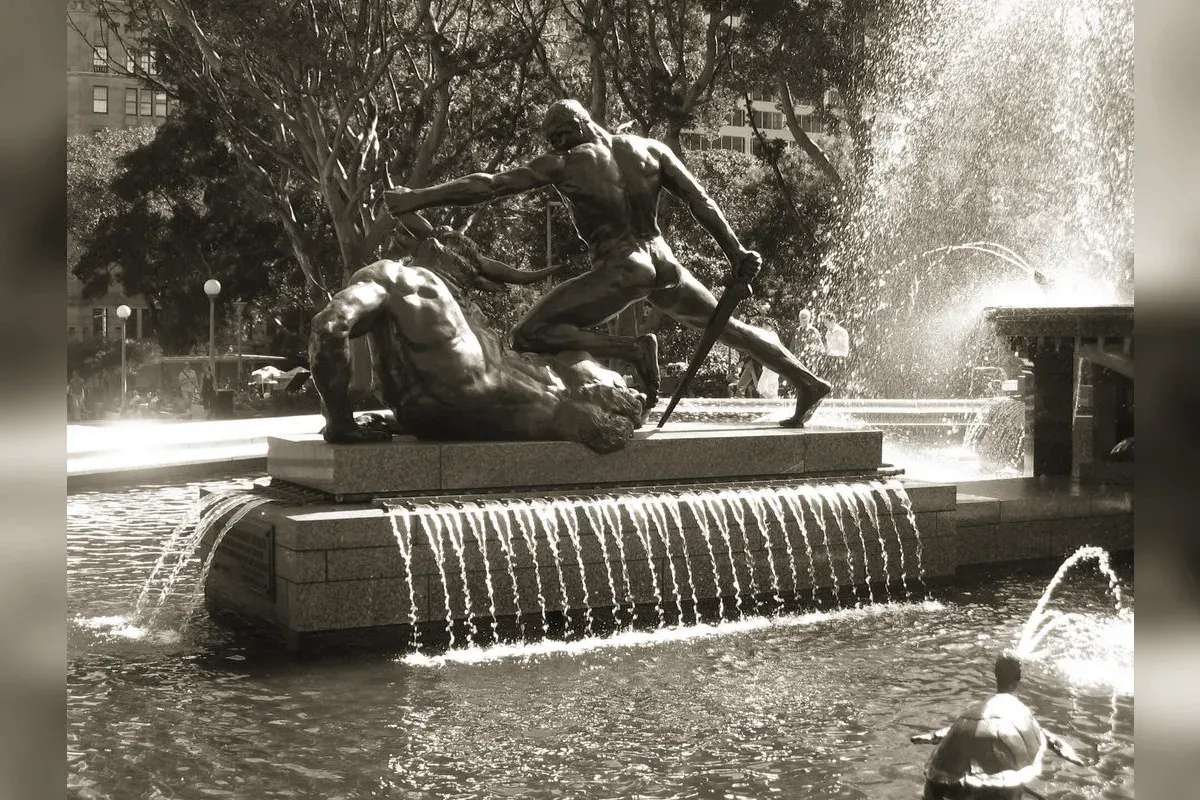
Theseus and the Minotaur: the hero against the monster beneath the city
The myth of Theseus and the Minotaur is far more than an adventure pitting hero against monster. It is the founding narrative of Athens as a civilising power, a metaphor for the passage from youth to adulthood, and an exploration of what victory costs — in love, in loyalty, and in legacy.
The curse of Minos: Athens’s tribute
It begins with an injustice. Minos, king of Crete, had sent his son Androgeus to compete at the Panathenaic Games in Athens. Androgeus won every contest — and was killed shortly afterward in obscure circumstances. Depending on the source, he was murdered by jealous Athenians, or slain by the bull of Marathon that Aegeus had sent him to face.
Minos demanded reparation and made war on Athens with Zeus’s backing. Athens was struck by famine and plague. The oracle commanded submission to Minos, who imposed a terrible tribute: seven young men and seven young women from Athens sent to Crete each year (or every nine years in some versions), to be thrown into the Labyrinth and devoured by the Minotaur.
The Minotaur — Asterion by name — was born of the monstrous union between Pasiphae, Minos’s wife, and a white bull sent by Poseidon. Poseidon had given this bull to Minos to be sacrificed, but Minos kept it for himself — and the god avenged this affront by making Pasiphae fall in love with the animal. Daedalus built a wooden cow to facilitate the union. From this birth came the creature with a human body and a bull’s head.
Theseus volunteers
Theseus, son of king Aegeus and the mortal Aethra (or of the god Poseidon in a variant tradition), had grown up away from Athens and only reunited with his father in adolescence. Determined to end the humiliating tribute imposed on his city, he volunteers among the victims.
His father Aegeus, in despair, makes him swear one thing: if he returns alive, he will fly white sails on the ship. If the vessel returns with black sails, that will mean his death.
Arrival in Crete: Ariadne and the thread
On arriving in Crete, Theseus meets Ariadne, daughter of Minos and Pasiphae. She falls in love with him at once — some versions attribute this to an arrow from Eros or an intervention of Athena. Ariadne offers her help in exchange for a promise: Theseus will take her to Athens and marry her.
She gives him two things:
- a ball of thread (mitos) to find his way back through the Labyrinth;
- a sword or club to kill the Minotaur.
Ariadne’s thread is the most famous narrative invention of this myth: Theseus ties one end to the entrance of the Labyrinth and unspools it as he advances, guaranteeing he can retrace his steps once the monster is defeated.
Victory in the Labyrinth
Theseus descends alone into the Labyrinth — a structure designed by Daedalus to disorient anything that entered it. At the heart of the maze, he finds the Minotaur sleeping (in some versions) or confronts it directly.
The fight is brief. The hero’s strength, divine favour and the thread prevail. Theseus kills the Minotaur — bare-handed, with a sword or with a club depending on the source — and climbs back out following the thread to the entrance.
He frees the other captive Athenians and escapes from Crete with them, taking Ariadne on board.
The abandonment of Ariadne on Naxos
During the voyage home, the ship stops at the island of Naxos. Ariadne is left there. The reasons vary profoundly across sources:
- In the most widespread version, Theseus forgets her or deliberately abandons her — an inexplicable act of betrayal within the heroic framework.
- In Diodorus’s version, a dream sent by Dionysus compels Theseus to leave her: the god of wine loves Ariadne and wishes to make her his divine companion.
Dionysus comes to find her on Naxos, makes her his companion and immortalises her. Her stellar crown (Corona Borealis) is placed among the constellations.
The death of Aegeus: the black sails
Theseus returns to Athens — but forgets (or neglects) to change the black sails for white ones. Aegeus, standing at Cape Sounion to watch for his son’s return, sees the black sails and, believing his son dead, throws himself into the sea. That sea has borne his name ever since: the Aegean.
The most brilliant victory of Theseus costs his father’s life. One of the fundamental themes of the myth lies here: heroic glory does not protect against negligence or the debt owed to those one loves.
Theseus as king of Athens: the Attic synoikismos
Theseus becomes king of Athens after Aegeus’s death. His mythical reign is associated with one of the founding acts of Athenian democracy: the synoikismos (synoikismos) — the political unification of all the communities of Attica into a single city, Athens. Plutarch presents this unification as Theseus’s greatest political achievement, more important even than his warrior exploits.
What the ancient sources say
Plutarch (Life of Theseus, 1st–2nd century AD) is the most complete mythological biography of the hero. Apollodorus (Epitome I) synthesises the main narrative elements. Diodorus Siculus (IV) offers a rationalised version. Ovid (Metamorphoses VIII, 152–182) describes the construction of the Labyrinth and the death of the Minotaur. Virgil (Aeneid VI, 14–33) evokes the Labyrinth on the doors of the temple at Cumae, recalling the tragedy of Daedalus and Icarus. Attic ceramics (6th–5th century BC) provide a major iconographic source: hundreds of vases depict Theseus fighting the Minotaur.
Further reading
For the central heroic figure, read the page on Theseus. For the monster born of Minos’s transgression, see the page on the Minotaur. For the goddess who patronises Athens and guides its heroes, consult the page on Athena.
Story beats
- 01The curse of Minos: Androgeus's death and the tribute imposed on Athens
- 02Theseus volunteers among the tribute victims
- 03Arrival in Crete and the meeting with Ariadne
- 04Ariadne gives Theseus the thread and the sword
- 05Theseus enters the labyrinth and kills the Minotaur
- 06The escape from Crete and the abandonment of Ariadne at Naxos
- 07The forgetting of the white sails and the death of Aegeus
- 08Theseus as king of Athens and founder of the Attic synoikismos
Ancient sources
- Plutarch, Life of Theseus
- Apollodorus, Epitome I
- Diodorus Siculus, Library of History IV
- Ovid, Metamorphoses VIII
- Virgil, Aeneid VI
See also
Related entries
Frequently asked questions
Who built the Labyrinth?
The Labyrinth was built by the inventor and architect Daedalus on the orders of King Minos of Crete, to confine the Minotaur. Daedalus was subsequently imprisoned on Crete with his son Icarus to prevent him revealing the Labyrinth's secrets — which led them to attempt escape through the air with wax wings.
Why does Theseus abandon Ariadne on Naxos?
The sources differ. Some say Theseus forgets her or simply no longer loves her. Others invoke an order from Dionysus, who loved Ariadne and wished to claim her as his divine companion. In Apollodorus's version, Athena or Dionysus instructs him to leave her behind. The abandonment remains one of the hero's most morally ambiguous acts.
How does Aegeus, Theseus's father, die?
Before departing for Crete, Theseus had promised his father Aegeus to raise white sails on his ship if he returned alive — black if he was dead. On the return voyage, Theseus forgets (or in some accounts is distracted by the loss of Ariadne). Aegeus, watching from Cape Sounion, sees the black sails and throws himself into the sea in despair. That sea has borne his name ever since: the Aegean.