Greek mythology · Origins
The Myth of Pandora: the jar of evils and the origin of human suffering
The Greek myth of Pandora: the first woman fashioned by the gods, her marriage to Epimetheus, the jar that unleashed all evils, and the Hope that remained inside.
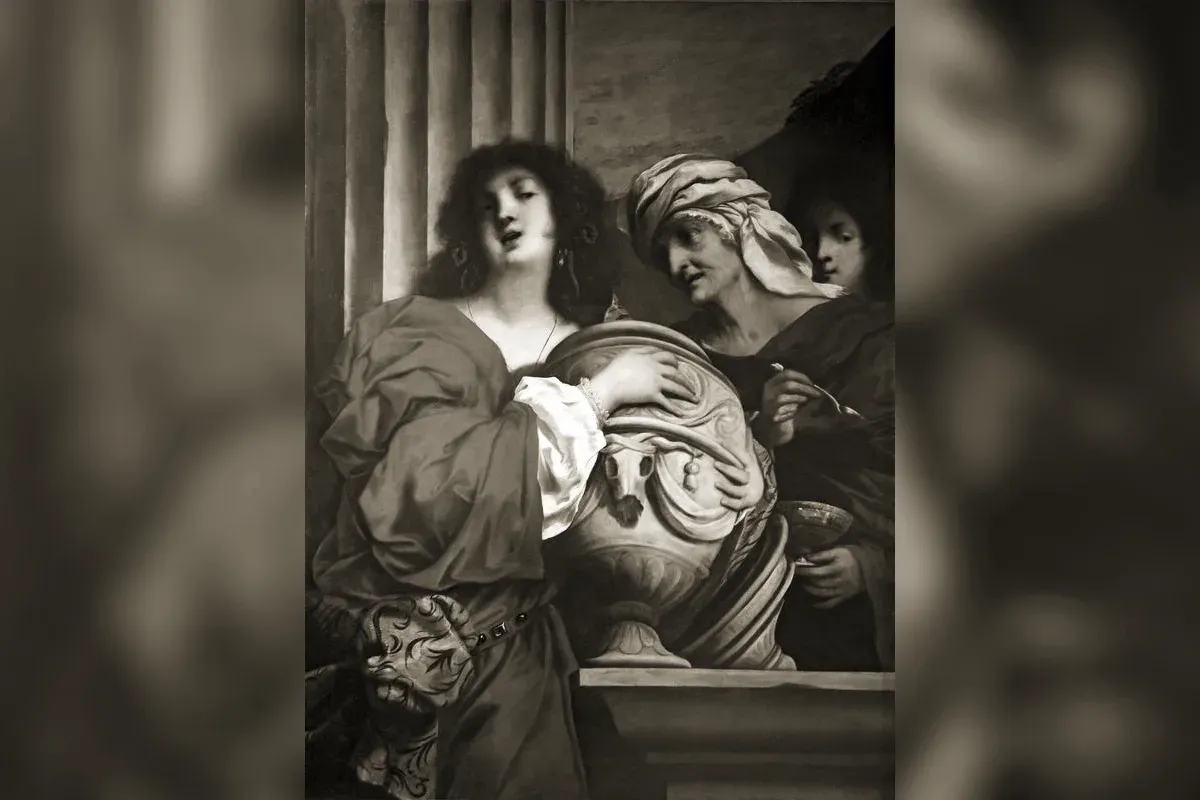
The myth of Pandora is the Greek narrative that explains why suffering, disease, and death are part of human existence. This is not original sin in the biblical sense: it is a deliberate divine punishment, inflicted by Zeus on humanity in retaliation for Prometheus’s theft of fire. Pandora is not guilty of a moral fault — she is herself an instrument of divine vengeance, fashioned to be irresistible and fatally curious.
Background: punishing Prometheus
Before Pandora, humanity lived without disease, premature old age, and — in some versions — without toil, in a state close to the Titans’ Golden Age. But Prometheus had tricked Zeus at a sacrifice: he hid the best cut of the ox beneath the entrails for humans and offered the gods bones wrapped in glistening fat. Enraged, Zeus deprived men of fire.
Prometheus scaled Olympus, stole a flame from the gods’ forge — perhaps from the Sun’s chariot — and carried it to mortals in the hollow of a fennel stalk.
Zeus prepared his revenge in two stages.
The fashioning of Pandora
On Zeus’s orders, Hephaestus molded from clay a form of perfect feminine beauty. Each Olympian god bestowed a gift:
- Athena taught her crafts and dressed her
- Aphrodite poured grace and desire over her
- Hermes breathed into her lies, cunning, and seductive words
- The Horae crowned her with flowers
- Zeus gave her a curious and impulsive nature
Her name, Pandora (from Greek pan = all, dôron = gift), means “she who received all gifts” — or, in an alternative reading, “she who gives everything.” She is the first woman, in contrast to an earlier, all-male humanity.
The poisoned gift: Epimetheus and the jar
Hermes escorted Pandora to Epimetheus, Prometheus’s brother. Prometheus had warned his brother: never accept a gift from Zeus. But Epimetheus — “He who thinks after the fact” — was dazzled by Pandora’s beauty and welcomed her.
In his home, Epimetheus kept a large sealed jar (pithos) that Zeus had had deposited there. It contained all the evils the gods had gathered: diseases, old age, toil, envy, madness — everything that was to tear humanity apart.
Pandora, stirred by the curiosity the gods had planted within her, lifted the lid.
The opening: evils released into the world
All the evils rushed out in a swarm and spread across earth and sea. Pandora slammed the lid back down in haste. One thing alone remained at the bottom: Elpis, Hope (or Expectation).
Hesiod does not say whether Elpis escaped or remained trapped. Ancient and modern interpreters debate:
- If Elpis stayed in the jar, humans can still access it: it is a good preserved for them.
- If Elpis is an evil like the others (the illusion that keeps us clinging to life even in suffering), sealing it was an act of grace.
- For others, Hope, had it spread with the evils, would have been even more destructive — keeping it sealed protects humanity from permanent vain expectation.
Variants and interpretations
In Hesiod (Theogony and Works and Days), the myth appears twice with nuances. In the Theogony, Pandora is purely a trap for men — woman as a scourge. In Works and Days, the account is more fully developed and includes the jar.
Pandora’s role: Hesiod presents her as passive, an instrument of divine will, not an autonomous agent. Modern feminist readings have reassessed this framework, noting that punishment falls on all of humanity yet symbolic blame is placed on a woman — a pattern also found in the Genesis account of Eve.
The box or the jar? Erasmus’s 16th-century translation error (pithos rendered as pyxis, box) is the source of the universal phrase “Pandora’s box.” The original Greek texts speak clearly of a jar.
The myth’s significance
The myth of Pandora poses a central cosmogonic question: why do humans suffer? The Greek answer does not seek an original moral fault but a deliberate divine act. Humanity is not condemned by its nature but by the history of the gods — which, paradoxically, leaves open the space of hope.
Further reading
For the context of the fire theft and Prometheus’s punishment, read the page on Prometheus. For the craftsman-god who molded Pandora from clay, see Hephaestus. For the god who commissioned her creation as an instrument of vengeance, read the page on Zeus. For Hermes, the messenger who escorted her and gave her the language of guile.
Story beats
- 01Prometheus steals divine fire and gives it to mortals
- 02Zeus orders Hephaestus to mold Pandora, the first woman
- 03The gods endow Pandora with contradictory gifts: beauty, deceit, curiosity
- 04Hermes escorts her to Epimetheus, Prometheus's brother
- 05Epimetheus accepts Pandora despite his brother's warning
- 06Pandora opens the jar, releasing all evils into the world
- 07Hope (Elpis) remains alone at the bottom of the jar
Ancient sources
- Hesiod, Theogony (ll. 570-612)
- Hesiod, Works and Days (ll. 60-105)
See also
Frequently asked questions
Why do we say 'Pandora's box' when the Greek texts describe a jar?
The phrase 'Pandora's box' stems from a translation error popularized by Erasmus in the 16th century. Hesiod's texts use the word pithos, a large clay storage jar. Erasmus translated the Greek into pyxis (box), and this error has persisted ever since in all European languages.
What was left in the jar after Pandora opened it?
Elpis, Hope (or Expectation), remained alone at the bottom of the jar when Pandora quickly closed it. Interpreters have debated since antiquity: is this a good thing (hope sustaining human life) or another evil (the illusion that prevents us from facing reality)? Hesiod himself does not resolve the question.
Who is Epimetheus and how does he relate to Prometheus?
Epimetheus ('He who thinks after the fact') is the brother of Prometheus ('He who thinks ahead'). Their opposition symbolizes two attitudes toward the future: foresight versus impulsiveness. Despite his brother's warning to accept nothing from the gods, Epimetheus welcomed Pandora and thus triggered divine vengeance on humanity.