Greek mythology · Origins
The Abduction of Persephone: the Greek myth of the seasons
The abduction of Persephone by Hades: Demeter's grief-stricken search, the pomegranate seeds, and the bargain with Zeus that explains the origin of the seasons.
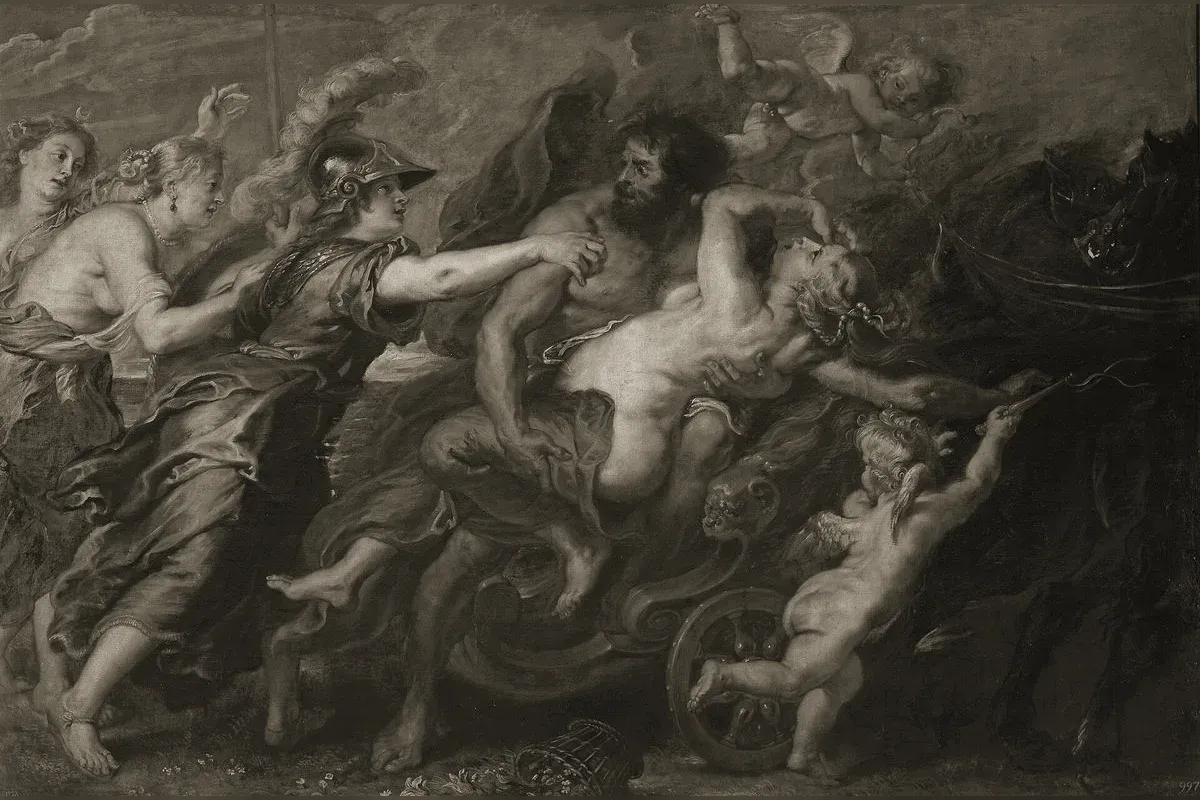
The most consequential abduction in Greek mythology
The abduction of Persephone is the story that explains, in Greek mythology, why the earth blooms in spring and turns barren in winter. It is not a minor mythological incident: it is one of the few Greek myths to give a complete narrative origin to a universal natural phenomenon, and the text that tells it best, the Homeric Hymn to Demeter, is also one of the oldest documents on the Eleusinian Mysteries. For the full biography of its two protagonists, see the pages on Persephone and Demeter; this story focuses on the precise unfolding of events, act by act.
Kore in the plain of Nysa
Before the drama, Persephone still bears the name Kore — “the Maiden.” She is gathering flowers with the Oceanids, her companions, in the plain of Nysa, a location that varies across sources but always symbolizes lush, seemingly harmless nature.
Among the roses, crocuses, violets, and hyacinths, a narcissus catches her eye: a flower with a hundred blooms, so fragrant it enchants both heaven and earth. The Homeric Hymn specifies that this flower is nothing natural — it was planted there by Zeus himself, at the request of Hades, as a trap (dolos) set for Kore.
The abduction
When Kore reaches for the narcissus, the earth splits open. Hades bursts forth on his chariot drawn by immortal horses and seizes her. She screams, calls out to her father — but no one intervenes: neither gods nor mortals hear her, except Hecate in her cave and Helios, the Sun, who sees everything from the sky. The earth closes again. Kore vanishes into the underworld, becoming Persephone, the reluctant queen of the dead.
Demeter’s search
Demeter hears the echo of her daughter’s cry but does not see its cause. For nine days, she roams the earth, two torches lit in her hands, neither eating, bathing, nor resting. On the tenth day, Hecate joins her and suggests they question Helios, the only witness. The Sun eventually reveals the truth: Hades has abducted Persephone with Zeus’s consent.
The revelation turns Demeter’s grief into open rupture. She leaves Olympus, takes the form of an old woman, and wanders among mortals until she reaches Eleusis, where she is welcomed by King Celeus — an episode the Hymn develops at length, and which tradition credits with founding the Eleusinian Mysteries.
The barren earth
Furious and grieving, Demeter stops performing her role as goddess of the harvest. The consequence is immediate and cosmic: seeds refuse to sprout, livestock wastes away, humans starve, and the gods see the sacrifices owed to them vanish. It is this existential threat — not simple pity — that pushes Zeus to act: an extinct humanity would deprive the gods themselves of worship.
Zeus first sends Iris, then several gods as envoys, to convince Demeter to return. She refuses everything, swearing the earth will stay barren until her daughter is returned to her.
Hermes in the underworld and the pomegranate seeds
Zeus resolves to send Hermes, the psychopomp messenger, to reclaim Persephone from Hades. The lord of the underworld agrees to let her go — but before she leaves his realm, he offers her a few pomegranate seeds. In the Homeric Hymn, Hades gives her a pomegranate seed to eat; in Ovid (Metamorphoses, Book V), Ascalaphus reports that she ate seven seeds.
This gesture is not innocent: according to the sacred law of the underworld, whoever eats the food of the dead remains bound there forever. By having her eat before her departure, Hades ensures — whether deliberately or not, depending on the reading — that she will have to return.
Zeus’s bargain and the birth of the seasons
Faced with the fait accompli, Zeus imposes a compromise: Persephone will spend one third of the year (according to the Homeric Hymn) or six months (according to later versions, including Ovid) with Hades in the underworld, and the rest of the time with her mother. As soon as Demeter is reunited with her daughter, the earth blooms again instantly — the Hymn describes nature literally bursting into flower the moment they reunite.
This division becomes the mythological explanation for the cycle of the seasons: autumn and winter correspond to Demeter’s mourning during her daughter’s absence, spring and summer to their reunion. Ovid adds a dramatic detail absent from the Hymn: the nymph Cyane, a helpless witness to the abduction, dissolves into tears within her own spring; and Ascalaphus, who reveals that Persephone has eaten the seeds, is turned into an owl by Demeter in retaliation.
Variants and interpretations
Ancient sources do not tell exactly the same story:
- The Homeric Hymn to Demeter is the oldest and most developed version: it emphasizes the mother’s grief and grounds the Eleusinian Mysteries.
- Hesiod (Theogony, lines 912-914) barely mentions the abduction: he focuses on Persephone’s sovereignty in the underworld, without developing the drama.
- Ovid (Metamorphoses, Book V) dramatizes the episode with narrative details typical of Latin poetry: Cyane, Ascalaphus, the exact number of seeds.
- The Orphic tradition offers a radically different reading, in which Persephone, united with Zeus in serpent form, becomes the mother of Dionysus Zagreus — placing the myth at the heart of a cosmology of reincarnation rather than one of the seasons.
The myth’s significance
This story accomplishes two things at once: it gives narrative meaning to the rhythm of the harvests, vital for any agrarian society, and it transforms Persephone from a simple victim into the legitimate sovereign of one of the cosmos’s three realms. The tension between these two readings — a young girl torn from the light, or a queen accepting her authority — is never fully resolved, which explains the myth’s lasting popularity throughout antiquity.
Further reading
For the full biography of the queen of the underworld, read the page on Persephone. For the goddess whose grief shapes the seasons, see the page on Demeter. For the god who now reigns beside her in the underworld, read the page on Hades. For another journey to the underworld in which Persephone plays a decisive role, read the story of Orpheus and Eurydice.
Story beats
- 01Kore gathers flowers with her companions in the plain of Nysa
- 02She reaches for a narcissus of extraordinary beauty, a trap set by Zeus and Hades
- 03The earth splits open: Hades emerges and carries her off to the underworld
- 04Demeter wanders for nine days before Hecate and Helios reveal the truth
- 05Demeter abandons Olympus and lets the earth turn barren; humans start to starve
- 06Zeus sends Hermes to the underworld to negotiate Persephone's return
- 07Persephone has eaten pomegranate seeds: she must now divide the year between both worlds
Ancient sources
- Homeric Hymn to Demeter (7th-6th century BCE)
- Hesiod, Theogony (lines 912-914)
- Ovid, Metamorphoses, Book V (lines 341-571)
- Apollodorus, Library, I, 5
See also
Frequently asked questions
Why does Zeus let Hades abduct Persephone?
Because he had secretly consented to the union himself without telling Demeter. Zeus considers Hades a fitting match for his daughter — a brother, sovereign of a third of the cosmos — but he knows Demeter would object. This hidden consent is the deeper cause of the conflict: it is not a crime committed behind the gods' backs, but a patriarchal decision imposed without the mother's consent or, initially, that of Persephone herself.
What would have happened if Persephone had eaten nothing in the underworld?
According to the cosmic law recalled in the Homeric Hymn, she would have returned to her mother fully and permanently, with no obligation to come back. It is precisely because Hades has her eat pomegranate seeds before her departure that an irrevocable bond forms with the realm of the dead. This detail turns a simple rescue into a permanent compromise: the seeds are what makes the seasons possible.
Does this myth really explain the origin of the seasons for the Greeks?
It is indeed the only coherent Greek mythological explanation of the seasonal cycle that has come down to us. It attributes autumn and winter to Demeter's mourning during her daughter's absence, and spring and summer to their reunion. It is no accident that the myth is tied to the agrarian sanctuary of Eleusis: it gives narrative meaning to the very rhythm of the harvests on which Greek cities depended for survival.