Greek mythology · Metamorphoses
Perseus and Medusa: the myth of the hero and the Gorgon
The Perseus and Medusa myth: how the hero beheads the Gorgon with divine aid, gives birth to Pegasus, rescues Andromeda, and creates the Gorgoneion of Greek art.
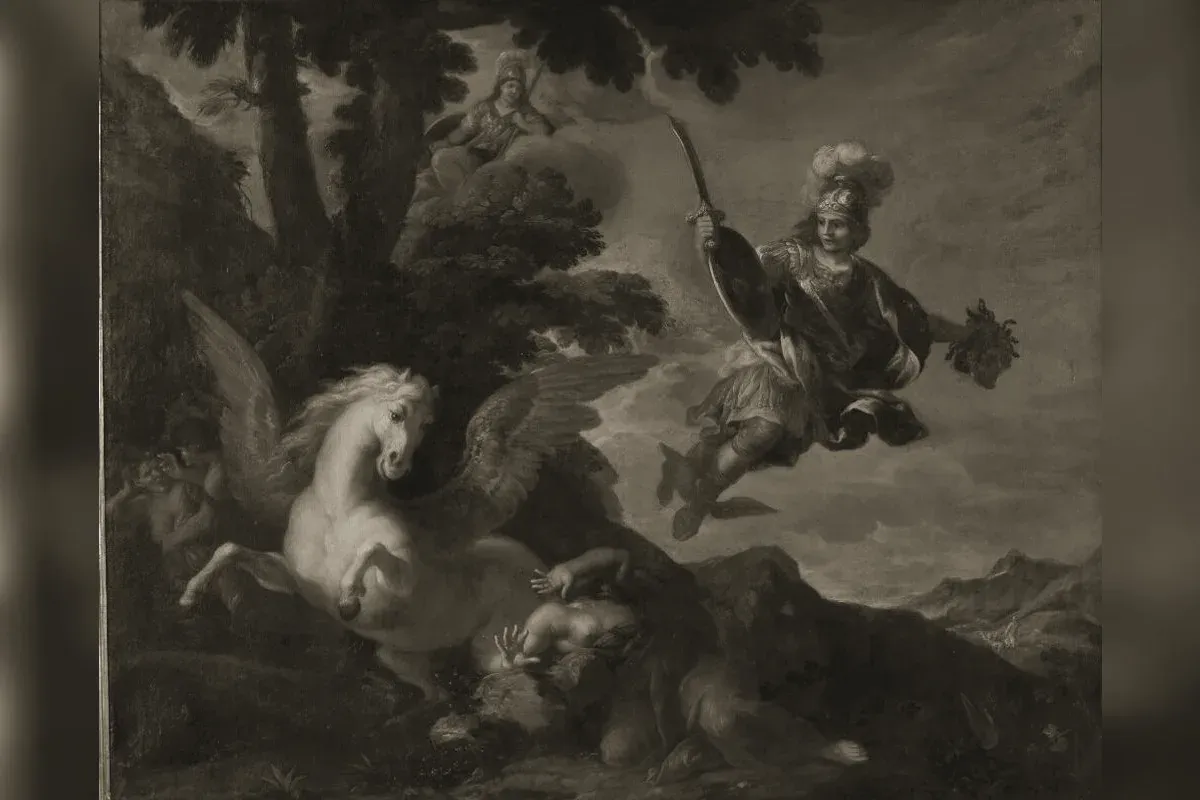
Perseus and Medusa: the quest to the edge of the world
The myth of Perseus and Medusa is one of the great quests of Greek mythology. Son of Zeus and the mortal Danaë, Perseus has neither army nor wealth — only divine aid and a decisive trick. This is also one of the rare Greek myths in which victory comes not through force but through the intelligence of the gaze: to kill Medusa, one must above all avoid looking at her directly.
The origins: Polydectes and the impossible mission
Perseus is the son of Zeus and Danaë, locked away by her father Acrisius in a bronze tower to ward off a prophecy foretelling that his grandson would kill him. Zeus, transformed into a shower of gold, enters the tower and fathers Perseus. Acrisius then seals Danaë and her child in a chest thrown into the sea — which washes up on the island of Seriphos.
The king of Seriphos, Polydectes, desires Danaë as his wife. To remove the young Perseus — grown into a strong and protective son — he organises a feast at which he demands gifts. Perseus, with nothing to offer, rashly promises anything. Polydectes demands the head of Medusa, the Gorgon whose gaze instantly petrifies every living creature.
It is a trap: no one returns alive from such an expedition.
Divine assistance: Athena, Hermes and the magical equipment
Perseus is not abandoned. Two deities come to his aid:
Athena, goddess of wisdom and enemy of Medusa since Poseidon violated her temple, gives him her polished bronze shield — a perfect mirror for approaching the Gorgon without looking at her directly.
Hermes, messenger of the gods, provides an adamantine sickle (or harpe) — the only blade capable of severing the Gorgon’s neck.
For the remaining equipment, Perseus must first find the Nymphs of the Far North. To do so, he must extract their location from the Graeae.
The Graeae: stealing the eye of the Old Ones
The Graeae (Graiai) are the three sisters of the Gorgons — Deino, Enyo and Pemphredo. Ancient since birth, they share between them a single eye and a single tooth, passed from one to another.
Perseus catches them mid-transfer and seizes the eye. He refuses to return it until they tell him the way to the Nymphs. Forced, they comply.
The Nymphs give Perseus three magical objects:
- winged sandals that allow him to fly;
- a leather pouch (kibisis) to carry the head without glimpsing its reflection;
- a cap of invisibility (belonging to Hades) to escape Medusa’s immortal sisters.
The beheading: the mirror exploit
Perseus flies to the western edge of the world, where the Gorgons dwell — beyond the Ocean, in a land the sun barely reaches.
He finds the three Gorgons sleeping. Approaching backwards, he looks only at Medusa’s reflection in his bronze shield. Guided by Athena herself in some versions, he severs Medusa’s head in a single stroke of the sickle.
From the severed neck spring two beings conceived long before from the union of Medusa and Poseidon:
- Pegasus, the white winged horse, leaping toward the sky.
- Chrysaor, the golden-sworded giant warrior, whose lineage will people the world’s edges.
Perseus seizes the head and slips it into the kibisis. Medusa’s two immortal sisters — Stheno and Euryale — wake and pursue him. The cap of invisibility allows him to escape.
The head as weapon: Atlas and Andromeda
Perseus is not done using Medusa’s head. On the homeward flight he stops at the Titan Atlas and asks for shelter. Atlas drives him away. Perseus draws the head from his pouch: Atlas is instantly transformed into a mountain — the Atlas range in north Africa, according to Ovid.
Flying over Ethiopia, Perseus spots a young woman chained to a sea cliff: Andromeda, daughter of King Cepheus and Cassiopeia. Her mother had boasted of being more beautiful than the Nereids (sea nymphs) — enraging Poseidon, who sent a sea monster to ravage the coast. The oracle of Ammon declared that Andromeda must be sacrificed to appease the god’s anger.
Perseus slays the sea monster — by drawing out Medusa’s head in some sources, by sword in others — and frees Andromeda, whom he marries.
Return to Seriphos: the petrification of Polydectes
Back on Seriphos, Perseus learns that Polydectes has continued to pursue his mother Danaë and reduced her to servitude. He enters the king’s court, draws Medusa’s head from the pouch, and petrifies Polydectes and his entire court. He frees his mother.
He then entrusts the rule of Seriphos to Dictys, the man who had once rescued Danaë and her child from the sea.
The gift to Athena: the Gorgoneion
Perseus presents Medusa’s head to Athena, who affixes it to the centre of her shield or aegis. This head — the Gorgoneion — retains its petrifying power even after Medusa’s death. It becomes one of the most widespread apotropaic motifs in ancient Greek art: found on shields, breastplates, temple pediments, coins and ceramics, it wards off evil through terror.
The prophecy fulfilled
Tragic irony: having fled Argos to avoid the prophecy that he would kill Acrisius, Perseus competes at athletic games in Larissa. A discus he throws is deflected by the wind and strikes an old man in the crowd. The old man is Acrisius, his grandfather, attending the games incognito. The prophecy is fulfilled despite every precaution taken to prevent it.
What the ancient sources say
Hesiod in the Theogony (vv. 270–283) gives the earliest known account of Medusa’s death and the birth of Pegasus and Chrysaor. Pindar in the twelfth Pythian ode celebrates Perseus’s exploit and links the invention of flute music to the Gorgons’ mourning-cry after their sister’s death. Apollodorus in the Library (II, 4) provides the most complete version of the quest. Ovid in the Metamorphoses (IV, 604–803) develops the Atlas and Andromeda episodes with exceptional literary scope.
Further reading
For the central hero of this myth, read the page on Perseus. For the defeated Gorgon and the tragedy of her transformation, see the page on Medusa. For the winged horse born from her blood, discover the page on Pegasus.
Story beats
- 01The impossible mission: Polydectes sends Perseus to fetch Medusa's head
- 02Divine assistance: Athena, Hermes, the Nymphs and the Graeae
- 03Flight to the edge of the world: the Gorgons' domain
- 04The beheading: Perseus uses the mirror-shield
- 05The birth of Pegasus and Chrysaor from Medusa's blood
- 06The return: petrification of Atlas, encounter with Andromeda
- 07The rescue of Andromeda and the sea monster
- 08Return to Seriphos: petrification of Polydectes
- 09The gift to Athena: birth of the Gorgoneion
Ancient sources
- Hesiod, Theogony
- Pindar, Pythian XII
- Apollodorus, Library II, 4
- Ovid, Metamorphoses IV
See also
Frequently asked questions
Why did Perseus have to bring back Medusa's head?
Polydectes, king of Seriphos where Perseus lived, wanted to marry Perseus's mother Danaë. To rid himself of Perseus, who protected his mother, he organised a feast at which he demanded gifts. Perseus rashly promised anything; Polydectes demanded Medusa's head, expecting Perseus to die in the attempt.
How does Perseus avoid Medusa's petrifying gaze?
Athena gives him her polished bronze shield as a mirror. Perseus approaches the sleeping Gorgons looking only at Medusa's reflection in the shield — never directly at her — then severs her head in a single stroke. Deflecting the gaze, rather than physical strength, is the key to the feat.
Who are the Graeae and what is their role?
The Graeae (Deino, Enyo and Pemphredo) are three ancient sisters who share a single eye and a single tooth between them, passing them back and forth. Perseus steals the eye mid-transfer and refuses to return it until they reveal the path to the Nymphs who hold his magical equipment.