Norse mythology · Gods & goddesses
Tyr, Norse god of law and war
Tyr, Norse god of justice and war: his sacrifice to bind Fenrir, the etymology of Tuesday, his role in the Thing assembly, and his mutual death with Garm at Ragnarök.
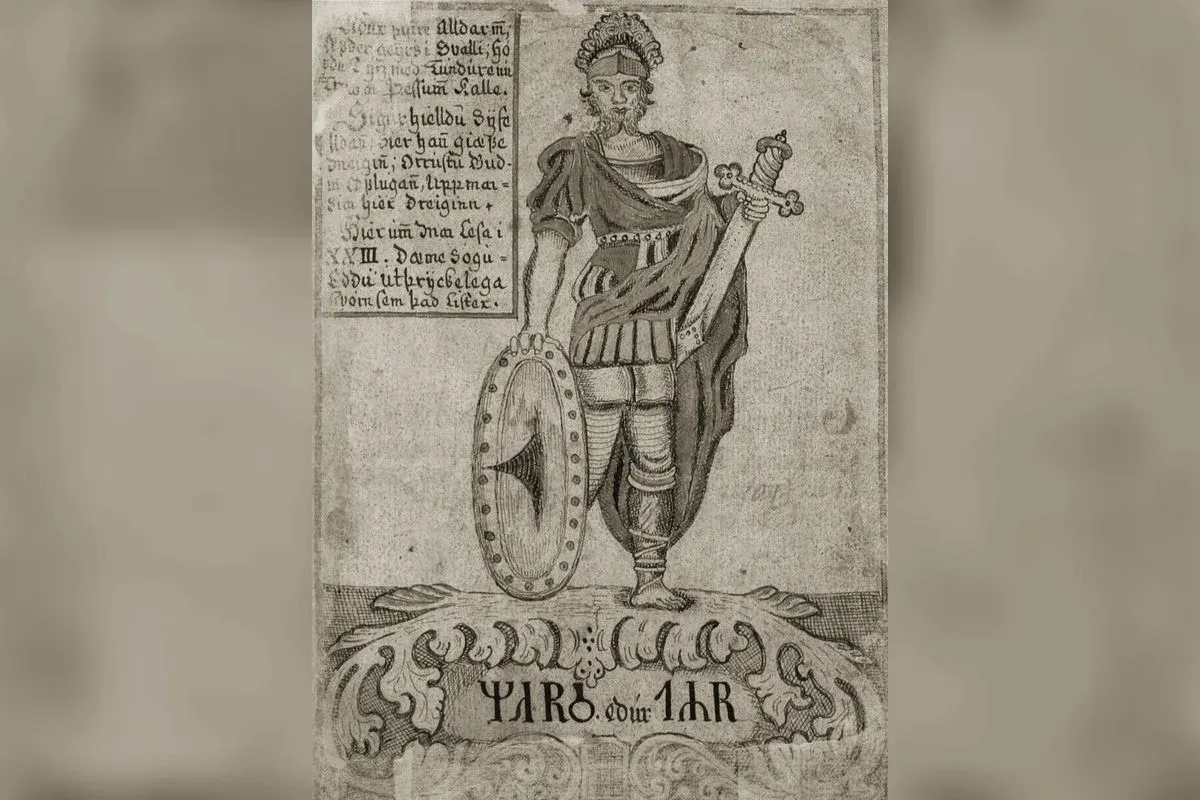
Who is Tyr?
Tyr is one of the oldest gods of the Germanic pantheon, and perhaps the most overlooked of the Aesir despite his original importance. God of justice, law of assemblies, and ordered warfare, he shares with Odin and Thor the prestige of war gods — but with a crucial distinction: where Odin embodies frenzied warfare and Thor brute strength, Tyr represents the legal and ritual dimension of conflict.
His name is one of the oldest Indo-European inheritances in Norse mythology. In Proto-Germanic, Tiwaz designated the sovereign sky deity — equivalent to the Indo-European Dyéws Phtḗr from which Zeus, Jupiter, and the Vedic Dyaus also descend. In the prehistory of Germanic religion, Tyr was likely the principal deity, before being progressively overshadowed by Odin and then Thor during the Viking Age.
Role, nature, and attributes
Tyr presides over the þing (judicial assemblies) where conflicts between men and between gods are resolved. In this sense, he is less a god of violence than the guardian of rule of law in warfare — just war, ordered, subject to rituals and oaths.
Tyr’s most striking attribute is his single hand: he lost his right hand during the binding of Fenrir. This infirmity is paradoxically a mark of greatness in Norse culture: where the other gods refused to place their arm in the wolf’s mouth, Tyr alone accepted — knowing he would lose the hand. The act is that of a being who sacrifices his physical integrity for the collective security of Asgard.
The sources diverge on Tyr’s genealogy. Snorri’s Prose Edda names Odin as his father. But the Hymiskviða (Poetic Edda) suggests his father is the giant Hymir — which would make Tyr half-Aesir, half-Jötunn, an ambiguity of nature found in several other major Norse figures.
The sacrifice of the hand: binding Fenrir
The defining episode of Tyr in Norse mythology is his role in the binding of Fenrir, narrated in the Gylfaginning.
Fenrir, son of Loki, was growing at a terrifying rate in Asgard. Prophecy clearly identified this wolf as the future destroyer of Odin. The Aesir decided to bind him. Two chains — Leyding, then Drómi — were broken by Fenrir without effort. The dwarves then forged Gleipnir, an indestructible but unremarkable-looking bond, as supple as a silk ribbon.
Fenrir, suspicious of its lightness, refused to accept the trial without a guarantee: a god must place his hand in his mouth. If the bond were not magical, he would return the hand. Otherwise, he would keep it.
No god dared — except Tyr, who placed his right hand inside the creature’s jaws.
Gleipnir held. Fenrir bit off the hand. The gods laughed — all except Tyr.
This act is the Norse model of justice that costs: Tyr knows that Gleipnir is magical, that Fenrir will not regain his freedom, that the promise is a deception. But he accepts the personal price that makes Asgard’s security possible. His one-handedness becomes a symbol of legal sacrifice: sometimes the law demands that the one who enforces it pay the price.
Tyr and the Roman interpretation
When Rome came into contact with Germanic peoples, it mapped their deities onto those of the Roman pantheon — a practice known as interpretatio romana.
Tyr was equated with Mars, the Roman god of war. This equivalence is inscribed in the calendar: dies Martis (Tuesday) corresponds to Tīwesdæg, the day of Tīw/Tyr.
This equation reveals how the Romans perceived Tyr: a foremost war deity of solemn authority and martial character, comparable to Mars in both his warlike and civic dimensions. Tacitus, in Germania (1st century CE), attests the ancient veneration of a sovereign sky deity (Tiwaz) among Germanic peoples.
Tyr at Ragnarök
In the final tableau of Ragnarök sketched by Snorri in the Gylfaginning, Tyr fights Garm, the monstrous hound guarding the entrance to Niflheim — an infernal counterpart to Fenrir. They kill each other.
This death is significant: Tyr does not die anonymously or by chance, but in a singular combat against the creature that symbolises the empire of the dead over the living. The god of law perishes while fighting the guardian of funerary chaos — a profound symbolic coherence in a mythology where each god has his appointed enemy.
For the full account of this final battle, read the story of Ragnarök.
What the ancient sources say
Direct mentions of Tyr in surviving Norse texts are relatively rare compared to Odin or Thor. The Gylfaginning (Prose Edda, Snorri Sturluson, c. 1220) provides the main information on his role, genealogy, and fate at Ragnarök. The Hymiskviða (Poetic Edda) presents him with the giant Hymir as father, in a maritime voyage with Thor. In the Lokasenna, Loki insults him by referencing his missing hand — a sign that his mutilation was widely known. Tacitus (Germania, 1st century CE) attests the antiquity of the Tiwaz cult among Germanic peoples.
Further reading
For the creature that bit off his hand and represents the other face of his sacrifice, read the page on Fenrir. For the king of the Aesir of whom Tyr is an essential lieutenant, see the page on Odin. For the final battle where Tyr will meet his end, read the story of Ragnarök.
See also
Stories featuring this entity
Frequently asked questions
Why does Tyr have only one hand?
When the gods decided to bind Fenrir with the magical chain Gleipnir, the wolf refused unless a god placed his hand in his mouth as a pledge of good faith. If the binding was harmless, he would return the hand; if not, he would keep it. Only Tyr was willing to accept. Gleipnir held — and Fenrir, realising he had been deceived, bit off Tyr's right hand. This voluntary sacrifice is the defining act of the character: Tyr embodies justice that sometimes demands a personal price.
Which day of the week is named after Tyr?
Tuesday comes from Old English *Tīwesdæg*, 'the day of Tīw/Tyr'. This naming mirrors the Roman scheme (dies Martis, the day of Mars), revealing that Tyr was equated with Mars in the Roman interpretation of Germanic religion. In modern English, four weekdays preserve Germanic deity names: Tyr (Tuesday), Woden/Odin (Wednesday), Thor (Thursday), and Frigg (Friday).
How does Tyr die at Ragnarök?
According to the Gylfaginning of Snorri Sturluson, Tyr fights Garm, the monstrous hound guarding the entrance to Niflheim. They kill each other. This symmetrical death — the god of justice eliminating the guardian of the realm of the dead, but at the cost of his own life — is consistent with Norse ethics: even the most just gods fall at Ragnarök.