Greek mythology · Heroes & mortals
Penelope, wife of Odysseus and queen of Ithaca in Greek mythology
Penelope in the Odyssey: the shroud that bought three years, the dream of the geese, and the bed test by which she interrogates her own husband.
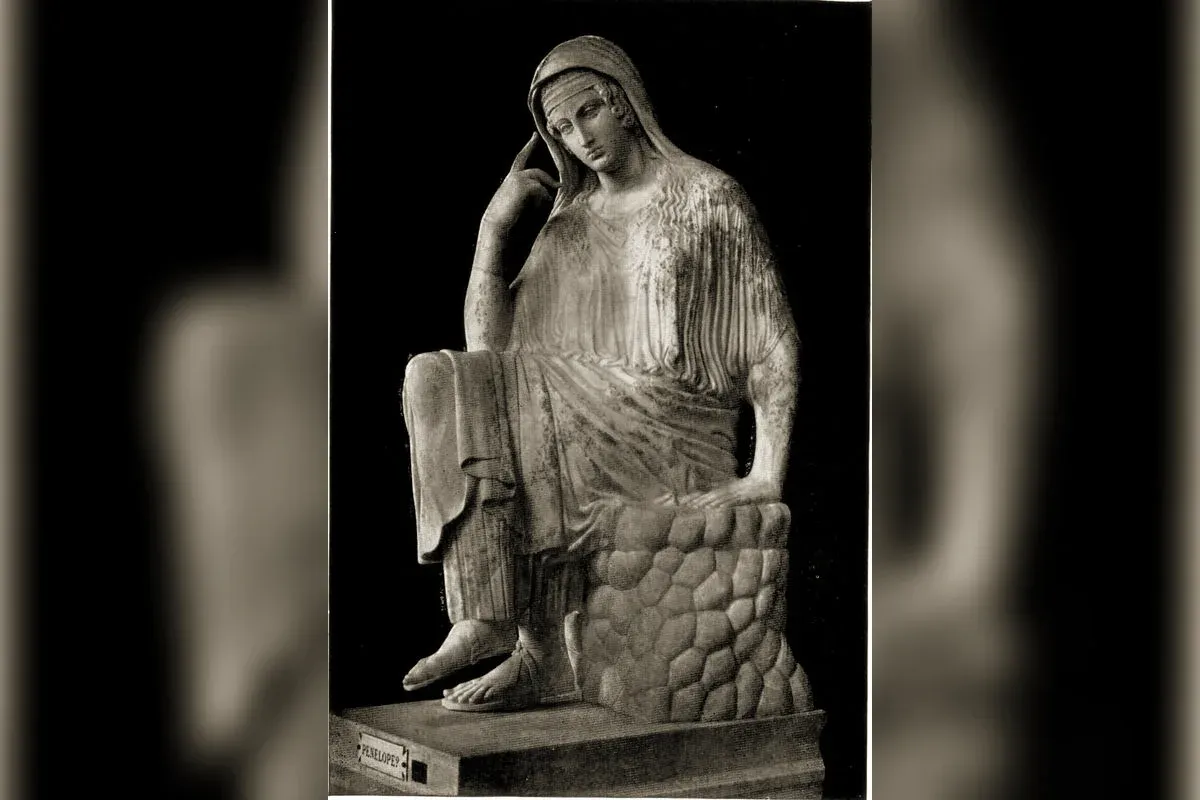
Penelope is the wife of Odysseus and mother of Telemachus, holding the household of Ithaca together through a twenty-year absence. Later ages turned her into a statue of marital patience. Homer wrote something considerably more interesting: a woman who runs a three-year deception, reads her own dreams sceptically, and puts her returning husband through a test he nearly fails.
The shroud, and what it was actually for
Penelope tells the suitors she will remarry once she has finished a burial cloth for Laertes, her father-in-law. She weaves through the day and unpicks the work by lamplight. The trick holds for three years, until a maid betrays it.
The excuse is unanswerable because it is pious: refusing to bury a man’s father unshrouded is not something suitors can argue against. And the delay is not sentimental. Ithaca has no adult king; whoever marries the queen takes the kingship, and every year she stalls is a year Telemachus grows closer to being able to claim it himself. The weaving is a holding action in a succession crisis.
Reading her own dream
In Book 19 she describes a dream to the disguised beggar. Twenty geese feed in her house; an eagle swoops down and breaks their necks; she weeps for the geese. Then the eagle speaks in a human voice: it is her husband, and the geese are the suitors.
The dream interprets itself, which is unusual, and she still refuses to trust it. She answers with the famous image of the two gates through which dreams pass — one of horn, through which true dreams come, and one of ivory, which sends deceptions — and says she cannot know which gate this one used. The Greek pun is untranslatable and deliberate: keras (horn) against krainō (fulfil), elephas (ivory) against elephairomai (deceive).
Homer gives her, in other words, the epic’s most sophisticated statement about the unreliability of signs, and gives it to her in the same book where she is supposedly failing to recognise her husband.
The test of the bed
After the suitors are dead, Odysseus stands before her washed, dressed, and vouched for by their son. She says nothing. Telemachus calls her hard-hearted.
Then she instructs the servants to move the bed out of the bedchamber for the stranger. Odysseus breaks: that bed cannot be moved, because he built it himself around the stump of a living olive tree still rooted in the ground, and no one alive knows that but the two of them.
She has done to him exactly what he does to everyone else in the poem — laid a trap out of a false statement and waited to see who walks into it. The hero of the Odyssey is finally identified not by his scar, his bow, or his name, but by failing to keep his temper under interrogation by his wife. Only then does she accept him.
How much did she know?
Whether Penelope recognises Odysseus before the bed test is the oldest live argument in Homeric criticism. She announces the contest of the bow immediately after meeting the beggar — a contest only Odysseus can win — which some readers find impossible to explain as coincidence. Others hold that the poem is precisely about a woman acting rightly on insufficient evidence.
Homer never resolves it, and the ambiguity is the point: Penelope’s mind, like her husband’s, is not fully available to the audience. It is the one thing in the Odyssey that stays closed.
Ancient sources
- Homer, Odyssey, 2.93-110; 19.535-581; 23.173-230
- Apollodorus, Epitome, 7
See also
Related entries
Stories featuring this entity
Frequently asked questions
How does Penelope test Odysseus?
After the suitors are dead and their son has vouched for him, she says nothing. Then she instructs the servants to move the marriage bed out of the bedchamber. Odysseus breaks: that bed cannot be moved, because he built it around the stump of a living olive tree still rooted in the ground. She has laid a trap out of a false statement and waited to see who walks into it — the hero is identified by failing to keep his temper.
What is the dream of the geese?
In Book 19 she describes twenty geese feeding in her house, killed by an eagle that then speaks in a human voice and identifies itself as her husband. The dream interprets itself, and she still refuses to trust it, answering with the image of the two gates through which dreams pass — one of horn for true dreams, one of ivory for deceptions. Homer gives the poem's most sophisticated statement about unreliable signs to her.