Greek mythology · Heroes & mortals
Peleus, king of Phthia and father of Achilles
Peleus: two exiles for killing kinsmen, betrayal on Mount Pelion, the goddess he had to wrestle, and a wedding that started the Trojan War.
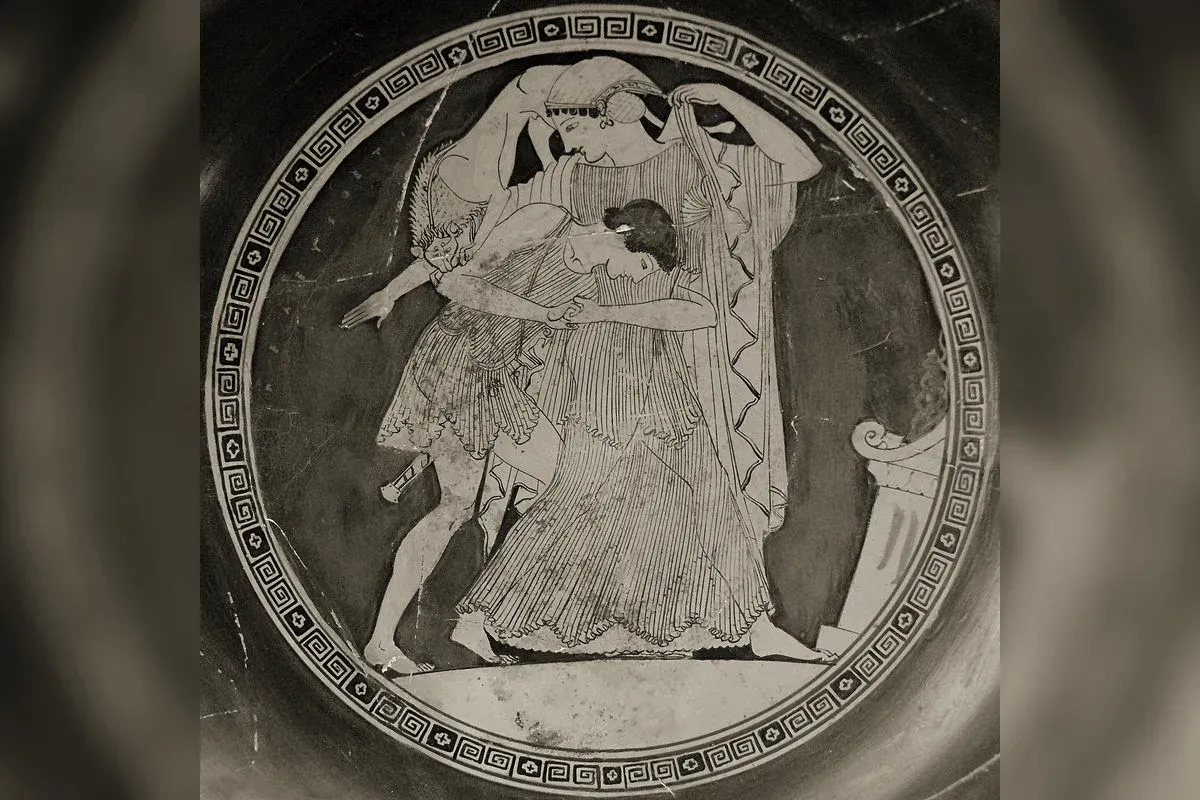
Peleus is the king of Phthia in Thessaly and the father of Achilles. He is best remembered for a wedding, which is unfortunate, because his own story is a sustained sequence of catastrophes — two exiles for killing relatives, one attempted judicial murder, and an arranged marriage to a goddess who did not want him and eventually left.
Twice exiled for killing kin
Peleus and his brother Telamon are sons of Aeacus, king of Aegina, a man so upright that he became a judge of the dead. Their half-brother is Phocus, an outstanding athlete. The brothers kill him — by a discus throw during training, which the sources present as murder rather than accident — and are driven off the island.
Peleus reaches Phthia, where King Eurytion purifies him of the blood and gives him a third of the kingdom and his daughter. Then, at the Calydonian boar hunt, Peleus throws a javelin at the boar, misses, and kills Eurytion. This time it genuinely is an accident. It makes no difference: blood-guilt in Greek myth is a pollution, not a verdict, and he is exiled again.
Two purifications, two dead kinsmen. Before he has done anything heroic at all, Peleus has been formally cleansed of homicide twice.
Betrayed on the mountain
He is purified a third time, at Iolcus, by King Acastus. Acastus’ wife Astydameia propositions him; he refuses; she tells her husband that he assaulted her.
Acastus will not kill a suppliant he has personally purified — that would incur the pollution he has just removed. So he takes Peleus hunting on Mount Pelion, waits until he sleeps, hides his sword in a pile of cattle dung, and goes home, leaving him unarmed on a mountain full of centaurs.
He survives because Chiron finds him and returns the sword. Chiron is the reason Peleus has a life at all, and later the reason his son has an education. Peleus eventually comes back and sacks Iolcus.
The wrestling match
Zeus and Poseidon both want Thetis until they learn she is fated to bear a son greater than his father. They then need a mortal husband for her, quickly, and Peleus is selected.
She is not consulted, and she resists. Advised by Chiron, Peleus catches her sleeping on the shore and holds on while she becomes fire, water, wind, a lion, a serpent, and a cuttlefish spraying ink. He does not let go, and she consents.
The wedding is held on Pelion and every god attends — the only mortal marriage in Greek myth that the whole pantheon turns out for. The gifts are the immortal horses Xanthus and Balius, a suit of divine armour, and from Chiron a spear cut from the ash trees of the mountain.
And Eris, Strife, uninvited, throws a golden apple among the guests inscribed to the fairest. Three goddesses claim it; a Trojan prince is appointed to judge; the Judgement of Paris follows, and the war that will kill the couple’s only son begins at their own wedding feast.
The spear no one else can lift
The ash spear stays in the poem. Homer notes in Book 16 that when Patroclus arms himself in Achilles’ gear he takes everything except that weapon: no other Achaean can wield it, because Chiron cut it on Pelion for Peleus, to be the death of heroes.
It is the perfect object for this family. A gift from the centaur who saved the father, given at the wedding that doomed the son, usable by exactly one man in the world.
Thetis leaves after Achilles’ infancy, and Peleus grows old alone in Phthia. He outlives his son — the Iliad keeps returning to the image of the old man waiting for a homecoming that will not happen, and it is by invoking his own father that Priam finally breaks Achilles in Book 24.
Ancient sources
- Homer, Iliad, 16.140-144; 18.84-87; 24.534-542
- Pindar, Nemean (3, 4, 5) and Isthmian, 8
- Apollodorus, Library, 3.12.6-3.13.8
- Euripides, Andromache
See also
Frequently asked questions
Why was Peleus exiled twice?
For killing relatives, twice. He and his brother Telamon killed their half-brother Phocus with a discus during training, and were driven off Aegina. Purified at Phthia by King Eurytion, he then killed Eurytion by accident at the Calydonian boar hunt — a javelin that missed the boar. It made no difference: blood-guilt in Greek myth is a pollution, not a verdict. Before doing anything heroic, Peleus had been formally cleansed of homicide twice.
What happened at the wedding of Peleus and Thetis?
Every god attended — the only mortal marriage in Greek myth that the whole pantheon turned out for. The gifts were the immortal horses Xanthus and Balius, divine armour, and an ash spear from Chiron. And Eris, uninvited, threw among the guests a golden apple inscribed to the fairest. Three goddesses claimed it, a Trojan prince was appointed to judge, and the war that killed the couple's only son began at their own wedding feast.