Greek mythology · Creatures
The Hesperides, guardians of the golden apples in Greek mythology
The Hesperides, nymphs of the golden apples: daughters of Night or of Atlas, the sleepless serpent Ladon, and the labour Heracles won by a trick.
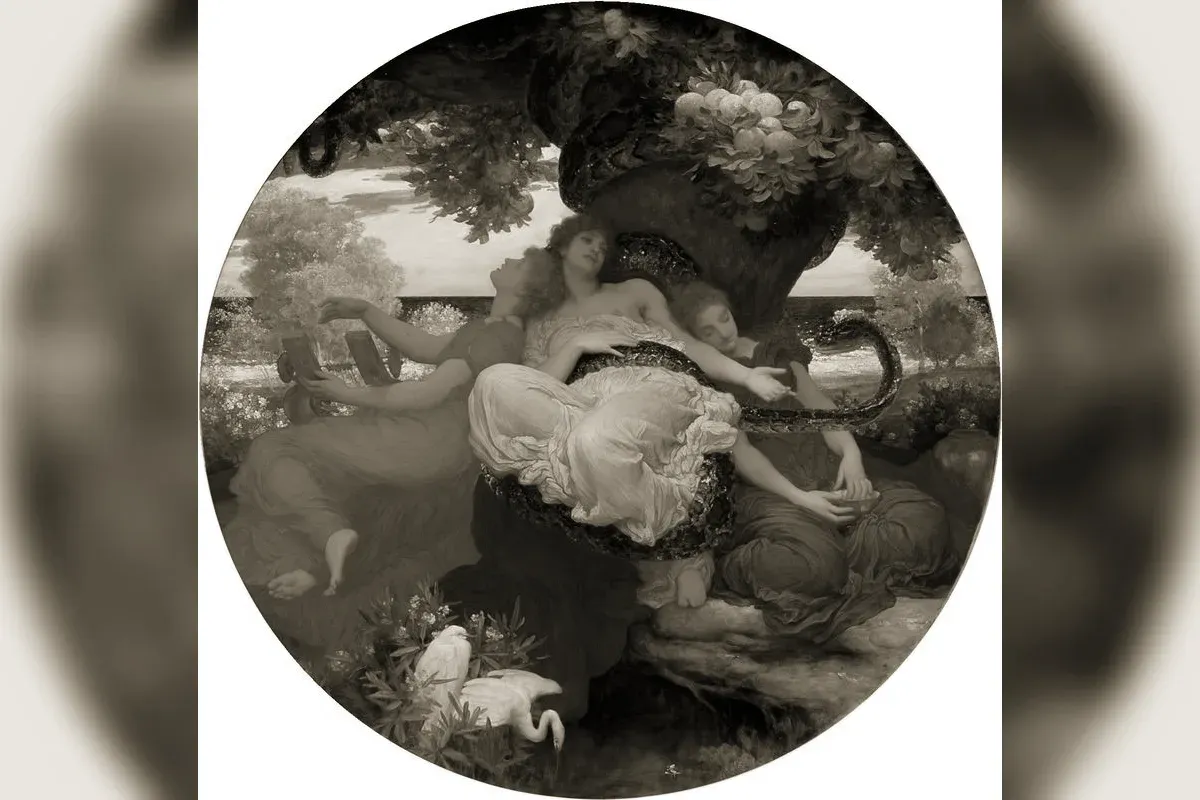
The Hesperides are nymphs of evening and the far West who guard a garden of golden apples at the edge of the world, watched over by the serpent Ladon. They are best known from the eleventh labour of Heracles — and from a persistent disagreement about who their parents were.
Daughters of Night, or daughters of Atlas
Hesiod lists them among the children of Nyx, Night, born of her alone alongside Doom, Fate, Sleep and the Fates. That placement makes them primordial abstractions: the daughters of Night who keep the apples beyond glorious Ocean.
Later writers make them daughters of Atlas and Hesperis — hence Atlantides — which turns them into a family, gives them a father who stands at the western edge holding up the sky, and connects them to the Pleiades, also Atlas’ daughters and also placed in the sky.
The genealogy on this site follows the Atlas line, because it is the version that integrates them into a coherent western geography. It is worth knowing that Hesiod, the earliest source, does not.
Their number and names are equally unstable: three, four or seven depending on the author, with Aegle, Erytheia, Hesperia and Arethusa recurring.
The garden
Gaia gives the golden apples to Hera as a wedding present when she marries Zeus, and Hera plants them in a divine garden. The Hesperides are set to tend it — and, because they were caught helping themselves to the fruit, Hera adds Ladon, a hundred-headed serpent who never sleeps, coiled around the trunk.
The garden therefore has two incompatible kinds of guardian: nymphs who sing, and a serpent that cannot be charmed. Its location is deliberately unfixable — Libya, the slopes of Mount Atlas, islands in the outer Ocean — because it is defined not by geography but by being past the end of the known.
The eleventh labour
Heracles’ hardest problem is not the dragon but the address: nobody can tell him where the garden is. He wrestles the sea god Nereus for directions, crosses Libya, kills Antaeus and frees Prometheus on the way.
In the fullest version he does not enter the garden at all. He takes the weight of the sky from Atlas, who walks in and asks his own daughters for the apples. Atlas then proposes to deliver them to Eurystheus himself and leave Heracles holding the sky permanently — and Heracles agrees, asking only that Atlas take the burden back for a moment while he pads his shoulders. Atlas does. Heracles picks up the apples and leaves.
It is the only labour won purely by a con, and the Iliad-scale strongman ends up using the tactics of Odysseus.
The other version, and the mourning
An alternative has Heracles shoot Ladon and take the fruit himself. The Argonauts, arriving the day after, find the Hesperides in mourning: the serpent’s body still twitching under the tree, the nymphs turned into trees — a poplar, an elm, a willow — before resuming their shape to speak.
That scene, in Apollonius, is the only place the myth is told from the garden’s point of view, and it inverts the whole labour. From inside, the eleventh labour is a home invasion by an enormous stranger who killed the family guard dog.
The apples, in any case, do not stay. Athena returns them, because objects belonging to the gods cannot simply be relocated by mortals.
Ancient sources
- Hesiod, Theogony, 211-216, 274-275, 333-335
- Apollodorus, Library, 2.5.11
- Apollonius of Rhodes, Argonautica, 4.1396-1449
- Diodorus Siculus, 4.26-27
See also
Related entries
Stories featuring this entity
Frequently asked questions
Are they daughters of Night or of Atlas?
Hesiod, the earliest source, lists them among the children of Nyx, born of her alone alongside Doom, Sleep and the Fates — primordial abstractions. Later writers make them daughters of Atlas and Hesperis, which turns them into a family, gives them a father at the western edge and connects them to the Pleiades. The tree on this site follows the Atlas line because it makes the geography coherent, but it is the younger version.
What did the Argonauts find in the garden?
Mourning. Apollonius has them arrive the day after Heracles, and tells the eleventh labour from the garden's point of view: Ladon lies under the tree, his body still twitching, flies settling on the wounds, and the nymphs turn to dust and then to trees — a poplar, an elm, a willow — before resuming shape to speak. Seen from inside, the great heroic labour is a break-in that began by killing the guard dog.