Greek mythology · Creatures
The Cretan Bull, father of the Minotaur and opponent of Heracles
The Cretan Bull: the sacrifice Minos kept, the father of the Minotaur, Heracles' seventh labour, and the beast Theseus finally put on an altar.
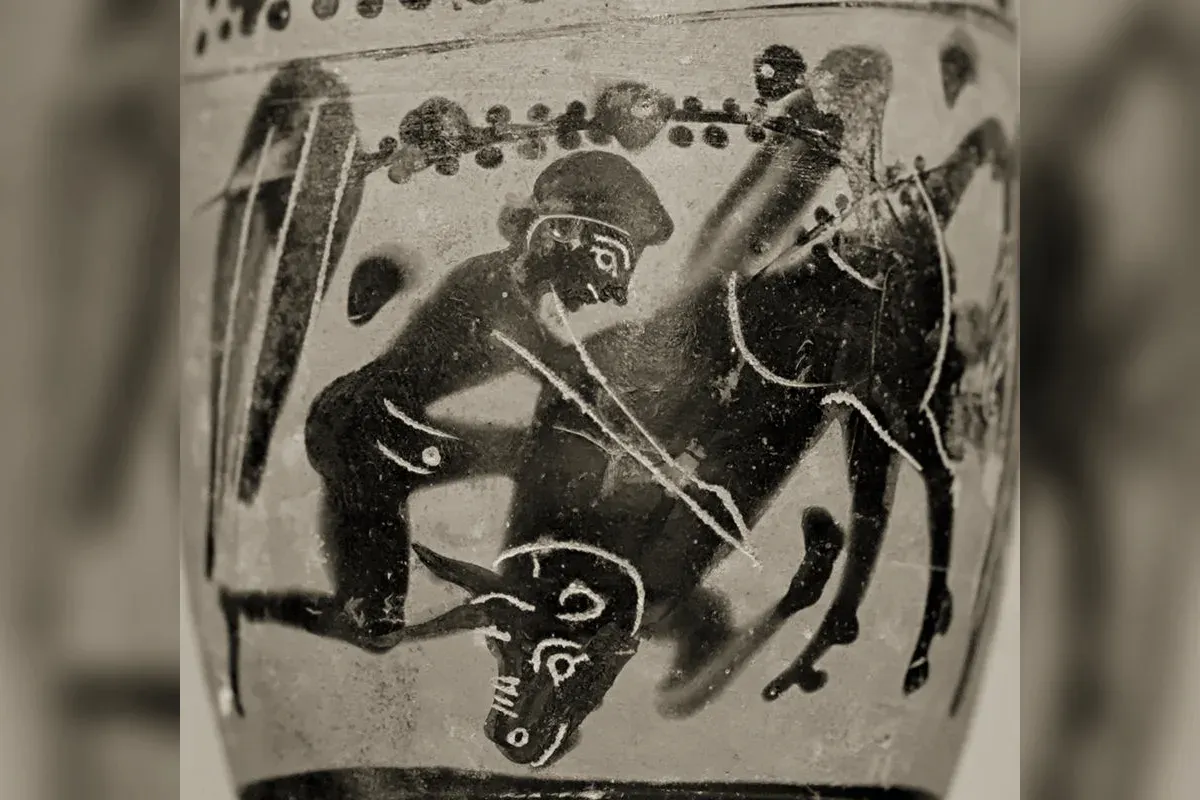
The Cretan Bull is the animal whose withheld sacrifice sets off the entire Cretan cycle. Sent from the sea by Poseidon, it fathers the Minotaur, becomes the seventh labour of Heracles, and ends its career at Marathon as the bull Theseus kills. One animal links three separate bodies of myth.
A sign that was meant to go back
Minos, contesting the throne of Crete, asks Poseidon for a sign proving the gods support him, and promises to sacrifice whatever the god sends. A bull of extraordinary beauty comes out of the sea, and the Cretans accept the claim.
Minos keeps it. He puts the bull in his own herds and sacrifices an ordinary animal instead — a substitution that fails on both counts, since it is both a theft and a lie about what was on the altar.
The Greek category being violated here is specific. A sacrificial victim promised to a god is already the god’s property; withholding it is not stinginess but appropriation. Everything that follows flows from a single act of keeping something that was no longer his.
Not the father of the Minotaur — the father of the Minotaur
The retaliation is indirect. Poseidon does not punish Minos; he makes Pasiphae desire the bull. Daedalus builds the wooden cow, and the Minotaur is born.
This is the point at which most retellings go wrong. Poseidon is not the Minotaur’s father — a claim this site’s genealogy previously recorded and has corrected. He causes the chain of events; the parents are Pasiphae and the bull itself, which is why the tree now shows the Cretan Bull as a parent node.
Heracles, and the release
The bull turns wild and lays waste to Crete, and Eurystheus assigns Heracles the task of bringing it back alive — a constraint that makes the labour a wrestling problem rather than a hunt.
Minos, sick of the animal, offers help. Heracles refuses it, subdues the bull bare-handed, and crosses the sea with it, in some versions riding it. He presents it at Tiryns; Eurystheus wants to dedicate it to Hera; Hera refuses a gift that would credit Heracles; and the bull is simply let go.
That release is the hinge of the whole story. The most dangerous animal in the Aegean is turned loose in mainland Greece because of a quarrel between a goddess and a king about who gets the credit.
Marathon
It wanders through the Peloponnese and settles in Attica, on the plain of Marathon, where it ravages the countryside. Theseus, establishing himself as an Athenian hero before the Labyrinth, captures it, parades it through the city, and sacrifices it to Apollo — completing, at last, the sacrifice Minos refused two generations earlier.
The tradition sometimes calls this the Marathonian Bull and treats it as a separate animal, and Apollodorus preserves a further variant identifying it with the bull that carried Europa to Crete — which would make the same creature responsible for founding the Cretan royal house and for destroying it.
Theseus then sails to Crete and kills the Minotaur: the bull’s own son, born because the bull was never given back.
Ancient sources
- Apollodorus, Library (2.5.7, 3.1.3-4) and Epitome, 1.5-6
- Diodorus Siculus, 4.13
- Pausanias, Description of Greece, 1.27.9-10
- Plutarch, Theseus, 14
- Diodorus Siculus, Library of History, Book 4
See also
Frequently asked questions
Why was the bull released after the seventh labour?
Because of a quarrel about credit. Heracles brought it back alive to Tiryns as ordered; Eurystheus wanted to dedicate it to Hera; Hera refused an offering that would honour Heracles; and the animal was simply let go. The most dangerous beast in the Aegean was turned loose in mainland Greece because a goddess and a king could not agree on who deserved the glory.
Is the Marathonian Bull the same animal?
In the standard account, yes: released at Tiryns, it wandered through the Peloponnese into Attica and ravaged the plain of Marathon, where Theseus captured it and sacrificed it to Apollo — completing at last the sacrifice Minos had refused two generations earlier. Some traditions treat them as separate animals, and Apollodorus preserves a further variant identifying it with the bull that carried Europa to Crete.