Greek mythology · Metamorphoses
The Myth of Narcissus: Fatal Love of One's Own Reflection in Greek Mythology
The myth of Narcissus: Echo's punishment by Hera, the beautiful hunter's fatal obsession with his own reflection, and his transformation into a flower in Ovid's Metamorphoses.
The Myth of Narcissus in Brief
The myth of Narcissus is one of the best-known transformation stories in Greek mythology. It is the account of a being of perfect beauty, incapable of loving anything outside himself, who finds in his own reflection the object of an impossible love — and dies of it. Beside him, the nymph Echo, condemned to repeat only the words of others, is his inverted and painful mirror image: one can only repeat what the other says; the other can see only himself. Both figures embody the impossibility of connection.
Echo: The Nymph Condemned to Silence
Before she meets Narcissus, Echo is a lively, talkative mountain nymph known for distracting Hera with long stories while Zeus amused himself with other nymphs. When Hera discovers the trick, her punishment is cold and precise: Echo is condemned to never speak first. From now on she can only repeat the final words of what she hears — imprisoned in the speech of others.
This curse transforms Echo into a living metaphor: she no longer possesses her own voice or her own expressible thought. She becomes the auditory reflection of the world, just as Narcissus will become his own visual reflection.
When Echo first sees Narcissus in the forest, she falls hopelessly in love with him. But she can only approach him when he speaks, echoing his words back. One day Narcissus hears the strange sound and calls out: “Is anyone here?” Echo answers: “Here!” He calls: “Come!” She answers: “Come!” — and rushes toward him. Narcissus rejects her with cruelty. Devastated, Echo retreats into caves and forests, wasting away from shame and love until nothing is left of her but her voice.
Narcissus: Beauty and Arrogance
Narcissus is the son of the river god Cephisus and the nymph Liriope. At his birth, the blind seer Tiresias delivers an enigmatic prophecy: the child will live long “if he does not know himself” (se ipsum non noverit). This inversion of the Delphic “Know thyself” suggests that for Narcissus, self-knowledge will be fatal.
Narcissus grows into a youth of such perfect beauty that young men and young women alike fall in love with him. But he rejects every one of them with equal contempt. He is closed to everything outside himself — not from modesty or wisdom, but from a profound inability to perceive the other as real. Artemis is associated in some versions with this fierce chastity: like the hunter goddess who refuses all love, Narcissus carries the bow and rejects all intimacy.
This closure is a form of hubris — arrogance that offends the divine order. Eros, the god of love whose power Narcissus scorns, is affronted. The punishment eventually comes.
The Spring and the Fatal Reflection
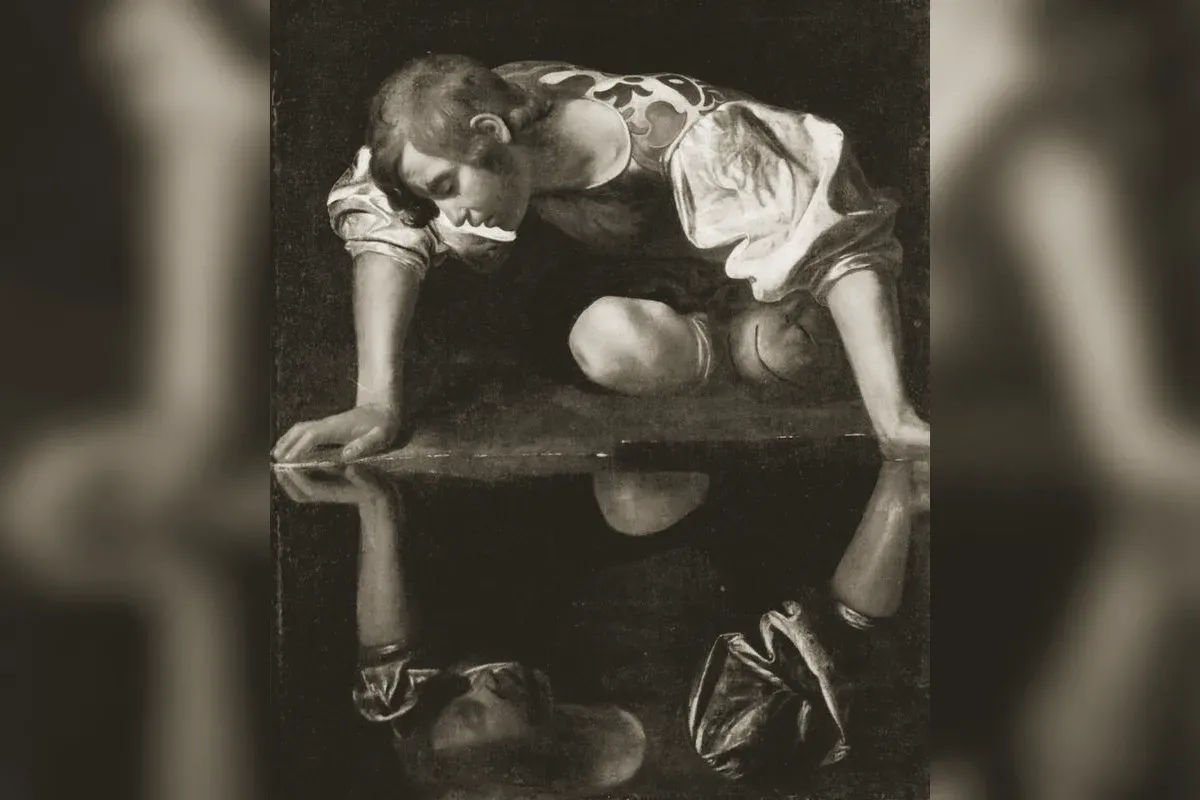
One day while hunting, Narcissus — thirsty — bends over a clear spring in a clearing. He sees in the water a face of extraordinary beauty.
It is his own. But he does not know it.
Ovid describes with remarkable psychological precision the nature of this error: Narcissus sees not a reflection but a presence. He reaches his arms toward the face — the face reaches its hands toward him. He weeps — tears disturb the water and the face disappears. He turns to leave — the face calls him back. The spring is a nameless mirror, and Narcissus is the first being in mythology to fail to recognize his own face.
He gradually understands. “I am he — I am that other I love,” he says in Ovid’s version (iste ego sum). But this recognition does not free him: it imprisons him further. How can you embrace what you cannot touch? How can you love what is yourself? The suffering is absolute because it is without exit.
Narcissus stays at the edge of the spring, refusing to eat, drink, or sleep. He wastes slowly away, consumed by love for what he can never possess. His beauty fades. He melts like snow in spring. And when he dies, a flower grows where his body fell: the narcissus, yellow and white, bending forever over its own reflection in the water.
Variants of the Myth
Ovid (Metamorphoses, Book III) gives the canonical version including Echo. But Pausanias (Description of Greece, IX, 31) records an older variant without Echo: Narcissus had loved a twin sister who resembled him perfectly, who died young. Inconsolable, he sought her face in the water. This reading shifts the myth from the register of hubris to that of impossible grief.
Conon (Narrations) records a version in which Narcissus is loved by a youth sent to him by Eros. The young man kills himself in despair. As punishment, Eros condemns Narcissus to fall in love with his reflection.
These variants reveal the myth’s richness: it adapts to different contexts (heterosexual or homosexual love, grief or arrogance) while keeping its core — the impossibility of love when one is sealed within oneself.
Symbolic Meaning: What Narcissus Says About Us
The myth of Narcissus has endured across the centuries because it touches something universally recognizable: the human tendency to turn inward, to see in the world only a reflection of one’s own expectations, to love not the other but one’s idea of the other.
Aphrodite — goddess of love and connection — is structurally absent from the myth, but her logic runs through it: love requires stepping outside oneself, recognizing the other as genuinely distinct and real. Narcissus is the absolute counter-example: he is incapable of that movement.
The oldest philosophical interpretation, in Plotinus (3rd century CE), reads Narcissus as a metaphor for the soul seduced by its own image in matter, losing its path toward the Good. Modern psychoanalysis — from Freud to Lacan — made “narcissism” a technical concept for this pathological fixation on one’s self-image. But before being a concept, Narcissus is a character: a thirsty young man who does not recognize his own face in the water, and drowns there without ever diving in.
What the Ancient Sources Say
The fullest and most influential version comes from Ovid (Metamorphoses, Book III, lines 340–510), written in the 1st century BCE. Ovid is the first author to weave the Echo and Narcissus myths into a single narrative. His version introduces the psychology of gradual recognition (“I am that other I love”) and the figure of Nemesis, whom he names after her Attic sanctuary, Rhamnusia. Pausanias (Description of Greece, IX, 31, 2nd century CE) mentions the Echo-less variant and notes that some people refused to believe a human being could fail to recognize his own reflection. Conon (Narrations, 1st century BCE) provides the masculine erotic variant. Shorter allusions appear in Nonnus (Dionysiaca, 5th century CE).
Further Reading
For the god of love whose power Narcissus scorns, and whose retribution is often invoked as the source of his punishment, read the page on Eros. For the goddess of love and beauty whose structural absence from the myth reveals Narcissus’s nature, read the page on Aphrodite. For the goddess whose jealousy condemns Echo and sets the myth’s causal chain in motion, see the page on Hera. For the power that grants the rejected suitor’s prayer and returns to Narcissus the exact measure of his cruelty, see Nemesis. For another myth of transformation and impossible love, read the story of Orpheus and Eurydice.
Story beats
- 01Echo, a talkative nymph, is condemned by Hera to repeat only the last words she hears
- 02Narcissus, a beautiful hunter fated never to know his own face, rejects every suitor
- 03Echo falls in love with Narcissus, who cruelly rejects her
- 04Nemesis punishes Narcissus's arrogance by making him fall in love with his own reflection in a spring
- 05Narcissus wastes away, unable to embrace what he loves
- 06He dies beside the spring and is transformed into the narcissus flower
Ancient sources
- Ovid, Metamorphoses, Book III (lines 340–510) — the most complete version
- Pausanias, Description of Greece, IX, 31 — variant without Echo
- Conon, Narrations, 24 — erotic male variant
See also
Related entries
Frequently asked questions
Who is Echo in the myth of Narcissus?
Echo is a mountain nymph (Oread) condemned by Hera to speak only the last words she hears. Her offense: she had deliberately kept Hera distracted with long stories while Zeus amused himself with other nymphs. When Hera discovered the ruse, her punishment was precise — Echo could no longer initiate speech, only repeat. Falling in love with Narcissus, she could never declare her love in her own words, only echo his.
Why is Narcissus punished?
In Ovid's version, Narcissus is punished by Nemesis (goddess of divine retribution) for cruelly rejecting every suitor — including Echo. One rejected lover prays that Narcissus might love without being loved in return. The punishment is perfectly symmetrical: Narcissus falls in love with his own reflection, which he can never embrace.
Does the narcissus flower really come from the myth?
That is what the ancient sources claim. Both Ovid and Pausanias state that the flower grows where Narcissus died. The Greek narke (numbness, torpor) is sometimes proposed as a shared root between the flower's name and the myth — the plant contains toxic alkaloids. But the precise relationship between name, myth, and flower cannot be established with certainty.