Norse mythology · Gods & goddesses
Frigg, queen of Asgard and mother of Baldr in Norse mythology
Frigg, queen of the Aesir and Odin's wife: her silent gift of foresight, the oath to protect Baldr, her grief after his death, and her legacy in the name Friday.
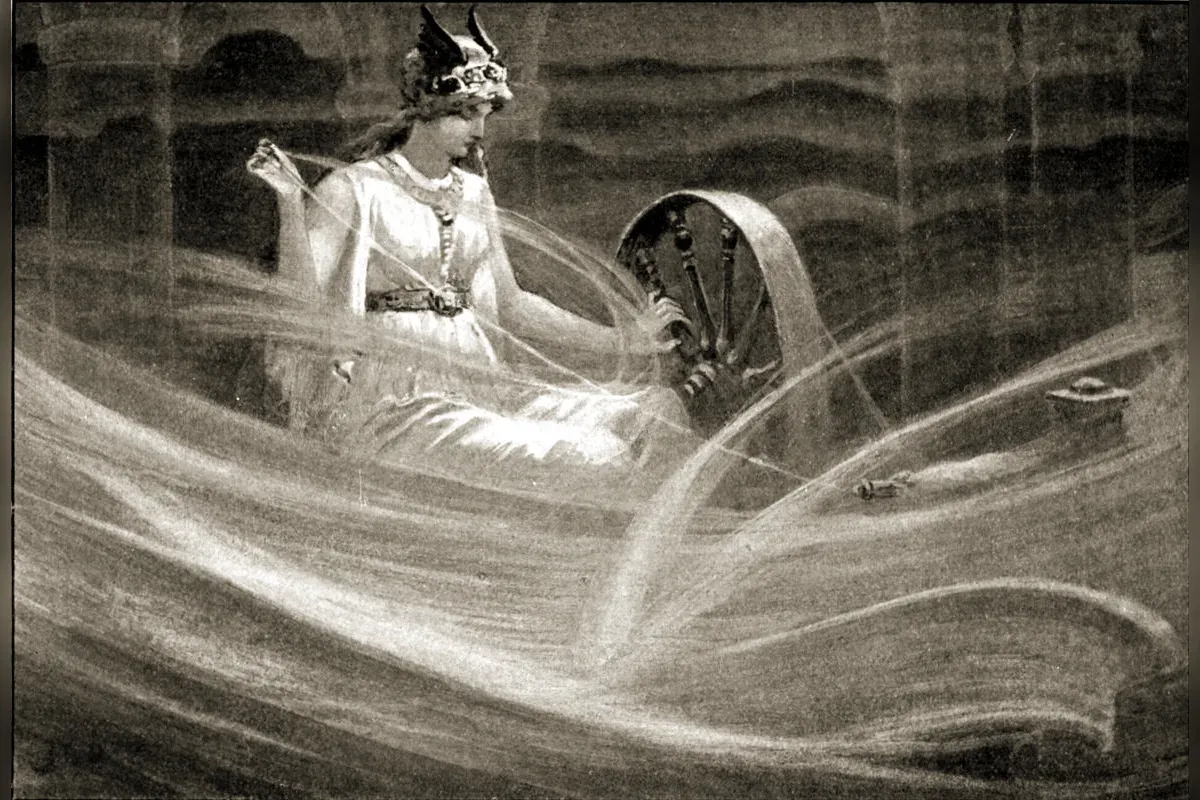
Who is Frigg?
Frigg is the queen of the Norse pantheon, wife of Odin and mother of Baldr. Foremost of the Aesir goddesses, she sits on the throne Hliðskjálf beside Odin and can survey all nine worlds as he does. But where Odin seeks knowledge through sacrifice and wandering, Frigg sees everything without speaking — a silent omniscience that makes her one of the most enigmatic figures in the Norse pantheon.
Her domain covers marriage, motherhood, the household, and fates — which she knows, according to the Eddas, but which she refuses to reveal. This reserve is not passivity: it is the mark of a deity who knows that certain things cannot be changed, and that announcing them would only hasten their fulfilment.
Fensalir and the queen’s attributes
Frigg inhabits Fensalir (“hall of the fens”), her own domain within Asgard — giving her an independent residence, a sign of her status as a goddess in her own right and not merely a consort. This marshy palace carries symbolic weight: still waters are places of memory, depth, and visions.
Her principal attributes are the distaff and spindle — symbols of fate-weaving, echoing the Norns who weave the threads of life for every being. Frigg also carries a falcon-feather cloak that allows her to travel between worlds in bird form. Keys are another attribute, symbolising her mastery of the divine household — her prerogative as mistress of Asgard.
Frigg and Odin: a balance of omnisciences
The Frigg–Odin couple is one of the most complex relationships in the Norse pantheon. Both see everything from Hliðskjálf, but their relationships to knowledge are radically different.
Odin conquers knowledge through sacrifice (his eye, his hanging from Yggdrasil) and active seeking. He questions oracles, descends to the underworld, wanders in disguise. For him, knowledge is a weapon.
Frigg possesses knowledge innately, as a silent gift, but does not deploy it actively. She knows what will happen to Baldr — her son’s death is inscribed in what she perceives — yet does not tell Odin in the texts that have come down to us.
This asymmetric sharing of omnisciences makes Frigg and Odin two complementary facets of the same sovereign divine principle.
The oath for Baldr
The episode most closely associated with Frigg is at the heart of the myth of Baldr’s death. When Baldr, her beloved son, begins to have prophetic nightmares foretelling his death, Frigg takes the matter into her own hands.
She travels through the nine worlds and asks every thing — rocks, metals, trees, diseases, venoms, beasts, fires, waters — to swear never to harm Baldr. All swear. The gods invent a game: they throw arrows, stones, and swords at Baldr. Everything bounces off. Baldr is invulnerable.
But Frigg has overlooked one thing: the mistletoe, which she judged too young and too slight to be worth asking. Loki, who suspects a gap, discovers it by disguising himself as an old woman to question her. He then cuts mistletoe, shapes it into a weapon, and guides the blind hand of Höðr — who kills Baldr.
Frigg’s fault is not moral: it is a cosmic error of judgement. She believed she could seal fate with enough precautions, but fate slipped through the exception she had left open.
Frigg’s grief
Frigg’s grief after Baldr’s death is described as one of the most devastating events in Asgard. When Hermóðr rides to Hel to plead for Baldr’s return, it is implicitly at Frigg’s urging. The whole world weeps for Baldr — and Frigg is at the centre of this collective mourning.
When the giantess Þökk (Loki in disguise) refuses to shed a tear, condemning Baldr to remain in the underworld for eternity, it is Frigg who bears in silence the reality of the permanent loss.
In some Norse traditions, Frigg’s grief is placed in parallel with that of Freya, suggesting a symbolic kinship between the two goddesses in their relationship to loss and mourning.
The legacy of Friday
As Thor gave his name to Thursday and Tyr to Tuesday, Frigg gave her name to Friday — from Old English Frīgedæg, “the day of Frigg”.
This naming corresponds to the Romanisation of the Germanic calendar: dies Veneris (the day of Venus) was translated by the day of the Germanic goddess closest to Venus in her role as goddess of marriage and femininity. Frigg embodies, like Venus, the power of the conjugal bond and the protection of the household.
What the ancient sources say
The Gylfaginning (Prose Edda, Snorri Sturluson, c. 1220) is the principal source on Frigg: it describes her seat at Hliðskjálf, her knowledge of fates, her domain of Fensalir, and her central role in the myth of Baldr’s death. The Völuspá (Poetic Edda) indirectly references her attributes. The Lokasenna contains Loki’s insults directed at her — proof that she was important enough to be a target. Briefer mentions appear in Grímnismál and in the Prose Edda’s passage on divine feminine figures (the dísir).
Further reading
For the myth in which Frigg is the central tragic figure, read the story of Baldr’s death. For her beloved son, the god of light she tried to save, see the page on Baldr. For her husband, the Allfather, consult the page on Odin.
See also
Related entries
Stories featuring this entity
Frequently asked questions
Are Frigg and Freya the same goddess?
This question has animated Norse studies since the 19th century. Both goddesses share a common Proto-Germanic root (*Frijjō*), both are associated with love and magic, and in some Germanic dialects a single figure seems to combine their functions. But in the Norse Eddas, they appear as clearly distinct characters: Frigg is Odin's wife and Baldr's mother; Freya is a Vanir goddess with a different relationship to Odin. Most modern scholars treat them as separate but historically related deities.
Why does Frigg not speak of what she knows?
Frigg is described in the Eddas as knowing the fates of all — but refusing to speak of them. This reticence is not ignorance or weakness: it reflects the Norse conception of fate as something that cannot be changed or contested. To speak a fate is to activate it. Frigg carries in silence the weight of her foresight, including the inevitable death of her son Baldr.
Which day of the week is named after Frigg?
Friday comes from Old English *Frīgedæg*, 'the day of Frigg'. This naming corresponds to the Latin dies Veneris (day of Venus) in the Roman interpretation of Germanic deities — Frigg being seen as the goddess of love and the household, comparable to Venus in her role as tutelary deity of marriage. Along with Tuesday (Tyr), Wednesday (Odin), and Thursday (Thor), Friday preserves the name of a Germanic deity in the English calendar.