Greek mythology · Heroes & mortals
Polynices, son of Oedipus and attacker of Thebes in Greek mythology
Polynices, exiled son of Oedipus: exile at Argos, the necklace that bought him an army, his father's curse, and the body Creon left unburied.
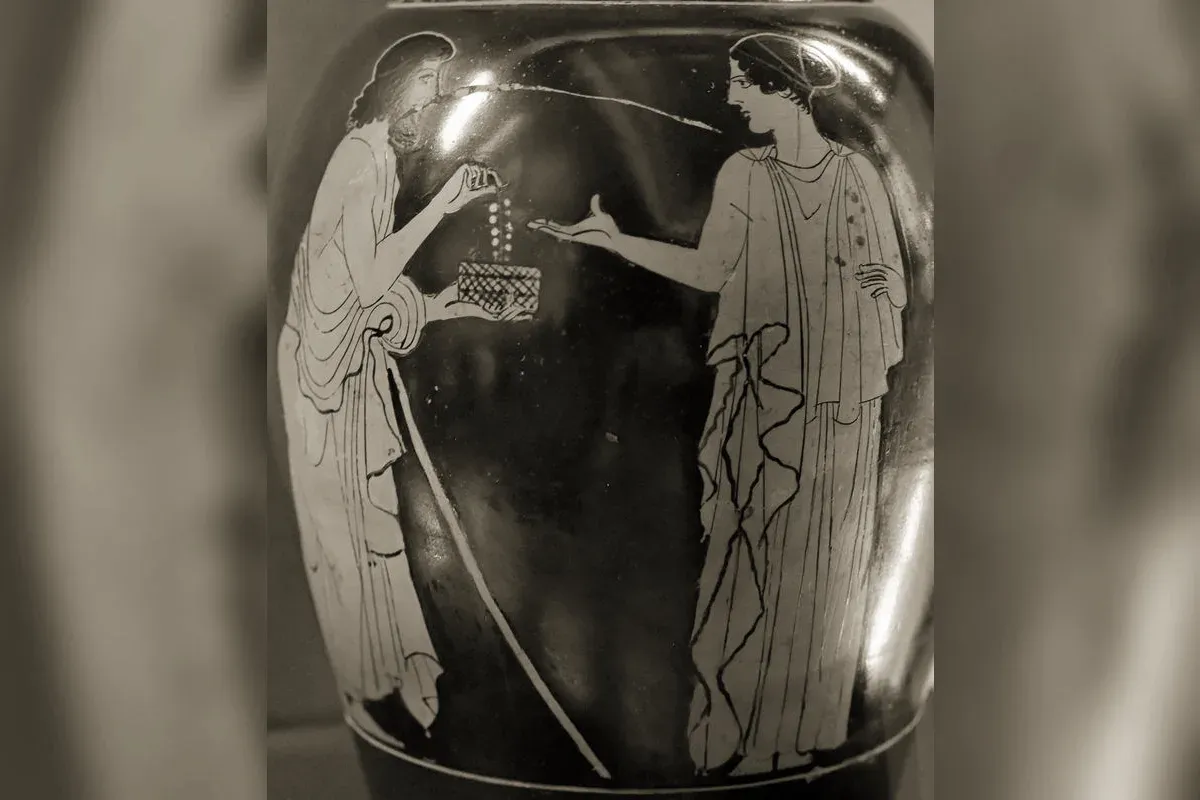
Polynices is the son of Oedipus who is denied his turn on the throne of Thebes, raises a foreign army to take it, and dies at the hands of his brother Eteocles in the gateway of his own city. His unburied corpse then becomes the problem that Antigone dies solving.
In the tragic tradition followed by the tree, Polynices is the son of Oedipus and Jocasta, and the brother of Eteocles, Antigone, and Ismene. This generation does not appear in the earliest Homeric version, where Epicaste — the later Jocasta — has no named children by Oedipus; it belongs to the subsequent development of the Theban cycle.
Argos, and the price of an alliance
Driven out after the brothers’ agreement collapses, Polynices reaches Argos and brawls in the porch of the palace with another exile, Tydeus of Calydon. King Adrastus separates them, notices that one wears a lion’s skin and the other a boar’s, and recognises an oracle telling him to yoke his daughters to a lion and a boar. He marries both men to his daughters and swears to restore both to their kingdoms. Thebes goes first.
Assembling the Seven takes one more transaction, and it is the ugliest thing Polynices does. The seer Amphiaraus knows the expedition will fail and that he will die on it, and refuses to go. His wife Eriphyle holds a casting vote in their marriage. Polynices bribes her with the necklace of Harmonia, the cursed wedding gift that has been destroying Theban women since Cadmus founded the city, and she sends her husband to a death he has already foreseen.
The detail is worth pausing on. Polynices’ war is financed with an heirloom that carries its own curse, handed to a woman who will be killed by her son for taking it. The Theban catastrophe spreads by contagion into a second royal house.
Refused at Colonus
In Oedipus at Colonus, oracles declare that whichever side holds Oedipus will win, and Polynices comes as a suppliant to the father he helped drive out.
His speech is not cynical. He admits the exile, admits the neglect, weeps, and asks for help against a brother who has done to him precisely what they together did to their father. Antigone urges Oedipus to listen. And Oedipus, in the most unforgiving speech Sophocles ever wrote for him, curses both sons: they will not take the city, they will fall by each other’s hand, and each will kill and be killed by his brother.
Polynices hears it, accepts it, and asks his sisters only to bury him. Then he goes to Thebes knowing the outcome — which is what raises him above a simple aggressor, and what makes Antigone’s later promise a debt rather than an impulse.
A corpse that becomes a legal problem
The brothers meet at the seventh gate and kill each other. Creon buries the defender with honours and forbids anyone to bury the attacker, on pain of death.
The ban is not merely vindictive. It states a claim about where political authority ends — whether a city may extend its judgement past a man’s death and into the rites owed him as a human being. Greek practice generally held that even enemy dead must be given back for burial; Creon is doing something recognisably extreme, and the play knows it.
So Polynices’ final role is to be the object rather than the agent. His name promised many quarrels, and he supplies them after he can no longer take part: over the throne, over the war, and finally over whether the state or the family owns a body.
Ancient sources
- Sophocles, Oedipus at Colonus (1254-1446) and Antigone
- Aeschylus, Seven Against Thebes
- Euripides, Phoenician Women
- Apollodorus, Library (3.6.2) for Eriphyle and the necklace
See also
Frequently asked questions
Why is Polynices denied burial?
Creon buries the city's defender with honours and forbids anyone, on pain of death, to bury the man who attacked it. The ban is not merely vindictive: it states a claim about where political authority ends — whether a city may extend its judgement past a man's death, into the rites owed him as a human being. Greek practice generally held that even enemy dead must be returned, so the play knows Creon is doing something extreme.
Was Polynices in the right?
His claim is arguably legitimate — he was denied his agreed turn on the throne. But he answers it by bringing a foreign army against his own city, which turns the injured heir into an aggressor. And he finances the expedition by bribing a seer's wife with a cursed necklace, sending a man to a death he had already foreseen.